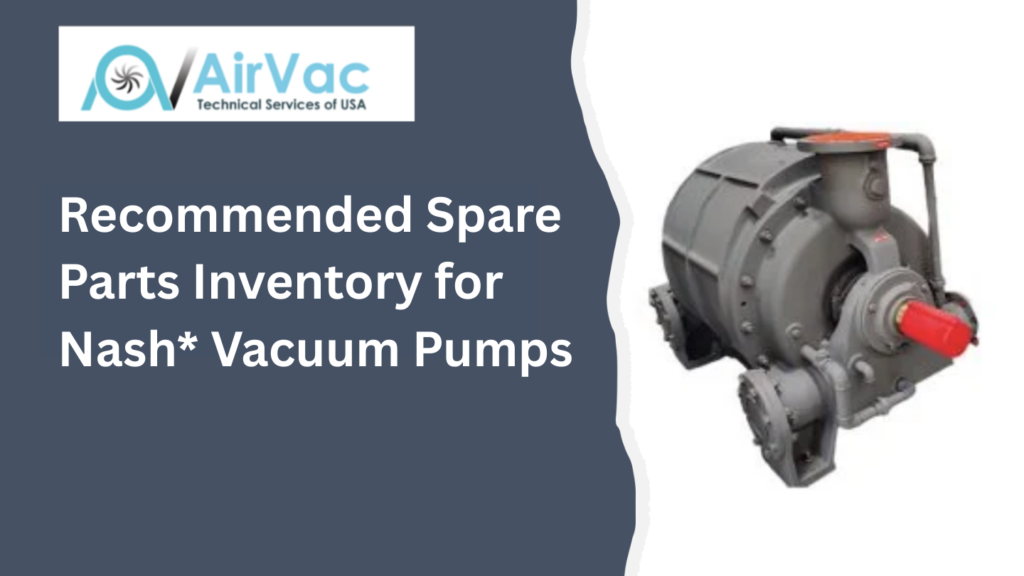
Industrial plants depend on vacuum systems every day. If a Nash liquid ring pump stops, production often slows or shuts down. That is why a well-planned Nash vacuum pump spare parts inventory is not optional. It is a key part of plant reliability.
This guide explains which parts you should keep in stock, why they matter, and how they reduce downtime. It also connects spare parts planning with real-world failure data, maintenance best practices, and Nash liquid ring pump troubleshooting steps. If you manage a paper mill, chemical plant, food facility, power station, or medical vacuum system, this guide will help you build a smart and cost-effective inventory plan.
Why Spare Parts Planning Matters for Nash* Vacuum Pumps?
Nash liquid ring pumps are known for their simple design and long service life. They handle wet gas, vapor, and light solids better than many other pump types. But no pump runs forever without wear.
According to data from the United States Department of Energy, unplanned downtime in industrial facilities can cost thousands of dollars per hour in lost production and labor costs.
In many plants, vacuum pump failure ranks among the top causes of process interruption.
A strong Nash vacuum pump spare parts inventory helps you:
- Reduce emergency shutdown time
- Avoid rush shipping charges
- Protect production schedules
- Improve maintenance planning
- Extend equipment life
Spare parts planning is not about overstocking. It is about stocking the right parts based on failure risk and lead time.
How Nash Liquid Ring Pumps Work and Why Parts Wear?
Before building a Nash vacuum pump spare parts list, it helps to review how the pump works.
A Nash liquid ring pump uses a rotating impeller inside a cylindrical casing. Water or seal liquid forms a ring along the casing wall. As the impeller spins off-center, gas enters, is compressed, and exits through the discharge ports.
The design has a few moving parts. That makes it durable. But several internal components still face wear from:
- Cavitation
- Corrosive gases
- Abrasive particles
- High-temperature seal water
- Shaft misalignment
- Poor lubrication
Understanding these stress points helps identify the most critical spare parts for Nash vacuum pumps.
Core Nash* Vacuum Pump Spare Parts Inventory
Below is a practical table that lists the most important Nash liquid ring pump replacement parts to keep on hand.
| Part | Failure Risk | Downtime Impact | Keep in Stock? |
| Mechanical seal | High | Immediate shutdown | Yes |
| Bearings | High | Severe vibration and damage | Yes |
| Gasket kit | High | Air leaks, loss of vacuum | Yes |
| O rings | Medium | Performance loss | Yes |
| Shaft sleeve | Medium | Seal damage | Recommended |
| Impeller | Medium | Reduced capacity | For critical systems |
| Cone plate | Low to Medium | Efficiency loss | For older pumps |
| Complete rebuild kit | High for aging pumps | Major outage | Yes for high-use pumps |
This table forms the base of a strong Nash vacuum pump maintenance parts strategy.
1. Mechanical Seals
Mechanical seals are the most common failure item in liquid ring pumps. Studies on rotating equipment show that seal-related issues account for up to 40 percent of pump failures.
Why Seal Failure Happens
- Dry running
- Dirty seal water
- Shaft misalignment
- Incorrect seal material
- Excess heat
Seal problems often lead to Nash vacuum pump seal failure, which causes:
- Water leakage
- Air leaks into the system
- Lower vacuum levels
- Rising motor amperage
Inventory Recommendation
Always keep at least one full mechanical seal assembly in your spare parts inventory for each critical pump.
For high-duty plants, keep two.
2. Bearings
Bearings support the shaft and impeller. When bearings fail, vibration rises fast. Damage spreads to seals and shaft surfaces.
According to SKF, poor lubrication causes about 50 percent of premature bearing failures in rotating equipment.
Signs of Bearing Trouble
- Grinding noise
- Increased vibration
- High bearing temperature
- Shaft movement
Inventory Recommendation
Keep:
- One full bearing set per pump
- Correct grease type
- Bearing lock nuts and hardware
Bearings are one of the most critical spare parts for Nash vacuum pumps.
3. Gaskets and O-Rings
These parts are small and low cost. But they often cause air leaks.
Air leaks reduce vacuum performance and increase energy use.
Heat and chemicals cause gaskets to harden over time.
Inventory Recommendation
Always stock:
- Full gasket kits
- O-ring kits for each pump model
Replace them during every rebuild.
4. Shaft Sleeves
Shaft sleeves protect the main shaft where seals contact the surface. Over time, grooves form.
If the groove becomes deep, it damages new seals quickly.
Inventory Recommendation
Keep at least one spare shaft sleeve per pump.
For pumps that run nonstop, consider keeping a spare shaft.
5. Impellers
Impellers do not fail often in clean systems. But in chemical, mining, or pulp applications, erosion and cavitation are common.
Damaged impellers reduce vacuum capacity by 10 to 30 percent.
Inventory Recommendation
For mission-critical pumps, keep:
- One spare impeller
or - A backup rebuilt rotating assembly
Impellers are expensive, so plan based on risk.
6. Cone Plates and Port Plates
Cone plates control suction and discharge flow. Cavitation and debris cause scoring.
Worn plates reduce efficiency.
Inventory Recommendation
For older pumps, keep spare cone plates on hand or confirm the supplier’s lead time.
7. Complete Rebuild Kits
For pumps older than 5 years, a full rebuild kit is a smart choice.
A rebuild kit may include:
- Seals
- Bearings
- Gaskets
- O rings
- Shaft sleeve
- Hardware
This approach simplifies planning for Nash liquid ring pump replacement parts.
How to Build Your Nash* Vacuum Pump Spare Parts List
Not all plants need the same inventory. Use this process.
Step 1: Identify Critical Pumps
Ask:
- Does this pump support main production?
- Is there a backup system?
- How long is the supplier lead time?
If downtime exceeds eight hours, stock key parts.
Step 2: Review Failure History
Use maintenance logs. Look at:
- Past seal failures
- Bearing replacements
- Cavitation issues
Frequent failure parts should be in stock.
Step 3: Consider Lead Times
OEM lead times can range from days to weeks.
If a part takes more than one week to ship, stock it.
Step 4: Analyze Operating Conditions
Harsh applications need stronger inventory planning:
- Paper mills
- Chemical plants
- Food plants
- Power generation
- Mining
These industries rely heavily on Nash vacuum pump maintenance parts.
Inventory Levels by Application
| Application | Seal Kit | Bearings | Impeller | Rebuild Kit |
| Paper Mill | 2 sets | 2 sets | 1 spare | Yes |
| Chemical Plant | 2 sets | 2 sets | 1 spare | Yes |
| Food Processing | 1 set | 1 set | Optional | Recommended |
| Medical Vacuum | 1 set | 1 set | Optional | Recommended |
| Power Plant | 2 sets | 2 sets | 1 spare | Yes |
Connecting Spare Parts to Nash Liquid Ring Pump Troubleshooting
A smart inventory supports fast repair.
Below is a quick reference table.
| Symptom | Likely Part | Spare Needed |
| Loss of vacuum | Seal, gasket | Seal kit |
| Excess vibration | Bearings | Bearing set |
| Water leak at the shaft | Seal | Mechanical seal |
| High amperage | Impeller rub | Impeller |
| Air leak | O ring | Gasket kit |
Troubleshooting a strong Nash liquid ring pump starts with having theparts ready.
Cost of Not Stocking Critical Parts
Unplanned failures often cost 5 to 10 times as much as planned maintenance.
Example:
- Seal kit cost: 800 dollars
- Emergency shutdown cost: 10,000 dollars per hour
Storage Best Practices
Spare parts must be stored properly.
Seals
Keep in a clean, dry area.
Bearings
Store in original packaging.
Gaskets
Avoid heat and sunlight.
Impellers
Protect from moisture and corrosion.
The National Institute of Standards and Technology provides guidance on storage standards for industrial components.
Preventing Nash* Vacuum Pump Seal Failure
Seal failure is the top problem.
Reduce risk by:
- Monitoring seawater temperature
- Ensuring a steady flow
- Checking alignment yearly
- Avoiding a dry start
- Inspecting the shaft sleeve condition
Seal water quality directly affects life span.
Maintenance Strategy and Spare Planning
Follow a structured maintenance program:
- Monthly vibration checks
- Quarterly lubrication review
- Annual internal inspection
- Replace gaskets every rebuild
- Log vacuum levels and amperage
Plants with structured maintenance programs report up to 30 percent fewer emergency shutdowns according to reliability studies published by Reliabilityweb.com.
When to Keep a Complete Spare Pump?
For high-output facilities, keeping a fully rebuilt spare pump is often smarter than stocking individual parts.
Advantages:
- Fast swap
- Zero emergency rebuild time
- Predictable downtime window
This approach works well in pulp, power, and chemical plants.
FAQ Section
What are the most critical spare parts for Nash* vacuum pumps?
Mechanical seals, bearings, gasket kits, and shaft sleeves are the most critical spare parts for Nash vacuum pumps. These parts fail most often and cause immediate downtime.
How often should Nash* vacuum pump spare parts be replaced?
Seals and bearings should be inspected monthly and replaced as needed due to wear. Full internal inspection is recommended every 12 to 24 months, depending on operating hours.
What causes the Nash* vacuum pump seal failure?
Common causes include dry running, contaminated seal water, shaft misalignment, and incorrect selection of seal material.
How do I create a spare parts list for a Nash* vacuum pump?
Review the maintenance history, check supplier lead times, analyze pump criticality, and include high-failure components first.
Are Nash* liquid ring pump replacement parts expensive?
Seal kits and bearings are moderately priced. Impellers and rotating assemblies are higher-cost but less frequent replacement items.
Final Thoughts
A strong inventory of Nash vacuum pump spare parts protects uptime, production, and budgets. The goal is not to stock every part. The goal is to stock the right parts based on risk, lead time, and plant impact.
Mechanical seals, bearings, gasket kits, and shaft protection parts should always be available for critical systems. Impellers and full rebuild kits depend on the severity of the application. Proper storage, routine inspection, and smart troubleshooting reduce the risk of repeat failures.
When you plan inventory around real failure data and operating conditions, your vacuum system runs more smoothly and lasts longer.
For expert guidance on Nash liquid ring pump replacement parts, rebuild services, and support for ready-to-ship inventory, contact Airvac Technical Services.