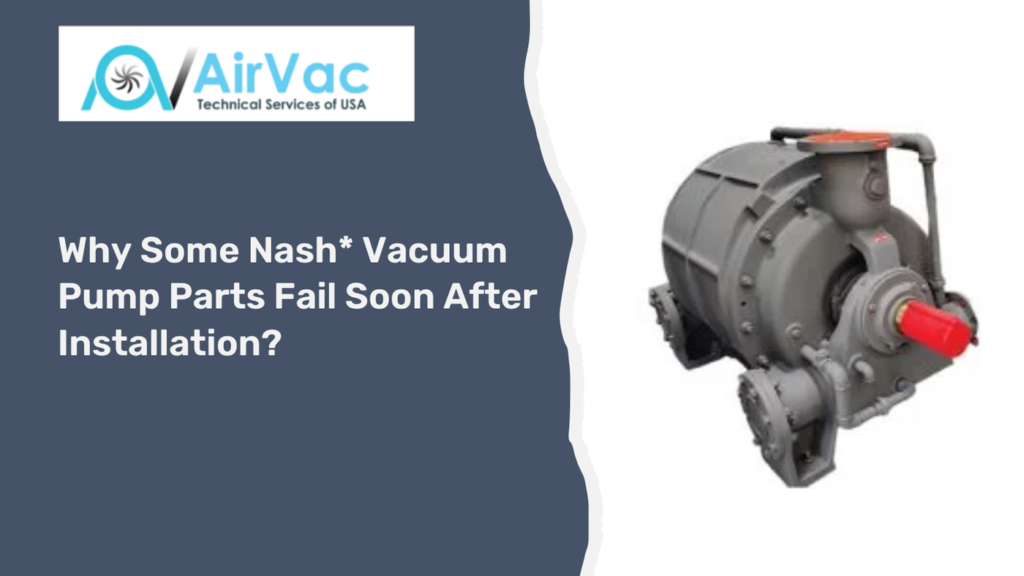
If new Nash vacuum pump parts fail soon after installation, the problem is often not just the parts themselves. In most cases, early failure happens because the root cause was never fixed. Common causes include shaft misalignment, pipe strain, poor lubrication, contaminated or unstable seal liquid, cavitation, improper part selection, incorrect installation, and worn mating components left in service. When one of those conditions remains in place, even a new bearing, seal, impeller, or packing set can fail much earlier than expected. EASA notes that misalignment and improper piping can distort bearing and seal alignment, increase vibration, and lead to premature failure. The Hydraulic Institute also explains that cavitation can damage pump passages directly and raise vibration levels enough to damage seals and bearings.
This issue matters because pump reliability affects more than maintenance costs. The U.S. Department of Energy says pumping systems represent a major energy opportunity in industry, and improving pump system performance can reduce both operating cost and waste. A pump that keeps chewing through parts is usually telling you something important about installation quality, system conditions, or internal wear.
For Airvac’s audience, this is a real plant problem, not a theory problem. The company’s ICP shows its core buyers are maintenance managers, plant engineers, procurement teams, and reliability staff at industrial sites that depend on vacuum uptime. Their pain points include unplanned failures, long OEM lead times, rising replacement costs, and the challenge of keeping older Nash CL, SC, 904, and XL pumps running reliably. Airvac’s own materials also show that customers value fast turnaround, tested rebuilds, spare parts availability, and compatible replacement options when downtime is costly.
This guide explains why early part failures happen, how to identify the real cause, and what to do before you install the next replacement part.
What usually fails first after installation?
The parts that fail first are usually the ones most exposed to heat, load, vibration, contamination, and unstable operating conditions.
In pump reliability work more broadly, EASA says failures are most commonly linked to seal failure, impeller damage, and bearing failures. That pattern aligns closely with what maintenance teams often see in vacuum pump service: seals run hot or leak, bearings wear or overheat, and rotating components suffer contact, imbalance, or cavitation-related damage.
On Airvac’s site, the spare parts focus includes seals, bearings, impellers, and casings for Nash models, which reflects the components most plants need to monitor and replace over time.
Common high-risk parts after installation
| Part | Why it fail early | Typical warning signs |
| Bearings | Misalignment, poor lubrication, contamination, vibration | Heat, noise, rising vibration |
| Mechanical seals or packing | Shaft movement, dry running, wrong flush or seal liquid issues | Leakage, scoring, overheating |
| Impellers | Cavitation, contact, corrosion, erosion, debris | Capacity loss, noise, performance drop |
| Gaskets and O-rings | Poor fit, chemical incompatibility, improper assembly | Leaks, loss of vacuum |
| Shaft sleeves and wear surfaces | Reused damaged surfaces, improper fit | Repeat seal failure, scoring |
| Couplings | Misalignment, installation error, base issues | Vibration, uneven wear |
Why do new parts fail so quickly?
New parts fail early because the pump system around the part is still unhealthy. A new seal cannot correct shaft runout. A new bearing cannot fix pipe strain. A new impeller cannot last long if cavitation remains active. In other words, parts usually fail early for one of three reasons:
- The root cause was not identified
- The installation was not done correctly
- The operating environment is still damaging the part
That is why replacing a single failed component without checking the entire machine often leads to repeated work.
How does misalignment cause premature parts failure?
Misalignment is one of the most common reasons newly installed parts fail. Even small alignment errors can load the bearings unevenly, disturb the seal faces, increase heat, and increase vibration. EASA states that misalignment and improper piping can introduce strain that distorts bearing and seal alignment, which leads to premature failure. Pump training resources from the Hydraulic Institute also note that poor piping practices can contribute to cavitation, seal failures, and premature bearing problems.
What misalignment looks like in practice
A plant changes bearings and a seal on a Nash pump. The pump starts normally, but after a few weeks, the bearing temperature climbs, and the seal begins to leak. The new parts were installed correctly, but the base was not checked, the coupling alignment drifted after bolting, and pipe strain pulled the casing slightly out of position. The result is early failure that appears to be a bad part, even though the real issue is system alignment.
Signs of misalignment may be present
- Repeated bearing and seal failures
- High vibration soon after startup
- Coupling wear that looks uneven
- Temperature rise near the bearing housing
- Leakage that returns shortly after seal replacement
Can pipe strain damage new Nash* vacuum pump parts?
Yes. Pipe strain is a frequent hidden cause of early part failure. When connected piping pulls on the pump casing or nozzles, it can shift internal alignment enough to affect bearings, seals, and rotating clearances. Nash’s maintenance tips also call out pipe strain as a significant issue that affects shaft alignment and contributes to misalignment-related failures.
This matters even more on older vacuum systems, where piping may have been modified over time. A pump can pass a visual inspection and still be under stress from connected lines.
Quick checks for pipe strain
- Verify that piping is supported independently
- Check whether flange bolts pull the piping into place
- Measure alignment before and after the piping is connected
- Look for nozzles under visible stress
- Recheck alignment after final tightening
How do lubrication mistakes shorten bearing life?
Bearings fail fast when lubrication is wrong, too little, too much, mixed, dirty, or incompatible. Nash’s maintenance guidance warns against mixing greases because it can reduce machine effectiveness and lead to overheating and breakdown. EASA also points to ongoing inspection, monitoring, and lubrication as essential to pump reliability.
Common lubrication mistakes
- Mixing grease types
- Overgreasing
- Undergreasing
- Using contaminated lubricant
- Ignoring relubrication intervals
- Failing to clean the housing during rebuild or repair
Practical example
A bearing is replaced during a shutdown. The team uses a grease that looks similar to the previous product, but the chemistries are incompatible. The bearing runs hotter than normal, grease separates, and the replacement fails months early. The bearing was not defective. The lubrication plan was.
Why does poor seal liquid quality damage the liquid ring pump parts?
Liquid ring vacuum pumps depend on stable seal liquid conditions. When seal liquid flow is too low, temperature is too high, or the liquid carries solids, scale, or chemicals that the pump is not prepared to handle, the pump can run hot, lose performance, and damage internal parts. Nash’s maintenance tips highlight that high vacuum pump temperature can indicate low seal water flow, and that calcium buildup can increase horsepower, reduce capacity, cause lost production, and damage the pump.
Seal liquid problems that cause early parts failure
| Condition | What it does |
| Low seal liquid flow | Raises the temperature and reduces cooling |
| Dirty liquid | Wears internal surfaces and damages seals |
| Scale or calcium buildup | Restricts flow and raises power use |
| Wrong liquid chemistry | Causes corrosion or material attack |
| Unstable temperature | Changes performance and increases stress |
For plants in paper, chemical, food, power, and other heavy industries, this is especially important because Airvac’s ICP shows these sectors rely on vacuum systems for daily production and utility functions.
What role does cavitation play in repeat failure?
Cavitation is a major cause of repeated damage. The Hydraulic Institute explains that cavitation happens when vapour bubbles form and then collapse with high energy, damaging surrounding pump parts. It can also generate enough vibration to harm seals and bearings. Nash’s cavitation maintenance material also flags cavitation as a failure mechanism in liquid ring equipment.
Signs of cavitation
- Crackling or gravel-like noise
- Drop in capacity or vacuum level
- Vibration increase
- Impeller or internal surface damage
- Rising maintenance frequency
Why cavitation often fools maintenance teams
You can replace a damaged part, restart the pump, and still face another failure if suction conditions, temperature, gas load, or operating parameters stay the same. That is why cavitation should be treated as a system problem, not only a parts problem.
Can wrong part selection cause an early failure?
Absolutely. Even a high-quality part can fail if it is the wrong part for the model, material, service conditions, or tolerance requirement.
Selection problems include:
- Wrong material for the process fluid
- Incorrect seal type
- Bearing specification mismatch
- Dimension or fit issues
- Using a generic substitute without confirming suitability
- Installing a part meant for a different Nash series or revision
Airvac’s own positioning centres on Nash-specific expertise, model compatibility, and support for CL, SC, 904, and XL series pumps, which matters because these are not one-size-fits-all components. The company also emphasises direct compatible replacement lines and parts support for legacy equipment.
What installation mistakes lead to immediate or near-term failure?
Installation quality matters as much as part quality. EASA notes that pump repair requires tight tolerances, cleanliness, and proper assembly procedures, especially for bearings and seals.
High-impact installation mistakes
- Dirty assembly environment
- Improper torque procedures
- Damaging seal faces during handling
- Forcing parts into position
- Reusing damaged mating surfaces
- Skipping shaft or sleeve inspection
- Failing to verify runout and alignment
- Not checking clearances after assembly
A simple rule
If the pump was not measured, aligned, cleaned, and verified, the job is not finished.
Why do old mating parts ruin new replacement parts?
A new component often depends on older connected surfaces. If a shaft sleeve is scored, a housing bore is worn, or a coupling is damaged, the new part can fail early because its operating surface is already compromised.
This is one reason repeat seal failure is so common. Teams replace the visible failed item but leave the worn surface that caused the damage in the first place.
Components to inspect before reassembly
- Shaft sleeves
- Seal chambers
- Bearing seats
- Housings
- Couplings
- Rotor condition
- Casing wear areas
When are repeated parts failures a sign that the pump needs rebuilding or replacement?
If the same category of parts keeps failing, the problem may be broader than a repair issue. Airvac’s website overview indicates that the company supports rebuilds, swap-out programs, spare parts, and replacement AV-series pumps for ageing Nash equipment. Its ICP also highlights that customers often face ageing models, repeated downtime, and the need for cost-effective alternatives to OEM replacement.
Consider a rebuild or replacement when:
- Bearings and seals fail repeatedly within short intervals
- Internal clearances are worn
- The pump has broad corrosion or erosion
- Performance stays poor after parts replacement
- Parts are becoming hard to source
- Downtime cost is higher than the cost of a deeper fix
In those cases, a parts-only strategy can become more expensive than a rebuild or a compatible replacement pump.
How should maintenance teams diagnose the real cause?
Use a structured process, not guesswork.
Step-by-step diagnostic approach
- Document the failed part
Record which part failed, how long it lasted, and what symptoms came first. - Inspect the failed surface
Look for heat, scoring, contamination, corrosion, fatigue, or impact marks. - Review operating conditions
Check seal liquid flow, temperature, vacuum level, speed, load, and recent process changes. - Check alignment and piping
Measure before and after piping is connected. - Review lubrication practices
Confirm lubricant type, amount, intervals, and contamination control. - Inspect mating components
Do not assume connected surfaces are acceptable. - Decide whether the machine is still repairable
Repeated symptoms may point toward rebuilding or replacement.
Failure diagnosis table
| Symptom | Possible cause | Best next check |
| The new seal leaks quickly | Misalignment, scored sleeve, dry running | Check the shaft sleeve, alignment, and seal faces |
| The bearing overheats early | Lubrication issue, misalignment, vibration | Review grease, alignment, bearing fit |
| Capacity drops after part change | Cavitation, wrong clearances, assembly issue | Review operating conditions, inspect internals |
| Repeated noise or vibration | Pipe strain, imbalance, cavitation | Check piping, vibration trend, and suction conditions |
| Packing burns or wears fast | Incorrect adjustment, poor liquid conditions | Check the packing setup and seal the liquid |
What can plants do to prevent early failure next time?
Prevention is about process discipline.
Best practices that reduce repeat failures
- Perform root cause analysis before ordering the next part
- Verify model and material compatibility
- Measure alignment carefully
- Check pipe strain after final assembly
- Use the correct lubricant and never mix greases without approval
- Confirm seal liquid flow, cleanliness, and temperature
- Inspect all mating surfaces
- Track vibration and temperature after startup
- Review whether the pump is still the right fit for the process
The U.S. Department of Energy recommends focusing on pump system performance, not just individual components, because system improvements can reduce both failures and wasted energy.
What should procurement ask before buying another replacement part?
Procurement can help prevent repeat failures by asking better questions.
Useful questions before the next order
- What is the confirmed root cause?
- Is this part failure isolated or recurring?
- Are we replacing the mating component as well?
- Has alignment been checked?
- Are seal liquid and lubrication conditions under control?
- Is this the correct material and specification?
- Would a rebuild or an exchange unit lower the risk of total downtime?
That approach aligns with Airvac’s buyer profile, which emphasises uptime reliability, lifecycle cost, quick turnaround, and trusted Nash-specific support.
Do maintenance rules vary across the United States?
Yes, plant maintenance, safety, environmental, and documentation requirements can vary by state, industry, insurer, and facility policy. Follow your site procedures, OEM guidance where applicable, and any local or licensed service requirements that apply to your operation. That matters most in regulated sectors such as chemical processing, healthcare, utilities, and food production.
FAQs
Why would a new Nash* vacuum pump seal fail right away?
A new seal usually fails right away due to misalignment, shaft sleeve damage, dry running, contaminated seal fluid, or improper installation. The seal is often the first part to show a deeper machine problem.
Can cavitation damage new pump parts after only a short time?
Yes. Cavitation can damage internal surfaces directly and also create vibration that harms bearings and seals. If the suction or operating conditions do not change, new parts can fail again quickly.
How long should replacement bearings last in a vacuum pump?
There is no single answer because bearing life depends on alignment, lubrication, load, contamination, and operating conditions. If bearings fail soon after replacement, inspect the system for root causes rather than assuming faulty parts.
Is it better to keep replacing parts or rebuild the whole pump?
If a single isolated part failed, replacement may be sufficient. If failures repeat, clearances are worn, or multiple components show damage, a rebuild or replacement pump is usually the more reliable long-term choice.
What is the most common reason new pump parts fail early?
The most common reason is that the underlying cause was never corrected. Misalignment, pipe strain, poor lubrication, and unstable operating conditions are frequent culprits.
Should I use OEM, rebuilt, or compatible replacement parts?
That depends on the application, budget, turnaround time, and equipment condition. The key is confirming fit, material suitability, and service support, not just choosing the lowest initial price.
Conclusion
New parts should solve a problem, not restart it. If Nash vacuum pump parts fail soon after installation, the smartest response is to step back and look at the whole pump system. Check alignment, pipe strain, lubrication, seal liquid quality, cavitation risk, part selection, mating surfaces, and installation quality before the next replacement goes in. That approach reduces repeat failures, protects uptime, and gives maintenance teams a better basis for deciding whether a repair, rebuild, or full replacement makes more sense.For plants running ageing CL, SC, 904, and XL equipment, repeated parts failure is often a sign that more than a single component needs attention. Airvac Technical Services is positioned around that reality, with support for spare parts, rebuilds, swap-out programs, and compatible replacement options for industrial and medical vacuum applications.