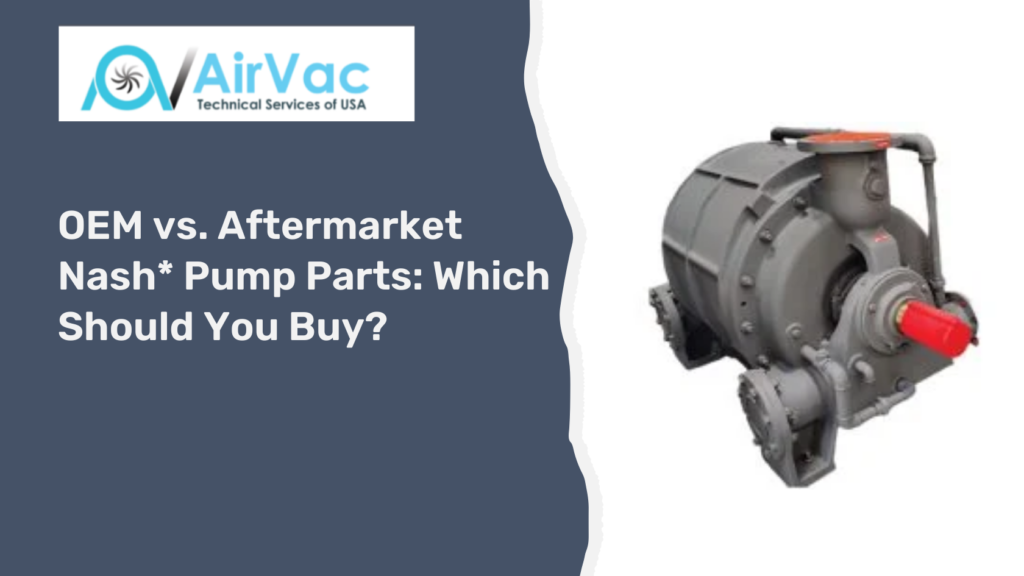
OEM (Original Equipment Manufacturer) Nash pump parts are made to exact factory specs and are best for warranty repairs or critical operations. Aftermarket parts cost 20%–50% less and work well for older pumps or budget-driven maintenance if you source them from a reputable supplier. The right choice depends on your pump’s age, warranty status, operating criticality, and available budget.
When a Nash liquid ring vacuum pump needs repair, one of the first decisions you face is whether to use OEM (Original Equipment Manufacturer) parts or aftermarket alternatives. Get it right, and your pump runs reliably for years. Get it wrong, and you could face repeat failures, costly downtime, and frustrated maintenance teams.
This guide breaks down the real differences between OEM and aftermarket Nash pump parts, covering cost, quality, availability, compatibility, and the scenarios where each option makes the most sense. Whether you manage a single pump or an entire fleet of industrial vacuum systems, this comparison will help you make a smarter, more informed purchasing decision.
What Are OEM Nash* Pump Parts?
OEM parts are manufactured by or under direct authorization from the original equipment maker. For Nash vacuum pumps, this means parts are produced to the exact engineering specifications set by Gardner Denver, which acquired the Nash brand and currently owns the product line.
OEM parts carry several distinct characteristics:
- Exact dimensional tolerances: Every measurement matches the original design blueprint, ensuring a precise fit without modifications.
- Verified material grades: Materials, including cast iron, stainless steel, and bronze alloys, are tested to meet the pump’s original performance standards.
- Factory quality control: OEM parts go through the same QC processes used during original pump manufacturing.
- Traceability and documentation: Each part has documented provenance, which matters for regulated industries like food processing, pharmaceuticals, and chemical manufacturing.
- Warranty compatibility: Using OEM parts typically preserves any remaining manufacturer warranty on the pump.
According to the U.S. Department of Energy’s industrial efficiency guidelines, maintaining pumping systems with manufacturer-specified components is recommended to maximize efficiency and reduce lifecycle costs.
What Are Aftermarket Nash* Pump Parts?
Aftermarket parts are components made by third-party manufacturers not the original brand or an authorized OEM partner. These suppliers reverse-engineer or independently design parts to fit Nash pump models, often at a significantly lower price point.
The aftermarket parts industry is large and diverse. Some suppliers produce high-quality components with tight tolerances and solid engineering. Others cut costs by using inferior materials or less precise manufacturing. This range in quality is one of the biggest challenges with aftermarket sourcing. The label alone tells you very little.
Key things to evaluate when considering aftermarket Nash pump parts:
- Supplier reputation and track record: Look for suppliers with verifiable references and a history of serving industrial pump customers.
- Material certifications: Ask whether the parts meet ASTM or equivalent material standards for the specific alloys used.
- Dimensional testing data: Reliable aftermarket suppliers can provide or reference engineering drawings and tolerance specs.
- Return and warranty policy: Reputable aftermarket companies stand behind their parts with at least a limited warranty.
- Industry-specific compliance: For regulated environments, confirm that the parts meet applicable industry standards (e.g., FDA, ATEX, etc.).
OEM vs. Aftermarket Nash* Parts: Side-by-Side Comparison
The table below summarizes the key differences to help you compare at a glance:
| Factor | OEM Parts | Aftermarket Parts |
| Cost | Higher upfront cost ($$$) | Lower upfront cost ($) |
| Fit & Compatibility | Guaranteed exact fit | Varies by manufacturer |
| Warranty | Often backed by OEM warranty | Limited or no warranty |
| Availability | May have longer lead times | Usually faster availability |
| Quality Consistency | Strict manufacturing standards | Varies widely by brand |
| Best Use Case | Critical systems, warranty repairs | Budget repairs, older pumps |
| Long-Term Cost | Lower (fewer replacements) | Potentially higher (varies) |
How Much Do OEM and Aftermarket Nash* Parts Cost?
Cost is often the first factor that pushes buyers toward aftermarket parts, and understandably so. OEM Nash pump components typically carry a 20%–50% price premium over comparable aftermarket alternatives.
Here’s a general cost range by common part type (based on industry pricing data for Nash CL and 2BH series pumps):
| Part Type | OEM Price Range (USD) | Aftermarket Price Range (USD) |
| Mechanical Seal | $200 – $800+ | $100 – $450 |
| Impeller | $300 – $1,200 | $150 – $700 |
| Bearing Set | $80 – $250 | $40 – $150 |
| Shaft Sleeve | $120 – $400 | $60 – $250 |
| End Plate | $400 – $1,500 | $200 – $900 |
| Wear Plate | $150 – $600 | $75 – $350 |
Note: These are approximate market ranges. Actual pricing varies by pump model (CL, 2BH, TC, SC series), supplier, and current market conditions. Always request formal quotes before making purchasing decisions.
While the lower upfront price of aftermarket parts is attractive, it’s important to factor in the total cost of ownership. If an aftermarket part fails prematurely, the cost of labor, downtime, and secondary damage can far exceed the initial savings.
Quality and Reliability: OEM vs. Aftermarket Nash* Parts
Quality is arguably more important than price when it comes to vacuum pump components. A failed mechanical seal or a cracked impeller doesn’t just cost you a part it can take an entire production line offline.
Where OEM Parts Excel
- Tight manufacturing tolerances validated against original design drawings
- Material consistency: same alloy grades used in the original pump build
- Full compatibility with seal systems, rotor clearances, and thermal expansion profiles
- Documentation suitable for regulated industry audits
- Predictable performance across the pump’s rated operating range
Where Aftermarket Parts Can Compete
- High-quality aftermarket suppliers use CNC machining and coordinate measuring machine (CMM) verification to match OEM tolerances
- Some aftermarket bearings (e.g., sourced from top-tier bearing brands like SKF or Timken) may match or exceed OEM bearing specifications
- For older or discontinued Nash pump models, aftermarket parts may be the only practical option
- Reputable aftermarket suppliers can provide material certs and dimensional reports on request
The Hydraulic Institute, the leading U.S. trade association for pump manufacturers, recommends always verifying that replacement parts (OEM or aftermarket) meet the original pump’s engineering tolerances and material specifications before installation.
Parts Availability: Which Is Faster to Source?
In unplanned downtime situations, every hour counts. Availability is often the deciding factor in the OEM vs. aftermarket decision.
OEM Nash parts are distributed through an authorized network managed by Gardner Denver. Lead times can range from a few days to several weeks, depending on the part and your location. Stock levels for legacy pump models can be limited, particularly for older Nash series pumps that have been discontinued.
Aftermarket suppliers, by contrast, often warehouse large inventories of common Nash pump components, mechanical seals, bearings, and impellers, and can ship same-day or next-day for most standard models. This speed advantage makes aftermarket parts particularly attractive for emergency repairs.
Consider stocking critical spare parts, such as mechanical seals and bearing sets, whether OEM or aftermarket. According to a study by the U.S. Department of Energy, unplanned industrial downtime costs U.S. manufacturers an estimated $50 billion per year. A proactive spare parts program is one of the most cost-effective ways to reduce that exposure.
When Should You Choose OEM Nash* Parts?
OEM parts are the right choice in several specific situations:
- Pump is under active manufacturer warranty: Using non-OEM parts can void your warranty coverage. Stick with OEM parts until the warranty period expires.
- Critical or regulated applications: Industries such as pharmaceuticals, food processing, and chemical manufacturing often require OEM documentation for compliance audits.
- High-pressure or precision operating conditions: When pump performance tolerances are tight, and failure consequences are severe, OEM parts provide the lowest-risk option.
- Recently manufactured pumps: For pumps still within their service design life, OEM parts ensure full compatibility and performance consistency.
- When documentation trails are required: OEM parts come with traceability records that may be required for regulated industry maintenance logs.
When Are Aftermarket Nash* Parts the Better Choice?
Aftermarket parts offer real advantages in the right circumstances:
- Older, out-of-warranty pumps: For pumps more than 10–15 years old, OEM parts may be discontinued or extremely expensive. Aftermarket becomes the practical solution.
- Budget-constrained maintenance: When capital budgets are tight, aftermarket parts from a verified supplier can deliver reliable performance at 30%–50% lower cost.
- Emergency breakdowns: When you need parts immediately and OEM lead times are too long, high-quality aftermarket parts can restore uptime quickly.
- Non-critical applications: For vacuum systems operating in low-risk, non-regulated environments, the cost savings of aftermarket parts are easier to justify.
- Large fleets with standardized maintenance: Organizations managing multiple Nash pumps of the same model can negotiate significant volume discounts on aftermarket spares.
Most Commonly Replaced Nash* Vacuum Pump Parts
Understanding which parts wear fastest helps you build a smarter spare parts inventory. Across Nash liquid ring vacuum pump models, including the CL, 2BH, TC, and SC series the following components have the highest replacement frequency:
| Part | Typical Replacement Interval | Common Failure Cause |
| Mechanical Seal | 1–3 years | Cavitation, dry running, liquid contamination |
| Bearings | 2–5 years | Misalignment, inadequate lubrication |
| Impeller | 3–8 years | Erosion, corrosive liquid ring fluid |
| Shaft Sleeve | 3–6 years | Seal wear, corrosion |
| End Plate / Cone | 5–10 years | Erosion, clogging |
| Wear Plate | 3–7 years | Abrasion from entrained solids |
For a full Nash pump parts reference, including model-specific diagrams and part numbers, visit AirVac Technical Services, which stocks a broad range of Nash pump components for the U.S. market.
How to Evaluate an Aftermarket Nash* Parts Supplier?
Not all aftermarket suppliers are equal. Before placing an order with a new supplier, ask these key questions:
- Do you provide material certifications? ASTM or equivalent material certifications confirm that alloys meet the required standards for your application.
- Can you provide dimensional inspection reports? CMM reports or tolerance verification data, confirm that the part will fit correctly.
- What is your quality management system? ISO 9001-certified suppliers operate under formal quality management frameworks, which reduces the risk of receiving substandard parts.
- What is your return and warranty policy? Reputable suppliers offer at least a limited warranty on parts and a reasonable return process for defective items.
- Do you have references in the industrial pump sector? Ask for customer references from maintenance operations similar to yours.
- How long have you supplied Nash pump parts? Experience specifically with Nash or liquid ring vacuum pump components matters more than general pump parts experience.
When in doubt, start with a small trial order for non-critical parts before committing to large inventory purchases from a new aftermarket supplier.
Practical Tips for Managing Nash* Pump Spare Parts
A smart spare parts strategy reduces the risk of downtime and balances cost efficiency. Here are practical steps to implement today:
- Create a pump asset register: Document each Nash pump’s model number, serial number, installation date, and service history. This data is essential for ordering the right parts and tracking wear patterns.
- Identify critical vs. non-critical parts: Critical parts (mechanical seals, bearings) should be stocked on-site in OEM form if the pump is warranty-active or in a regulated environment. Non-critical parts can be sourced from verified aftermarket suppliers.
- Review lead times annually: OEM part availability changes over time, especially for aging equipment. If OEM lead times are increasing, it’s time to develop an aftermarket backup source.
- Train maintenance staff on part verification: Equip your team to visually and dimensionally inspect new parts before installation. A few minutes of verification can prevent hours of downtime.
- Document every repair: Record what parts were used, when they were installed, and what condition the replaced parts were in. This data improves future purchasing decisions.
For additional guidance on vacuum pump maintenance best practices, the Hydraulic Institute’s pump maintenance resources offer free and member-accessible materials for U.S. industrial professionals.
Frequently Asked Questions:
The following questions and answers are structured for quick reference and formatted to support eligibility for featured snippets and AI overviews.
Are OEM Nash* pump parts always better than aftermarket?
Not necessarily. OEM parts guarantee exact fit and are made to original specs, making them ideal for critical or warranty-covered applications. However, high-quality aftermarket parts from reputable suppliers can perform comparably at a lower cost, especially for older pumps or non-critical uses.
How much do OEM Nash* pump parts cost compared to aftermarket?
OEM Nash parts typically cost 20%–50% more than aftermarket equivalents. For example, OEM mechanical seals or impellers may run $200–$800+, while aftermarket versions of the same parts can be found for $100–$500. Prices vary by part type, pump model, and supplier.
Will aftermarket parts void my Nash* pump warranty?
Using non-OEM parts on a pump still under the manufacturer’s warranty may void that warranty. Always check your pump documentation or contact the OEM before switching to aftermarket parts if your pump is under active warranty coverage.
What are the most commonly replaced Nash* pump parts?
The most frequently replaced Nash vacuum pump parts include mechanical seals, impellers, bearings, shaft sleeves, wear plates, and end plates. These are available in both OEM and aftermarket versions from most industrial parts suppliers.
Where can I buy genuine OEM Nash* pump parts in the USA?
You can source OEM Nash parts through authorized distributors, directly from Gardner Denver (the current Nash brand owner), or from specialized industrial pump service companies. Ensure the supplier is an authorized reseller to avoid counterfeit parts.
How do I identify the right part for my Nash* pump model?
Use your pump’s nameplate data, including model number, serial number, and pump series, to match the correct part. Cross-reference with the original equipment manual or contact a certified Nash pump service provider for confirmation.
What is the lead time for OEM Nash* parts vs. aftermarket?
OEM Nash parts may have lead times of 1–4 weeks, depending on availability, while many aftermarket parts are stocked locally and can ship within 1–3 business days. Aftermarket options are often preferred for emergency or unplanned downtime situations.
Can I mix OEM and aftermarket parts in my Nash* pump?
Yes, in many cases you can mix OEM and aftermarket parts, but always verify compatibility before installation. Critical components such as mechanical seals, impellers, and bearings should ideally come from a single source to ensure proper tolerances and fit.
Making the Right Call for Your Nash* Pump
The OEM vs. aftermarket decision is rarely black and white. In most real-world maintenance environments, the right answer is a smart mix of OEM parts when reliability, compliance, or warranty protection is essential, and carefully vetted aftermarket parts when cost savings and availability favor that route.
What matters most is knowing your pump, understanding its operating context, and sourcing from suppliers you’ve verified. A $100 aftermarket seal that fits perfectly and lasts 3 years is a better investment than a $350 OEM seal ordered from a supplier with a 6-week backlog, especially when your pump is down now.
Build your parts strategy around data failure history, lead times, criticality, and total cost of ownership, not just the unit price on an invoice.
Need Help Sourcing Nash* Pump Parts?
Airvac Technical Services specializes in Nash vacuum pump parts, repair, and technical support for industrial operations across the United States. Whether you need OEM components with full documentation or high-quality aftermarket alternatives for an aging pump, our team can help you find the right part at the right price without the guesswork.