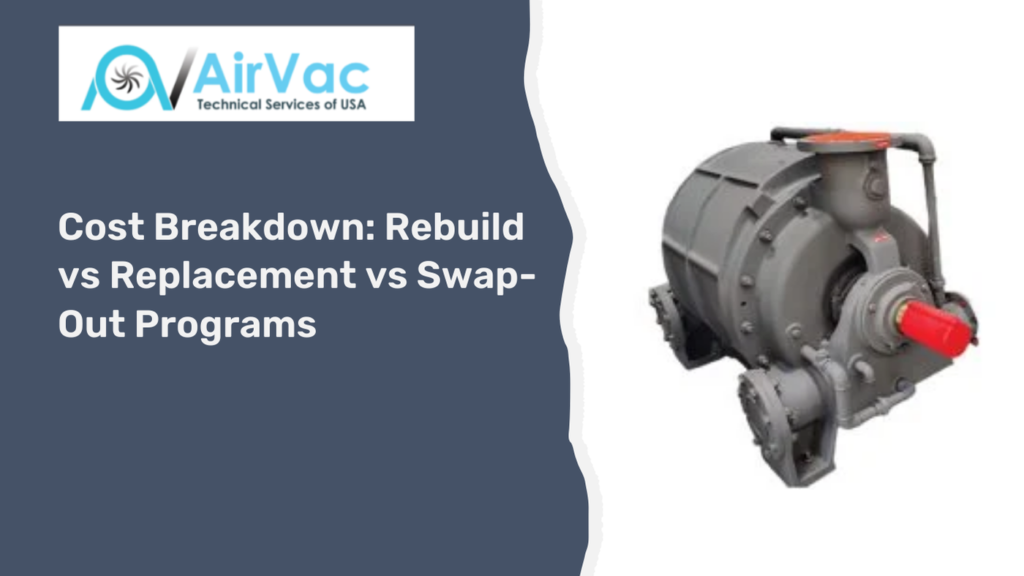
When an industrial pump fails or begins to lose performance, plant managers face a critical decision: should they rebuild the existing pump, buy a brand-new replacement, or use a swap-out program to quickly get a reconditioned unit back into service? Each option comes with a different cost structure, a different impact on production downtime, and a different long-term value. This guide gives you a clear, honest cost breakdown of all three options so you can make the right call based on your specific situation, budget, and operational needs.
Understanding the Three Options
Before looking at costs, it helps to understand exactly what each option involves. Many people use these terms loosely, and that leads to confusion when comparing quotes.
What Is a Nash* Pump Rebuild?
A rebuild means your existing pump is taken apart, inspected, and restored to working condition. Worn or damaged parts are replaced. Internal components are cleaned, measured, and brought back to original specifications. The pump casing and major structural parts are usually retained if they remain within tolerance.
A rebuild is done on your own pump. You get the same unit back, restored and ready to run. The work is typically carried out by a pump service workshop or by the original equipment manufacturer’s authorized service center.
What Is a Nash* Pump Replacement?
Replacement means you buy a brand-new pump. The old unit is removed, and a new one is installed in its place. You get all new components, a full manufacturer’s warranty, and the latest design improvements if the model has been updated.
Replacement is the most straightforward option in terms of what you receive, but it is almost always the most expensive upfront and has the longest delivery lead time.
What Is a Swap-Out Program?
A swap-out program, sometimes called an exchange program or pump exchange, works differently. The service provider holds a stock of reconditioned pumps. When your pump fails, you send in your unit and receive a pre-rebuilt pump in return, often within a day or two.
This option prioritizes speed. You get a fully reconditioned pump that has been tested and returned to service, without waiting weeks for your unit to be rebuilt or for a new unit to be delivered.
| Key insight: The three options are not interchangeable in all situations. The right choice depends on pump age, failure severity, production criticality, and your total downtime cost. |
Full Cost Breakdown of Each Option
Most people only look at the direct quote they receive. But the true cost of each option includes several other factors that are easy to overlook. Here is a complete breakdown.
Rebuild Cost Breakdown
The cost of a rebuild varies with the pump size, the extent of wear, and the cost of replacement parts. For a mid-sized industrial vacuum pump or liquid ring pump, typical rebuild costs range from 25 to 60 percent of the new pump price.
| Cost Component | Typical Range (INR) | Notes |
| Labour for disassembly and inspection | 8,000 to 20,000 | Depends on pump size and complexity |
| Replacement parts (seals, bearings, impeller) | 15,000 to 1,50,000 | Major variable depending on wear |
| Machining and surface restoration | 10,000 to 50,000 | If casing or shaft needs work |
| Testing and commissioning at the workshop | 5,000 to 15,000 | Includes performance run test |
| Transport to and from the workshop | 3,000 to 15,000 | Depends on pump weight and distance |
| Downtime cost during rebuild (per day) | 25,000 to 5,00,000+ | The biggest variable depends on the process |
| Total estimated cost (excluding downtime) | 41,000 to 2,50,000 | For a typical mid-sized industrial pump |
Rebuild timelines typically range from 5 to 20 working days, depending on parts availability and workshop workload. For plants where every day of downtime costs lakhs of rupees, this is a critical number.
Replacement Cost Breakdown
Buying a new pump is simple in concept but complex in cost. The sticker price is just the beginning.
| Cost Component | Typical Range (INR) | Notes |
| New pump purchase price | 1,50,000 to 15,00,000+ | Highly dependent on size and type |
| Import duty and taxes (if applicable) | 10 to 28% of the pump value | For imported brands like Nash, Siemens |
| Freight and insurance | 5,000 to 40,000 | Domestic vs international sourcing |
| Installation and commissioning | 10,000 to 50,000 | Piping, electrical, and alignment work |
| Disposal of the old pump | 0 to 15,000 | Scrap value may offset this |
| Lead time downtime cost | 25,000 to 5,00,000 per day | New pumps often take 6 to 16 weeks |
| Total estimated cost (excluding downtime) | 1,65,000 to 16,05,000+ | For a typical mid-sized industrial pump |
The lead time for new pumps from international manufacturers such as Nash (Gardner Denver), Siemens, or Busch can range from 8 to 20 weeks for non-standard configurations. For critical process equipment, this wait can be devastating.
Swap-Out Program Cost Breakdown
Swap-out programs have a different cost model. You pay a fixed exchange fee and get a reconditioned pump immediately. Here is how the costs typically break down.
| Cost Component | Typical Range (INR) | Notes |
| Exchange or swap-out fee | 40,000 to 3,50,000 | Includes reconditioning and testing |
| Core charge (refundable on return of old unit) | 20,000 to 1,50,000 | Returned when your pump is sent in |
| Transport of the failed pump to the provider | 3,000 to 15,000 | You pay to send in your old unit |
| Installation and commissioning | 10,000 to 40,000 | Standard fit-up and alignment |
| Downtime cost (typically 1 to 3 days) | 25,000 to 15,00,000 | Very fast turnaround is the key advantage |
| Total estimated cost (excluding downtime) | 53,000 to 5,05,000 | For a typical mid-sized industrial pump |
The swap-out advantage is speed. Where a rebuild takes two to four weeks and a new pump can take two to four months, a swap-out gets your process running again in one to three days. For plants with high downtime costs, this speed difference can easily justify the higher exchange fee.
Side-by-Side Cost Comparison
This table gives you a quick view of how the three options compare across the most important decision factors.
| Factor | Rebuild | Replacement | Swap-Out |
| Typical upfront cost | Low to medium | High | Medium |
| Total cost including downtime | Medium to high | Very high | Low to medium |
| Turnaround time | 5 to 20 days | 6 to 20 weeks | 1 to 3 days |
| Risk of further failure | Medium | Low | Low to medium |
| Warranty period | 3 to 12 months | 12 to 24 months | 6 to 12 months |
| Best for pump age | Under 10 years | Over 15 years or obsolete | Any age |
| Parts availability dependency | High | None | Low |
| Suitable for critical processes | Depends on downtime tolerance | Yes (planned) | Yes (emergency) |
| Environmental impact | Lowest | Highest | Low |
| Lifecycle cost over 10 years | Lowest if maintained | Highest | Medium |
When Does Each Option Make the Most Financial Sense?
Choose a Rebuild When
- The pump is less than 10 to 12 years old, and the casing is in good condition
- The failure is limited to wear parts like seals, bearings, or impeller blades
- You have a spare pump available so the failed unit can be rebuilt without stopping production
- New replacement units have very long lead times, and you cannot wait
- Budget is tight, and the rebuild cost is significantly lower than replacement
- The pump model has been discontinued, and a replacement is not possible
| Industry insight: According to the Hydraulic Institute, rebuilding a pump to like-new condition typically costs 40 to 60 percent of a new pump’s price. For pumps with good casing condition, this is usually the best long-term investment. |
Choose Replacement When
- The pump is over 15 years old and has had multiple rebuilds already
- The casing is cracked, heavily corroded, or dimensionally out of tolerance
- The pump model is obsolete, and spare parts are no longer available
- Technology has improved significantly since the pump was installed, and a newer model offers better efficiency
- You are planning a major process upgrade and want modern equipment with full warranty
- The total rebuild cost exceeds 60 to 70 percent of the new pump price
Important note: The US Department of Energy’s Motor Challenge program recommends replacing pumps when the rebuild cost exceeds 60 percent of the new equipment cost, especially if the pump is over 10 years old. This guideline is widely used in industrial purchasing decisions.
Choose a Swap-Out Program When
- The pump failure is unexpected, and production cannot stop
- Downtime costs per day are high enough to justify a premium for speed
- You do not have a spare pump and need something running within 24 to 48 hours
- Your workshop or service provider offers a reliable swap-out stock for your pump type
- The process is seasonal, and you cannot afford delays during peak production periods
- You want to avoid the uncertainty of rebuild timelines due to parts availability
Hidden Costs That Change the Decision
Most plant teams look at the direct quote and make a decision. But several hidden costs can completely flip the economics. Here are the ones that matter most.
Production Downtime Cost
This is almost always the highest cost in any pump failure scenario. Calculate your hourly downtime cost before comparing options. For many process plants, one day of lost production is worth more than the pump’s entire cost.
For example, if your plant loses INR 2,00,000 in production per day when a pump is down, a 15-day rebuild costs INR 30,00,000 in lost production alone. A swap-out that takes 2 days costs only INR 4,00,000 in downtime. Even if the swap-out fee is INR 5,00,000 more expensive than the rebuild, the total cost is still far lower.
Repeat Failure Risk
A rebuild using low-quality parts or performed by an inexperienced workshop may fail again within months. Each repeat failure adds to the total cost. When evaluating rebuild quotes, always ask about the quality and origin of replacement parts and the workshop’s track record with that pump type.
Energy Efficiency After Repair
A worn pump wastes energy. But a poorly rebuilt pump can also waste energy if internal clearances are not restored correctly. After any repair, check motor current readings against the original specification. A pump drawing 10 percent more power than it should costs money every hour it runs.
The US Department of Energy estimates that energy costs account for over 95 percent of a pump’s total lifetime cost in continuous-duty applications. A repair that restores full efficiency pays back in energy savings within months.
Warranty and Support Costs
New pumps come with full manufacturer warranties, usually 12 to 24 months. Rebuilds typically carry workshop warranties of 3 to 12 months. Swap-out programs offer warranties on the exchanged unit, usually 6 to 12 months. If a warranty claim arises, who bears the cost of re-repair and the associated downtime? This risk has a real financial value.
Inventory and Spare Parts Carrying Cost
If you choose to rebuild and rely on ordering parts each time, you risk lead-time delays. If you maintain a spare pump, you carry the cost of that inventory. Swap-out programs effectively outsource this inventory risk to the service provider, which offers real cost savings for plants that do not want to carry large spare parts inventories.
How to Calculate the True Cost of Each Option
Use this simple framework to compare the total cost of each option for your specific situation.
| Step | What to Calculate | How to Get the Number |
| 1 | Direct repair or purchase cost | Get quotes from at least two providers |
| 2 | Estimated turnaround time (days) | Confirm with the service provider in writing |
| 3 | Daily downtime cost | Lost production value per day while the pump is down |
| 4 | Total downtime cost | Turnaround time (days) x daily downtime cost |
| 5 | Risk premium | Estimate the probability of repeat failure x cost of another failure |
| 6 | Energy cost difference | Calculate if a new or rebuilt pump changes the power consumption |
| 7 | True total cost | Add steps 1 + 4 + 5 + 6 for each option and compare |
This calculation often surprises plant teams. In many cases, the most expensive-looking option on paper turns out to be the cheapest when downtime is included. Running this calculation with real numbers from your plant takes less than 30 minutes and can save lakhs of rupees.
Does Pump Type Affect Which Option Is Best?
Yes. The right choice also depends on the type of pump involved. Here is a quick guide by pump type.
| Pump Type | Rebuild Viability | Swap-Out Availability | Best Default Option |
| Nash liquid ring vacuum pump | High (robust design) | Available from specialists | Rebuild if time allows; swap out for emergencies |
| Centrifugal pump (small/medium) | High | Widely available | Rebuild for planned, swap-out for emergency |
| Screw vacuum pump | Medium (complex internals) | Limited | Replace if over 10 years old |
| Rotary vane vacuum pump | High | Available from OEM | Rebuild with OEM parts |
| Diaphragm pump | Low (low unit cost) | Rare | Replace with new unit |
| Large multistage pump | High (high unit cost) | Rare | Always rebuild; replacement cost is prohibitive |
A Practical Decision Framework
Use these questions in order to guide your decision:
| Question | If Yes | If No |
| Is the pump casing cracked or heavily corroded? | Replace with new | Continue to the next question |
| Is the pump over 15 years old and has it had 2+ previous rebuilds? | Strongly consider replacement | Continue to the next question |
| Is the daily downtime cost over INR 1,00,000? | Consider a swap-out for speed | Rebuild may be the best value |
| Can you wait 10 to 20 days for a rebuild? | Rebuild is likely the most cost-effective | Use the swap-out program |
| Does the rebuild cost exceed 65% of the new pump cost? | Replacement makes financial sense | Rebuild is the better choice |
| Is the pump model obsolete, with no parts available? | Replace with new or equivalent | Rebuild is viable |
The Environmental Case for Rebuilding
Cost is not the only factor worth considering. Rebuilding a pump instead of replacing it has a clear environmental benefit. Manufacturing a new industrial pump consumes significant raw materials and energy, and produces carbon emissions during production and transport.
According to research published by the European Commission on sustainable manufacturing, remanufacturing industrial equipment uses up to 85 percent less energy and produces up to 88 percent fewer greenhouse gas emissions compared to making a new product from scratch.
For companies with sustainability targets or ESG reporting requirements, choosing a rebuild or swap-out over a new replacement is a measurable step toward reducing the environmental footprint of their operations. This factor is becoming increasingly important for large industrial buyers globally.
Frequently Asked Questions
How do I know if my pump is worth rebuilding or should be replaced?
The most reliable rule is the 60 percent threshold. If the rebuild cost is less than 60 percent of the price of a new pump and the casing is still in good condition, a rebuild is almost always the better financial choice. If the rebuild cost is higher or the casing is compromised, replacement makes more sense. Also consider the pump’s age and how many times it has already been rebuilt.
What is included in a typical pump swap-out program?
A swap-out program typically includes a fully reconditioned pump that has been disassembled, cleaned, fitted with new wear parts, reassembled to its original specifications, and performance-tested before dispatch. The provider holds an exchange stock, so a ready unit is available immediately. You send in your failed unit after receiving the replacement, and a core charge is refunded once your old pump arrives.
How long does a full pump rebuild take?
For most mid-sized industrial pumps, a full rebuild takes between 5 and 20 working days. The timeline depends on the extent of damage, the availability of replacement parts, and the workshop’s current workload. Pumps requiring machined parts, special-order bearings, or hard-to-find components can take longer. Always get a written estimate of the turnaround time before sending a pump for rebuild.
Are reconditioned pumps from swap-out programs reliable?
Yes, when provided by a reputable service specialist. A good swap-out provider completely disassembles, inspects, and rebuilds each pump to original specifications using quality parts. Performance testing before dispatch confirms that the unit meets the original design parameters. The warranty on a swap-out pump is typically 6 to 12 months, providing protection against early failures.
Can I use a swap-out program for Nash* vacuum pumps?
Yes. Several specialized service providers offer swap-out or exchange programs specifically for Nash liquid ring vacuum pumps. These providers maintain a stock of reconditioned Nash pump units in common sizes. If you operate Nash pumps in a critical process application, it is worth establishing a relationship with a Nash pump specialist who offers exchange programs before you need one in an emergency.
What warranty do I get with a pump rebuild versus a new pump?
A new pump from the original manufacturer typically carries a warranty of 12 to 24 months covering manufacturing defects. A professionally rebuilt pump carries a workshop warranty of 3 to 12 months, depending on the service provider and the scope of work done. When evaluating rebuild quotes, always ask about the warranty terms in writing, including what is covered and the process for making a claim.
Is it cheaper to rebuild a pump multiple times or buy a new one?
For the first and second rebuild, rebuilding is almost always cheaper than replacing. By the third rebuild, you need to evaluate carefully. A pump that has been rebuilt twice already may have a casing reaching its wear limits, and the cost of a third rebuild, combined with the higher risk of repeat failure, may tip the economics in favor of replacement. Run the true cost calculation, including downtime risk, before deciding.
Conclusion
There is no single right answer when choosing between a rebuild, replacement, or swap-out program. The right decision depends on the pump’s age and condition, the cost of downtime in your specific process, the availability of replacement parts, and your budget.
What is clear is that looking only at the upfront quote is a mistake. The total cost, including downtime, risk of repeat failure, energy efficiency, and warranty value, is what matters. Running a structured cost comparison using the framework in this guide will almost always lead to a better decision than going with gut feel or the lowest price tag.
As a general rule, rebuild if the pump is in reasonable condition and time allows, swap out if speed is critical, and replace only when the pump is truly at the end of its life or when the technology improvement justifies the investment.
If you need expert guidance on whether your pump is worth rebuilding, exchanging, or replacing, Airvac Technical Services offers professional pump assessment, full rebuild services, and swap-out programs for Nash liquid ring vacuum pumps and a wide range of other industrial pump types. With years of experience in vacuum pump and compressor servicing across industries, Airvac Technical Services can help you make the most cost-effective decision and get your process running again with minimum downtime.