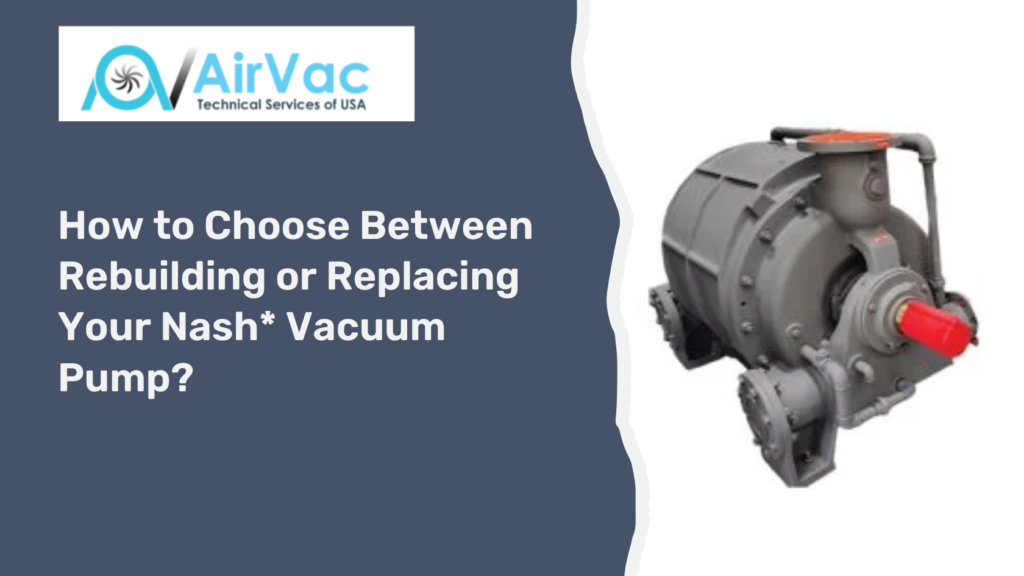
Vacuum pumps rarely get much attention until they stop working. In many industrial facilities, a Nash liquid ring vacuum pump quietly supports critical processes every hour of every day. From paper mills and chemical plants to food processing and medical systems, these pumps are mission-critical assets. When performance drops, or failures begin, the question quickly becomes unavoidable:
Should you rebuild your Nash vacuum pump or replace it entirely?
It’s not a simple yes-or-no decision. Rebuilding and replacement both have clear advantages, depending on your pump’s condition, age, application, and the cost of downtime at your facility. Make the wrong choice, and you may overspend, lose efficiency, or face repeated failures. Make the right one, and you can extend equipment life, control costs, and restore reliable operation with minimal disruption.
This guide is designed to help maintenance managers, plant engineers, and procurement teams make that decision with confidence. We’ll walk through the technical, financial, and operational factors that matter most so you can choose the option that makes sense for your specific Nash pump and facility.
Why Nash* Pumps Are Commonly Rebuilt or Replaced?
Nash liquid ring vacuum pumps are known for one thing above all else: longevity. Many models installed decades ago are still running today. That durability is why rebuild-versus-replace decisions are so familiar with Nash equipment.
Long Operational Life
It’s not unusual for Nash pumps, especially CL, SC, 904, and XL series models, to remain in service for 20 to 30 years or more. The cast-iron construction, simple operating principle, and robust internal components enable these pumps to withstand harsh environments better than many modern alternatives.
However, longevity doesn’t mean immunity to wear. Over time, internal clearances increase, bearings fatigue, and corrosion takes its toll, especially in applications with poor seal water quality.
Heavy-Duty Industrial Applications
Nash pumps are often installed in continuous-duty environments:
- Paper and pulp mills
- Chemical and pharmaceutical processing
- Food and beverage production
- Power generation and utilities
- Medical and hospital vacuum systems
In these settings, uptime matters. Even a short outage can mean lost production, safety concerns, or regulatory risk. That’s why many facilities prefer rebuilds or drop-in replacements rather than experimenting with unfamiliar equipment.
Availability of Rebuild Kits and Replacement Options
Another reason Nash pumps are frequently rebuilt is the availability of parts. Bearings, seals, cones, impellers, and casings can often be restored or replaced, making rebuilds technically viable even after decades of use.
At the same time, drop-in replacement pumps engineered to match Nash performance specifications offer a faster path to zero-hour operation when rebuilds are no longer economical.
When Rebuilding a Nash* Pump Is the Best Option?
Rebuilding is often the first option facilities consider, and for good reason. When conditions are right, a professional rebuild can restore performance, extend service life, and cost significantly less than replacement.
Ideal Conditions for Rebuilding
A Nash vacuum pump is a strong candidate for rebuilding when:
- Wear is moderate, not catastrophic
Bearings may be worn, seals may leak, or efficiency may be reduced but the core components remain intact. - Vacuum performance has declined gradually.
Loss of vacuum, higher power draw, or reduced capacity often signal internal wear that can be corrected during a rebuild. - No structural damage is present.
Casings and shafts must be free of cracks, severe corrosion, or excessive pitting. - The pump frame remains dimensionally sound.
Machining allowances still exist to restore proper clearances.
If these conditions are met, rebuilding can return the pump to near-original performance.
Advantages of Rebuilding
1. Lower Capital Cost
A professional rebuild typically costs 40–60% less than purchasing a new or replacement pump. For facilities managing tight maintenance budgets or capital expenditure approvals, this difference can be significant.
2. Faster Turnaround with Swap-Out Programs
Downtime is often the biggest concern with rebuilds. However, a swap-out rebuild program minimizes this risk. In this approach:
- A rebuilt, thoroughly tested pump is shipped first
- Your existing pump is returned afterward for rebuilding
This allows facilities to maintain operations while still benefiting from a rebuilt unit.
3. Restored Performance
A properly executed rebuild isn’t just a repair; it’s a restoration. When bearings, seals, and internal components are replaced and clearances are corrected, vacuum performance and efficiency can return to factory standards.
4. Familiar Installation and Operation
Rebuilding keeps the original pump footprint, connections, and operating characteristics. There’s no need for piping changes, electrical modifications, or operator retraining.
When Is Replacing Your Nash* Pump the Right Decision?
While rebuilding is often cost-effective, it’s not always the most brilliant long-term solution. In some cases, replacement delivers better reliability and lower lifecycle cost.
Signs Replacement Is Necessary
Replacement should be strongly considered when you observe:
- Severe corrosion or erosion
Deep pitting, thinning casings, or material loss beyond machining limits compromise structural integrity. - Cracked casings or shafts
Structural damage cannot be reliably repaired and presents a risk of sudden failure. - Impeller-to-casing mismatch
When wear has altered geometry beyond acceptable tolerances, performance cannot be restored economically. - Repeated rebuilds with diminishing returns
If the pump has undergone multiple rebuilds and failures continue, replacement often becomes the more reliable option. - Extremely old legacy models
Some early Nash designs lack modern materials or efficiency improvements available in current replacements.
Benefits of Replacement Pumps
1. Zero Operating Hours
A replacement pump starts with a clean lifecycle. Bearings, seals, and rotating components are new, reducing the risk of early failure.
2. Improved Materials and Corrosion Resistance
Modern replacement pumps often feature upgraded metallurgy, coatings, or optional stainless steel construction, especially valuable in corrosive or wet applications.
3. Drop-In Compatibility
High-quality replacement pumps are engineered to match the footprint, connections, and performance of legacy Nash models. This allows for fast installation without redesigning your system.
4. Predictable Reliability
For facilities where uptime is critical, replacement provides peace of mind. The risk of unexpected internal failures is significantly lower than that of aging equipment.
Cost Comparison: Rebuild vs Replace
Cost is often the deciding factor, but focusing only on the upfront price can be misleading. A proper comparison considers total lifecycle cost, not just purchase price.
Rebuild vs Replace Cost Comparison Table
| Factor | Rebuild | Replace |
| Initial Cost | Lower (40–60% less) | Higher |
| Downtime | Low with swap-out | Minimal |
| Efficiency | Restored to the original | Often improved |
| Longevity | Extended (5–10+ years) | Full lifecycle |
| Warranty | Limited | Full |
| Parts Availability | Good | Excellent |
| Risk of Hidden Wear | Moderate | Low |
A rebuild is typically the better choice when budgets are tight and the pump is structurally sound. Replacement becomes more attractive when reliability, long-term ROI, and reduced maintenance risk are priorities.
Downtime Considerations
Downtime often costs more than the pump itself. Lost production, labor inefficiencies, and emergency repairs can quickly outweigh equipment savings.
Rebuild Lead Times vs Replacement Availability
- Traditional rebuilds may require weeks if your pump must be disassembled, inspected, machined, and reassembled.
- In-stock replacement pumps can often ship immediately.
- Swap-out rebuild programs combine the benefits of both minimal downtime and rebuild-level cost savings.
Impact of Downtime on Production Costs
For continuous operations, even a few hours of lost vacuum can:
- Interrupt production lines
- Create quality issues
- Trigger safety or environmental risks
That’s why many facilities prioritize availability and turnaround time over upfront savings.
Performance and Efficiency Factors
Performance matters just as much as reliability. A pump that runs but runs inefficiently still costs you money.
How Rebuilding Restores Efficiency
A professional rebuild addresses the most common efficiency losses:
- Worn bearings are causing shaft misalignment
- Increased internal clearances, reducing the vacuum
- Seal leakage increases power consumption
When corrected, the pump regains stable vacuum levels and predictable energy usage.
When Replacement Offers Better ROI
Replacement often delivers better ROI when:
- Efficiency losses are severe
- Power consumption has increased significantly
- Material upgrades reduce corrosion-related losses
In high-energy-cost environments, even minor efficiency improvements can justify replacement over time.
How Airvac Performs Professional Nash* Pump Rebuilds?
Not all rebuilds are equal. The quality of the process determines how long the pump will last after service.
A professional rebuild includes:
Full Teardown and Inspection
Every pump is completely disassembled and inspected. Wear patterns are documented, and components are measured against original specifications.
Cleaning, Sandblasting, and Machining
Casings and components are cleaned and resurfaced as needed. Machining restores proper tolerances and clearances.
Replacement of Critical Components
- Bearings
- Seals
- Cones and impellers (as required)
Only components meeting performance standards are reused.
Dynamic Balancing and Reassembly
Rotating assemblies are balanced to reduce vibration and bearing stress.
Final Performance Testing
Each rebuilt pump undergoes operational testing to verify:
- Vacuum level
- Flow rate
- Mechanical integrity
Warranty Coverage
Rebuilt pumps are backed by warranty coverage, providing confidence that they are ready for service.
Frequently Asked Questions
Should I rebuild or replace my vacuum pump?
It depends on structural condition, age, and downtime tolerance. Structurally sound pumps with moderate wear are good candidates for a rebuild. Severely damaged or repeatedly failing pumps are better replaced.
What are the signs a Nash* pump needs rebuilding?
- Reduced vacuum performance
- Increased noise or vibration
- Seal or bearing failures
- Rising power consumption
Is rebuilding a Nash* pump cheaper?
Yes. Rebuilding typically costs 40–60% less than replacement, especially when swap-out options are available.
When is it time to replace a Nash* pump entirely?
Replacement is recommended when severe corrosion, cracking, or repeated failures cannot be reliably corrected by rebuilding.
How long does a rebuild extend pump life?
A professional rebuild can extend service life by 5–10 years or more, depending on operating conditions and maintenance practices.
What benefits do replacement pumps offer?
Replacement pumps provide zero operating hours, improved materials, predictable reliability, and long-term lifecycle value.
Conclusion: Making the Right Choice for Your Facility
Choosing between rebuilding and replacing your Nash vacuum pump isn’t about finding a universal answer; it’s about finding the correct answer for your operation.
- Rebuild when the pump is structurally sound, downtime can be managed, and cost control is a priority.
- Replace when reliability, efficiency, and long-term performance outweigh upfront savings.
Both options can be wise investments when chosen for the right reasons.
Not sure if your Nash* pump needs a rebuild or replacement?
Contact Airvac Technical Services for a free evaluation and expert recommendation. With over 23 years of Nash-specific experience, we’ll help you make the decision that keeps your system running reliably and cost-effectively.