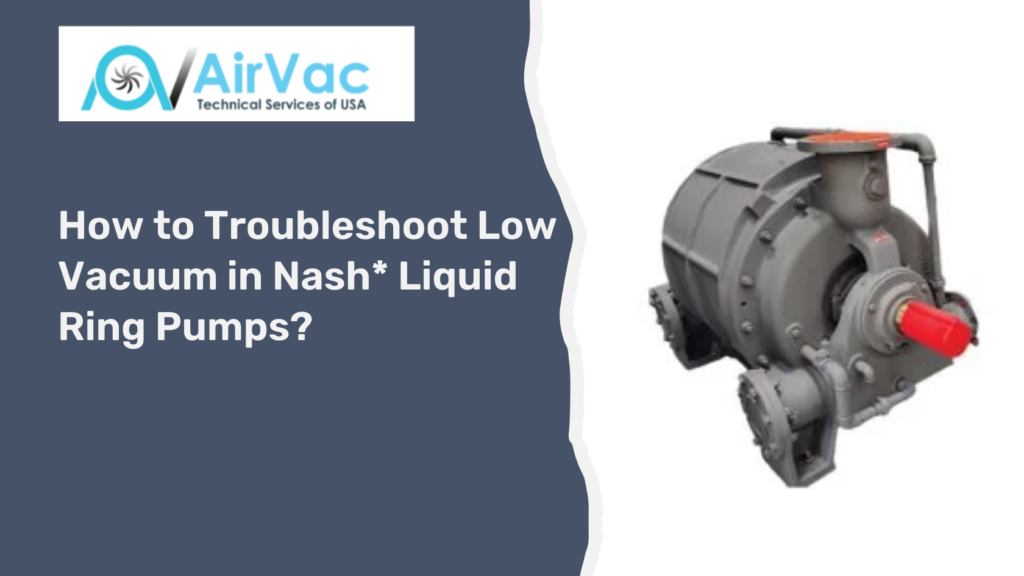
Low vacuum in a Nash liquid ring pump is most commonly caused by one of four issues: insufficient or overheated seal water, worn mechanical seals, air leaks in the system, or impeller wear. Start your diagnosis with seal water, it’s the fastest check and the most frequent root cause. This guide walks you through every major cause, a step-by-step diagnostic sequence, and the corrective actions that restore full vacuum performance.
A Nash liquid ring vacuum pump that’s losing vacuum doesn’t always announce the problem loudly. Sometimes performance drops gradually over weeks. Other times, you notice it when a process that used to run smoothly starts producing inconsistent results. Either way, diagnosing the root cause quickly before it escalates into a full pump failure saves time, money, and unplanned downtime.
Nash liquid ring pumps are workhorses in industries ranging from pulp and paper to food processing, chemical manufacturing, and power generation. According to the U.S. Department of Energy, vacuum system inefficiencies account for a significant share of avoidable energy losses in industrial facilities. A pump operating below its rated vacuum level doesn’t just degrade process performance; it wastes energy every hour it runs.
This guide covers the complete troubleshooting process for low vacuum in Nash liquid ring pumps: the most common causes, a prioritized diagnostic approach, corrective actions for each issue, and preventive steps to prevent recurrence.
How Does a Nash* Liquid Ring Pump Create a Vacuum?
Before you can diagnose what’s wrong, it helps to understand what’s supposed to happen. In a Nash liquid ring pump, an off-center impeller rotates inside a casing partially filled with seal water. The centrifugal force of the rotating impeller throws the water outward, forming a rotating liquid ring against the casing wall.
As the impeller rotates, the space between each impeller vane and the liquid ring alternately expands (drawing gas in from the suction port) and compresses (pushing gas out through the discharge port). The liquid ring acts as both the sealing medium and a continuous gas compressor.
Because the pump’s vacuum capacity depends directly on the liquid ring, anything that disrupts the ring, such as wrong water temperature, insufficient flow, air leaks, or worn components, immediately affects vacuum performance. This is why most low-vacuum diagnoses lead back to the seal water system.
What Causes Low Vacuum in Nash* Liquid Ring Pumps?
The table below organizes the most common causes by diagnostic priority start at the top and working your way down:
| Cause | Priority | Recommended Action |
| Worn or damaged mechanical seal | High | Replace seal; check seal flush system |
| Insufficient seal water flow | High | Check flow rate; clean or replace the strainer |
| Seal water temperature is too high | High | Reduce inlet temp to 59–68°F (15–20°C) |
| Air leak at pump casing or flanges | High | Pressure-test system; re-torque flanges |
| Worn or damaged impeller | Medium | Inspect for erosion/corrosion; replace if needed |
| Clogged or undersized discharge line | Medium | Clear blockage; verify pipe sizing |
| Incorrect pump rotation direction | Medium | Verify rotation matches nameplate arrow |
| Excessive system leaks downstream | Medium | Leak-test all valves, fittings, and connections |
| Low pump speed (belt/drive issue) | Low–Medium | Check belt tension, coupling, and motor speed |
| Worn end plates or cone sections | Low | Inspect clearances; replace worn components |
In most field cases, the first three causes seal water issues, and mechanical seal failure accounts for over 70% of low-vacuum complaints. Always start there before opening the pump.
Step-by-Step Diagnostic Process for Low Vacuum
Follow this sequence to systematically eliminate causes from most likely to least likely. Document your readings at each step. This data helps identify trends and supports future troubleshooting.
Step 1: Check Seal Water Flow and Temperature
Seal water is always the first thing to check. A Nash liquid ring pump cannot achieve its rated vacuum if the seal water is too warm or flowing at the wrong rate.
• Measure inlet water temperature: The target range is 59°F to 68°F (15°C to 20°C). Even a 10°F increase above this range can reduce maximum achievable vacuum by 20–30%.
• Verify flow rate: Compare actual flow against the OEM specification on the pump’s nameplate or manual. Low flow causes overheating; excessively high flow wastes energy without improving vacuum.
• Inspect the seal water strainer: A partially blocked strainer is a common culprit that’s easy to miss. Remove and clean it if the flow is below spec.
• Check the discharge temperature: If the outlet water is above 140°F (60°C), the seal water system is not removing heat effectively, increase the flow rate or improve cooling.
See the seawater parameter reference table below:
| Parameter | Target Range | Why It Matters |
| Inlet Temperature | 59°F – 68°F (15°C – 20°C) | Higher temperatures reduce vacuum capacity significantly |
| Flow Rate | Per OEM spec (typically 1–5 GPM) | Too little causes overheating; too much wastes energy |
| Water Quality | Clean, non-scaling, non-corrosive | Hard water causes scaling; aggressive water erodes components |
| Discharge Temperature | < 140°F (60°C) recommended | Excessive heat signals insufficient flow or cooling |
Step 2: Inspect for System Air Leaks
Air leaks are the second most common cause of low vacuum and can be deceptively small. Even a pinhole leak at a flange gasket or valve stem packing can bleed enough air into the system to prevent the pump from reaching its rated vacuum level.
- Isolate the pump from the process: Close isolation valves and cap open ports to separate the pump from the downstream system.
- Pressure test the system: Pressurize with dry nitrogen or clean compressed air to 5–10 psig and monitor for pressure drop over 5–10 minutes.
- Locate the leak: Apply soapy water to flanges, valve bodies, pipe fittings, and instrument connections. Bubbles indicate the leak source. Ultrasonic leak detectors provide a more precise location in noisy environments.
- Check valve seats and packing: Ball valves, gate valves, and control valves in the vacuum line are common leak points, especially on older systems.
Step 3: Verify Pump Rotation Direction
This is a quick check that’s easy to overlook, especially after any electrical work, motor replacement, or changes to the control panel. If the impeller rotates in the wrong direction, the pump produces very little vacuum and can be mistaken for a major mechanical failure.
- Look for the rotation arrow on the pump casing or nameplate.
- Bump-start the motor and observe the shaft rotation direction from the drive end.
- If rotation is reversed, swap any two of the three motor lead wires to correct the phase sequence.
Step 4: Check Pump Speed
Nash liquid ring pumps are designed to operate at a specific RPM. Running below the design speed reduces vacuum capacity in proportion. Causes of low speed include:
- Worn or slipping V-belts: Check belt tension and condition. Glazed or cracked belts slip under load, especially at startup.
- Coupling wear or misalignment: Direct-drive couplings can wear and allow shaft slippage. Verify coupling alignment with a dial indicator.
- Low motor voltage: Measure voltage at the motor terminals under load. Voltage drop below the nameplate rating reduces motor torque and speed.
- Variable frequency drive (VFD) settings: If the pump uses a VFD, confirm the frequency setpoint hasn’t been changed.
Step 5: Inspect the Mechanical Seal
If seal water, air leaks, rotation, and speed all check out, the mechanical seal is the next component to inspect. A worn or damaged mechanical seal allows air to bypass the seal and enter the pump casing, directly reducing vacuum performance.
- Look for visible water leakage at the seal faces even minor dripping indicates seal face wear.
- Check for seal water contamination (oil, debris, scale) that may have accelerated seal face wear.
- If the pump has been operating with insufficient seal water flow at any point, assume the seal has been damaged by dry running or thermal stress.
- For Nash pumps with a seal flush system, verify that flush ports are clear and delivering clean water to the seal faces.
Replacing a mechanical seal is a straightforward repair on most Nash pump models and is one of the most cost-effective ways to restore full vacuum performance. For guidance on seal types and sourcing, visit AirVac Technical Services.
Step 6: Inspect Internal Components: Impeller, End Plates, and Cone
If all external checks pass, it’s time to open the pump. Internal wear is a normal part of a liquid ring pump’s lifecycle, but it progresses slowly and is often overlooked until vacuum loss becomes severe.
- Impeller: Inspect vane surfaces for erosion, pitting, or corrosion. Measure the impeller diameter and compare it to the OEM spec. Wear beyond tolerance reduces the pump’s compression efficiency.
- End plates: Check the running clearance between the impeller face and end plate. Excessive clearance (beyond OEM tolerance) allows gas to bypass around the impeller, reducing vacuum.
- Cone sections: Inspect cone bores for wear and verify port geometry. Damaged or worn cone sections disrupt the gas flow path and reduce suction efficiency.
- Casing bore: Check for scale buildup from hard seal water. Heavy scale deposits reduce the effective bore diameter and disrupt liquid ring formation.
For model-specific clearance specs, refer to the Nash pump service manual for your series (CL, 2BH, TC, SC, or other). If you need assistance sourcing internal components or accessing service documentation, Nash pump parts and repair support are available for U.S.-based operations.
Is Your Discharge System Contributing to Low Vacuum?
Many troubleshooting processes focus entirely on the pump itself and miss problems in the discharge system. A restricted or undersized discharge line creates backpressure that limits the pump’s ability to draw a vacuum on the suction side.
- Check discharge line for blockages: Accumulated scale, debris, or a failed check valve can partially block the discharge path.
- Verify discharge pipe sizing: If the pump system has been modified since original installation, confirm that the discharge pipe diameter still matches the pump’s rated flow capacity.
- Inspect the discharge separator: Nash pumps typically use a water separator on the discharge side. A flooded or malfunctioning separator increases back-pressure and reduces vacuum performance.
- Check the vent valve on the separator: An improperly adjusted or stuck vent valve can trap gas in the separator, raising discharge pressure.
Could the Process Load Be the Problem?
Sometimes what looks like a pump problem is actually a process problem. If the gas load entering the pump has increased significantly due to a process change, a failed upstream valve, or a new leak in the process system, the pump may simply be working beyond its rated capacity.
- Compare current suction flow rates to the pump’s original design specification.
- Check for any recent process changes that might have increased gas ingestion in new connections, larger vessels, and additional vacuum draws.
- Measure suction pressure and compare against the pump’s performance curve for the current seal water temperature.
- If gas load has genuinely increased, the correct solution may be pump upsizing or adding a second pump in parallel, not repairing the existing unit.
The Hydraulic Institute provides pump selection and system analysis resources that can help engineers evaluate whether an existing pump is appropriately sized for a modified process load.
Why You Should Track Vacuum Performance Over Time
One of the most effective tools for Nash pump maintenance is a simple performance log, a written or digital record of vacuum readings, seal water temperatures, and flow rates taken at regular intervals.
A gradual decline in vacuum over 3–6 months typically indicates slow internal wear (impeller erosion or end plate wear), whereas a sudden drop usually signals an acute event, such as a seal failure, an air leak, or a change in rotation.
Recommended tracking intervals:
- Weekly: Record suction vacuum level at steady-state operating conditions
- Monthly: Log seal water temperature, inlet flow rate, and discharge temperature
- Quarterly: Inspect the mechanical seal for leakage; check the belt tension or coupling condition
- Annually: Full inspection including impeller clearances, end plate condition, and system leak test
A U.S. Department of Energy O&M Best Practices Guide recommends condition-based maintenance tracking for rotating equipment as a core strategy to reduce unplanned downtime and extend asset life.
When Should You Call a Certified Nash* Pump Specialist?
Not every low-vacuum issue requires professional intervention, but some do. Call a qualified Nash pump service provider when:
- The pump requires disassembly for internal inspection, and you don’t have certified technicians or the right tooling on-site
- Vacuum performance hasn’t recovered after addressing all external checks
- The pump is running louder or vibrating more than normal, indicating potential bearing or impeller damage
- You’re dealing with a critical process pump where unplanned extended downtime is not acceptable
- The pump model is older or discontinued, and sourcing the right parts requires specialist knowledge
- You need performance testing against the original pump curve to determine whether repair or replacement is the better economic decision
Frequently Asked Questions: Nash* Pump Low Vacuum Troubleshooting
These questions and answers are structured for quick reference and designed to support eligibility for featured snippets and AI overviews.
What causes low vacuum in a Nash* liquid ring pump?
The most common causes are worn mechanical seals, insufficient or overheated seal water, air leaks in the system, impeller wear, incorrect pump rotation, and clogged discharge lines. Start by checking the seal water flow rate and temperature before moving to internal components.
How do I check if my Nash* pump has an air leak?
Isolate the pump from the system and perform a pressure test using dry nitrogen or clean compressed air. Pressurize the system to a low safe level (typically 5–10 psig) and monitor for pressure drop. Soap solution or ultrasonic leak detectors help locate the exact leak point at flanges, valve stems, and fittings.
What is the correct seal water temperature for a Nash* liquid ring pump?
The recommended inlet seal water temperature is 59°F to 68°F (15°C to 20°C). Temperatures above this range reduce the pump’s vacuum capacity because the liquid ring becomes less dense and vapor pressure increases, reducing the effective compression ratio.
How often should Nash* pump mechanical seals be replaced?
Mechanical seals on Nash liquid ring pumps typically last 1–3 years under normal operating conditions. Premature failure is often caused by dry running, cavitation, contaminated seal water, or misalignment. Inspect seals during every scheduled maintenance interval and replace at the first sign of leakage.
Can I troubleshoot a Nash pump myself, or do I need a specialist?
Many common causes of low vacuum, including seal water issues, system leaks, and rotation direction, can be diagnosed and corrected by a trained maintenance technician without specialized tools. However, internal repairs such as impeller replacement, end plate refacing, or cone section work typically require disassembly of the pump by a qualified service professional.
What vacuum level should a Nash* liquid ring pump achieve?
Nash liquid ring pumps are designed to achieve vacuum levels down to approximately 25 mmHg absolute (about 29 inches Hg) under optimal conditions, depending on the model and seal water temperature. Performance degrades as seal water temperature rises to 77°F (25°C), and maximum vacuum is typically limited to around 50 mmHg absolute.
How do I know if my Nash* pump impeller needs replacement?
Signs of impeller wear include gradual vacuum performance loss over time, increased noise or vibration, visible erosion or pitting on impeller vanes during inspection, and reduced flow capacity. If the pump has operated for more than 5–8 years in a corrosive or abrasive service, inspect the impeller during the next scheduled maintenance.
What preventive maintenance steps reduce Nash* pump vacuum problems?
Key preventive steps include monthly seal water quality and flow checks, quarterly inspection of mechanical seals for leakage, annual impeller and end plate inspection, regular verification of pump rotation direction after any electrical work, system leak testing every 6–12 months, and maintaining a log of vacuum readings over time to track gradual performance trends.
Get Your Nash* Pump Back to Full Vacuum Performance
Low vacuum in a Nash liquid ring pump is almost always fixable, and in most cases, the solution doesn’t require major disassembly or expensive parts. Start with the fundamentals: seal water temperature and flow, system air leaks, rotation direction, and pump speed. In most field cases, one of these four checks will identify the problem.
When the diagnosis points to internal wear, methodical inspection of the mechanical seal, impeller, end plates, and cone sections will reveal what needs to be addressed. Keep a performance log, follow a preventive maintenance schedule, and document your corrective actions. This data makes future troubleshooting faster and more accurate.
If your troubleshooting leads to parts replacement, repair, or expert technical support, Airvac Technical Services provides Nash vacuum pump parts, repair services, and hands-on technical guidance for industrial operations across the United States. Whether you need a mechanical seal, an impeller, or a second opinion from an experienced Nash pump technician, their team is available to help you restore performance and minimize downtime.