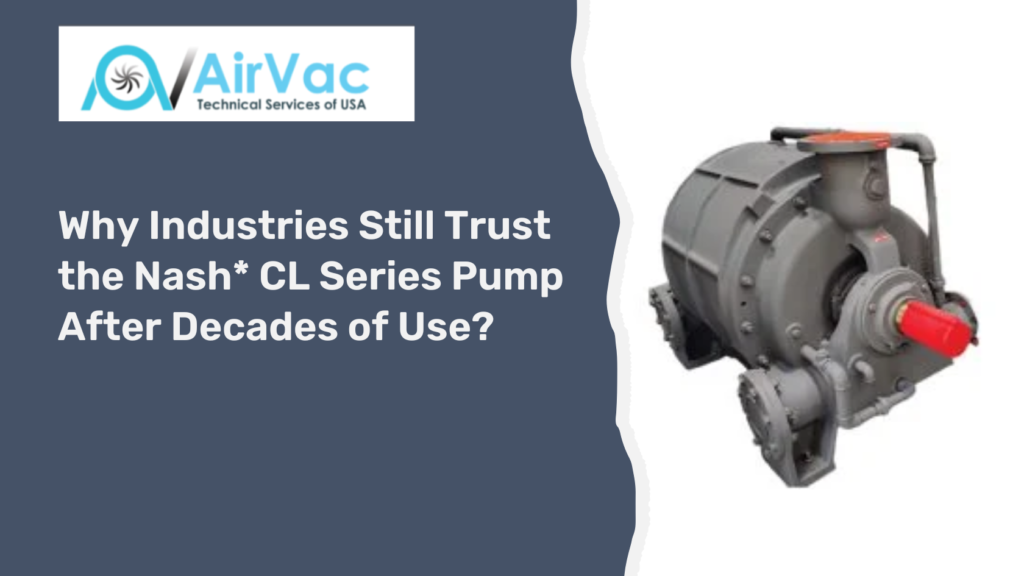
Industrial plants depend on equipment that runs day in and day out without failure. When a pump stops, production slows or stops altogether. That is why many industries continue to rely on machines that have proven their value over time. One of the strongest examples is the Nash CL Series pump.
The Nash CL Series pump has been in service for decades across heavy industries. Many units installed in the 1980s and 1990s still operate today. Others have been rebuilt and returned to service with strong results. This extended service life is not a coincidence. It is the result of solid design, simple engineering, and real-world performance.
This article explains why industries still trust the Nash CL Series pump. It covers how the pump works, where it is used, how long it lasts, and what makes it different from newer designs. The goal is to give engineers, plant managers, and maintenance teams clear, trustworthy facts.
What Is the Nash* CL Series Pump?
The Nash CL Series pump is a liquid ring vacuum pump. It uses water as a sealing fluid to create a vacuum. This design allows the pump to handle wet gases, vapors, and small amounts of liquid carryover.
Unlike dry vacuum pumps, a liquid ring pump does not rely on tight internal clearances. The water ring absorbs heat and protects internal parts. This makes the pump stable and forgiving in harsh conditions.
Key design features include
- Heavy cast iron casing
- Simple internal layout
- Low operating speed
- Strong shaft and bearing design
- Easy access for maintenance
These features support long service life and stable performance.
Why the Nash* CL Series Pump Is Still Trusted Today?
Proven Reliability in Harsh Conditions
Industrial environments are not clean. Pumps face dust, moisture, heat, and process gases every day. The Nash CL Series pump was built for these conditions.
The thick casing resists distortion and vibration. The liquid ring design allows the pump to handle saturated gases without damage. This makes it ideal for plants that require moisture.
According to data from the Hydraulic Institute, liquid ring vacuum pumps are among the most tolerant designs for wet gas applications. This tolerance reduces failure risk and extends service life.
Stable Vacuum Performance Over Time
Many processes need steady vacuum levels. Sudden changes can affect product quality or system safety.
The Nash CL Series pump delivers a stable vacuum because
- The liquid ring smooths pressure changes
- The seawater absorbs heat
- Wear has less impact on performance
Even as internal parts wear slowly, the pump continues to operate. This gives maintenance teams time to plan service rather than react to failures.
Simple Mechanical Design
Modern equipment often includes complex controls and high-speed parts. While these designs can offer efficiency gains, they also increase the number of failure points.
The Nash CL Series pump uses a simple mechanical layout. Fewer moving parts mean fewer things can fail. Technicians can inspect and service the pump without special tools or software.
This simplicity lowers training needs and supports long-term use.
Designed for Rebuilding
One of the biggest reasons the Nash CL Series pump lasts so long is rebuildability.
The pump can be fully disassembled. Worn parts can be repaired or replaced. Clearances can be restored. After rebuilding, the pump often performs close to original levels.
Many plants rebuild CL pumps every 10000 to 20000 operating hours. With proper care, a single pump casing can last several decades.
Typical Service Life of the Nash* CL Series Pump
The service life of a pump depends on operating conditions, maintenance, and process demands. However, the Nash CL Series pump demonstrates greater longevity than many alternatives.
Typical lifespan data
| Condition | Average Service Life |
| Original installation | 20 to 30 years |
| With scheduled rebuilds | 30 to 40 years or more |
| Harsh process conditions | 15 to 25 years |
These figures are based on industry case studies and field reports from paper mills, chemical plants, and power stations.
Industries That Rely on the Nash* CL Series Pump
Paper and Pulp Industry
Paper mills use a vacuum for dewatering and sheet forming. These processes involve warm, wet air with fiber carryover.
The Nash CL Series pump handles this environment well. Its liquid ring design prevents damage from moisture and contaminants. Many mills still run CL pumps installed decades ago.
Chemical Processing
Chemical plants use vacuum for filtration, distillation, and vapor recovery. These processes often involve corrosive gases.
The robust casing and stable operation of the CL pump make it a trusted choice. Proper material selection and seal water control improve durability.
Food and Beverage Processing
Food plants use a vacuum for packaging, conveying, and dehydration: clean operation and reliability matter.
The Nash CL Series pump provides a steady vacuum and handles washdown conditions well. With proper maintenance, it supports food-grade processes.
Power Generation
Power plants use vacuum pumps to remove condenser air. These systems must run continuously.
The CL pump delivers consistent performance with low risk of sudden failure. This reliability helps protect turbine efficiency and plant output.
Mining and Metals
Mining operations expose equipment to dust, heat, and fluctuating loads. The CL pump withstands these challenges and supports gas handling systems.
Comparison With Other Vacuum Pump Types
To understand why the CL Series remains popular, it helps to compare it with other standard pump designs.
| Feature | Nash CL Series | Dry Screw Pump | Rotary Vane Pump |
| Handles wet gas | Yes | Limited | Poor |
| Tolerance to dirt | High | Medium | Low |
| Rebuildable | Yes | Limited | Limited |
| Typical lifespan | Very long | Medium | Short to medium |
| Maintenance skill | Moderate | High | Low |
This comparison shows why many plants keep CL pumps in service even when newer options exist.
Maintenance Practices That Extend CL Pump Life
Seal Water Control
Seal water flow and temperature affect the vacuum level and internal wear. Operators should monitor these values daily.
Ideal practices include
- Maintain stable water temperature
- Ensure a clean water supply
- Avoid scale buildup
Vibration and Noise Monitoring
Changes in sound or vibration often signal bearing wear or imbalance. Early detection prevents significant damage.
Plants that use vibration monitoring often extend pump life by several years.
Regular Internal Inspections
During planned shutdowns, technicians should inspect
- Impeller surfaces
- Shaft condition
- Bearing wear
- Casing erosion
Minor repairs during inspections reduce rebuild cost later.
Planned Rebuild Schedule
Rebuilding before failure protects the casing and core parts. Planned rebuilds also reduce downtime and emergency repair costs.
Efficiency of Older CL Pumps
A common question is whether older CL pumps remain efficient.
The answer depends on the condition and maintenance. A well-maintained and rebuilt CL pump can operate at efficiency levels close to its original design.
According to studies published by the US Department of Energy, liquid ring vacuum pumps maintain stable efficiency when seal water systems are optimized and internal clearances are restored during rebuilds.
This means older pumps can still support modern production needs.
When Replacement Makes Sense
While rebuilding is often effective, replacement may be the right choice in some cases.
Replacement should be considered when
- The casing has severe erosion
- Capacity needs have changed
- Energy efficiency targets require upgrades
- Spare parts are no longer practical
In these cases, a drop in compatible replacement pumps enables plants to upgrade without redesigning the system.
Frequently Asked Questions
What is the Nash* CL Series pump used for?
It is used for industrial vacuum applications, including dewatering, filtration, vapor recovery, and condenser air removal.
Why are Nash* CL pumps considered reliable?
They use a liquid ring design, heavy construction, and simple mechanics. This reduces wear and failure risk.
How long does a Nash CL* Series pump last?
Many pumps operate for 20 to 40 years with proper maintenance and rebuilds.
Can old Nash* CL pumps still be rebuilt?
Yes. Most CL pumps are designed for complete rebuilds. This restores performance and extends service life.
Are Nash* CL pumps still supported today?
Yes. Rebuild services, spare parts, and compatible replacement models remain available through specialized service providers.
Final Thoughts
The Nash CL Series pump remains trusted because it works. Its design focuses on durability, stability, and serviceability. These qualities matter more than novelty in industrial environments.
Plants that maintain and rebuild these pumps often see decades of reliable service. This reduces total ownership cost and supports production uptime.
For facilities that operate or plan to support legacy CL pumps, working with an experienced specialist ensures long-term success. The last step is choosing the right partner, and many plants rely on Airvac Technical Services for rebuilds, parts, and compatible replacement solutions.