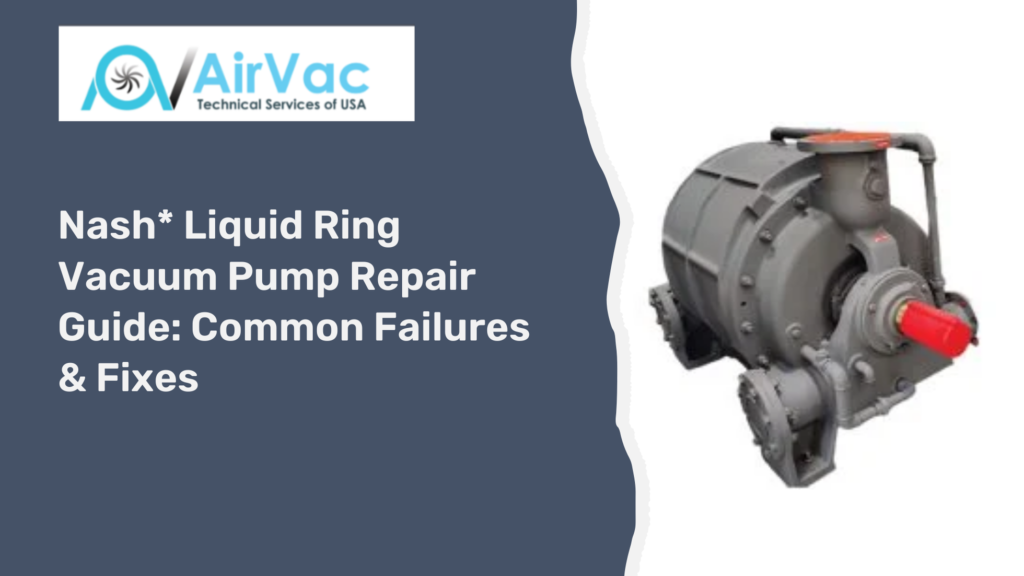
Liquid ring vacuum pumps are mission-critical assets in many industrial operations. Paper mills depend on them for dewatering and pulp processing. Chemical and pharmaceutical plants use them for filtration, vapor recovery, and distillation. Food processing facilities rely on stable vacuum levels for packaging and drying. Power stations use them to remove condenser air. Hospitals and medical facilities depend on them for central vacuum systems. When a Nash liquid ring vacuum pump fails, the impact is immediate. Production slows down. Product quality may suffer. Energy use increases. In some cases, operations must stop completely. Unplanned downtime raises maintenance costs and puts pressure on plant teams to restore performance quickly.
This guide provides a detailed and practical overview of Nash Liquid Ring Vacuum Pump Repair for maintenance managers, reliability engineers, and plant supervisors. It covers the most common liquid ring vacuum pump failures, including low vacuum performance, bearing damage, seal leakage, vibration issues, and internal corrosion. You will learn the root causes behind these problems, along with clear troubleshooting steps and proven repair solutions. The guide also explains when a minor repair is enough and when a full rebuild is the better option. In addition, it outlines preventive maintenance strategies that help extend pump life, improve vacuum efficiency, and reduce total operating cost. The objective is clear. Help industrial teams quickly restore vacuum performance, prevent repeat failures, and keep critical systems running safely and efficiently.
How a Nash* Liquid Ring Vacuum Pump Works?
A liquid ring vacuum pump uses a rotating impeller inside a partially filled casing. Water or another compatible liquid forms a rotating ring inside the housing.
As the impeller turns:
- Gas enters through the suction port
- Cavities between blades trap the gas
- Gas compresses as cavity volume decreases
- Compressed gas exits through the discharge port
There is no metal-to-metal contact under normal operation. This design makes the pump durable and suitable for wet or dirty gases.
However, performance depends on:
- Proper internal clearances
- Stable seal water temperature
- Correct alignment
- Healthy bearings
- Clean suction piping.
Even small deviations can reduce the vacuum level and efficiency.
According to the U.S. Department of Energy, poorly maintained pump systems can waste up to 30 percent of energy in industrial facilities. Proper maintenance improves reliability and reduces operating costs.
Why Nash* Liquid Ring Pumps Fail?
Nash vacuum pumps are known for long service life. Many units operate for decades. Most failures are not design flaws. They result from operating conditions or maintenance gaps.
Common failure categories include:
- Mechanical wear
- Hydraulic performance loss
- Seal water problems
- Bearing and lubrication issues
- Corrosion and erosion
The Hydraulic Institute notes that more than half of pump failures in industry are linked to maintenance or operating conditions rather than equipment design.
Understanding the root cause prevents repeat repairs.
Common Nash* Liquid Ring Vacuum Pump Failures
Low Vacuum or Reduced Performance
Low vacuum is one of the most common service calls.
Symptoms
- The pump cannot reach the design vacuum
- Process cycle time increases
- Higher power consumption
- The vacuum gauge fluctuates
Root Causes
- High seal water temperature
- Worn internal clearances
- Air leaks in suction piping
- Blocked suction strainer
- Damaged impeller blades
Seal water temperature plays a major role. As water temperature rises, the achievable vacuum level drops.
Fix
- Reduce seal water temperature
- Inspect and replace wear plates
- Repair suction leaks
- Check the impeller condition
- Confirm the correct pump speed
If clearances exceed limits, a complete Nash Liquid Ring Vacuum Pump Repair and rebuild is required.
Excessive Vibration
Vibration often signals mechanical trouble.
Symptoms
- High vibration readings
- Loud noise
- Premature bearing wear
- Shaft seal leakage
Root Causes
- Shaft misalignment
- Bent shaft
- Impeller imbalance
- Bearing failure
- Cavitation
Cavitation occurs when vapor bubbles collapse inside the pump. This can damage internal surfaces.
The Occupational Safety and Health Administration warns that excessive vibration increases the risk of equipment failure and workplace hazards.
Fix
- Perform laser alignment
- Balance impeller
- Replace worn bearings
- Check shaft runout
- Improve seal water flow
Bearing Failure
Bearings support the rotating shaft. When they fail, the pump can suffer major damage.
Symptoms
- High bearing temperature
- Grinding noise
- Shaft movement
- Grease leakage
Causes
- Poor lubrication
- Contamination
- Misalignment
- Overloading
Repair Steps
- Lock out electrical supply
- Remove coupling
- Remove bearing housing
- Press out damaged bearings
- Install new bearings to correct tolerance
- Reassemble and align
Always inspect shaft condition before reinstalling bearings.
Seal Leakage
Seal failure can lead to water loss and system contamination.
Symptoms
- Water leaking at shaft
- Reduced seal water pressure
- Visible spray around seal area
Causes
- Worn mechanical seal
- Shaft sleeve wear
- Excessive shaft runout
- Improper installation
Fix
- Replace the seal kit
- Inspect and replace the shaft sleeve if needed
- Verify alignment
- Confirm proper flush pressure
Improper seal installation is a frequent cause of repeat leaks.
Internal Corrosion and Erosion
Many Nash pumps operate in chemical and food processing plants where gases may contain corrosive compounds.
Signs
- Pitting inside casing
- Thinning impeller blades
- Reduced vacuum performance
Solutions
- Stainless steel internal components
- Protective coatings
- Improved water chemistry
The Environmental Protection Agency provides guidance on water treatment to reduce scaling and corrosion.
Failure Summary Table
| Failure Type | Main Cause | Immediate Action | Long-Term Solution |
| Low Vacuum | High seal water temp | Cool water | Full rebuild |
| Vibration | Misalignment | Realign | Bearing replacement |
| Bearing Failure | Poor lubrication | Replace bearings | Improve maintenance |
| Seal Leak | Worn seal | Install new seal | Check shaft runout |
| Corrosion | Chemical exposure | Minor repair | Stainless rebuild |
Step-by-Step Nash* Liquid Ring Vacuum Pump Repair Process
When damage exceeds minor repairs, a full rebuild is required.
Pre Inspection
Before disassembly:
- Record the vacuum level
- Measure motor amperage
- Check vibration readings
- Measure the seal water temperature
This baseline data helps confirm post-repair performance.
Disassembly
- Remove the coupling guard
- Disconnect coupling
- Drain seal liquid
- Remove end plates
- Extract impeller
Use proper lifting tools for larger CL and XL models.
Dimensional Inspection
Critical checks include:
- Impeller diameter
- Casing bore condition
- Wear plate thickness
- Shaft straightness
Excess clearance reduces efficiency and increases power draw.
Machining and Restoration
Common repair actions:
- Resurface wear plates
- Re sleeve shaft
- Machine casing bore
- Balance impeller
Precision machining restores factory tolerances.
Reassembly
- Install new bearings
- Install new seals
- Set correct internal clearances
- Torque bolts to specification
Proper alignment is essential before startup.
Performance Testing
After rebuild, test for:
- Design vacuum level
- Flow rate
- Motor amperage
- Vibration levels
Performance should match original manufacturer standards.
Preventive Maintenance Best Practices
Preventive maintenance reduces emergency breakdowns.
Weekly Checks
- Inspect for leaks
- Monitor seal water temperature
- Listen for abnormal noise
Monthly Checks
- Check alignment
- Inspect coupling
- Measure vibration
Quarterly Checks
- Inspect suction strainers
- Verify discharge pressure
- Check bearing condition
Industry data shows preventive maintenance can reduce unexpected downtime by up to 30 percent.
Rebuild Versus Replacement Decision Guide
Plant managers often ask whether to rebuild or replace.
Choose Rebuild When
- Casing is structurally sound
- The shaft is reusable
- Damage is moderate
- Downtime can be scheduled
Choose Replacement When
- Severe corrosion exists
- The casing is cracked
- An efficiency upgrade is required
- Rebuild cost exceeds 60 percent of the new unit cost
Drop-in compatible replacement pumps reduce installation time and minimize production interruption.
Cost Comparison Overview
| Option | Relative Cost | Downtime | Long Term Value |
| Minor Repair | Low | Short | Temporary |
| Full Rebuild | Medium | Moderate | High |
| OEM Replacement | High | Long lead time | High |
| Compatible Replacement | Medium | Short | High |
Rebuilding often saves up to 40 percent compared to full OEM replacement.
Quick Troubleshooting Guide
If pump does not start:
- Check power supply
- Inspect overload protection
- Examine coupling
If pump overheats:
- Check seal water flow
- Inspect bearing lubrication
- Verify discharge pressure
If pump draws high amperage:
- Inspect for internal rubbing
- Check alignment
- Confirm system load
Frequently Asked Questions
What causes low vacuum in a Nash* liquid ring pump?
High seal water temperature, worn clearances, and suction air leaks are the most common causes.
How often should a Nash* pump be rebuilt?
Most industrial pumps require a major rebuild every five to eight years, depending on service conditions.
Can an impeller be repaired?
Yes. Impellers can be machined, welded, or replaced depending on the severity of damage.
What is the ideal seal water temperature?
Typically, between 60 and 80 degrees Fahrenheit for optimal performance.
Is rebuilding more cost-effective than replacement?
In most cases, yes. If structural components are intact, rebuilding provides strong value and long service life.
Final Thoughts on Reliable Nash* Pump Repair
Liquid ring vacuum pumps are built for durability. Most failures result from heat, wear, water quality issues, or misalignment. A structured Nash Liquid Ring Vacuum Pump Repair process restores performance and extends equipment life.
Regular inspection, preventive maintenance, and accurate rebuild practices reduce downtime and control costs. Plants that act early prevent major damage and unexpected shutdowns.
For industrial facilities operating Nash CL, SC, 904, or XL series pumps, experienced technical support makes the difference between repeated failures and long-term reliability. Airvac Technical Services specializes in rebuilds, compatible replacements, and spare parts support backed by more than two decades of focused experience.