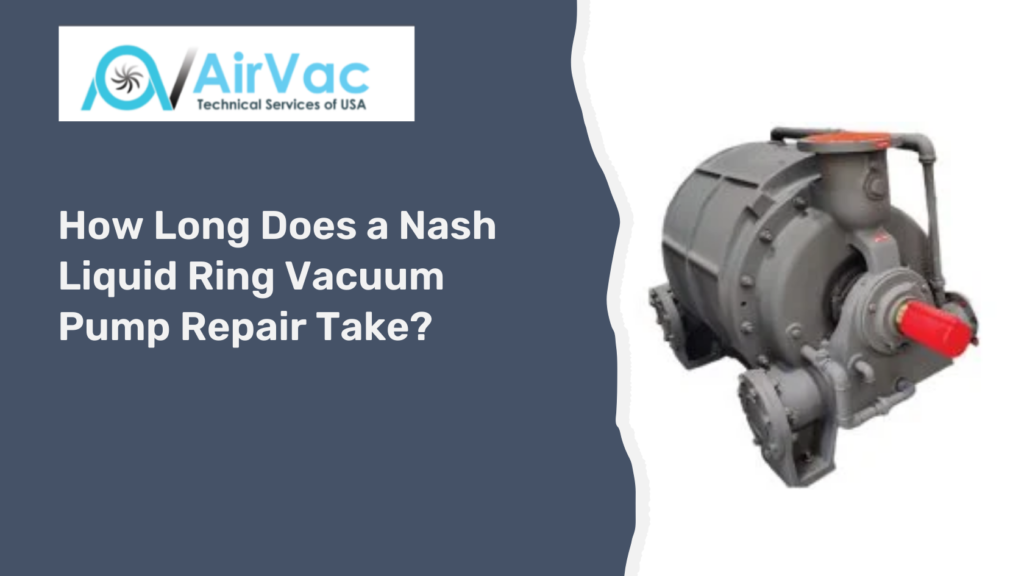
When a Nash liquid ring vacuum pump fails, the first question most plant managers and maintenance engineers ask is simple: how long will this take to fix? The honest answer is that repair time depends on several factors, including the type of fault, the pump model, parts availability, and whether the work happens in-house or at a specialist service center. In general, minor Nash vacuum pump repairs take 1 to 3 days. Standard overhauls take 3 to 7 days. Major repairs involving casing work, shaft restoration, or hard-to-source parts can take 2 to 4 weeks or longer. This guide breaks down every repair scenario with realistic timelines so you can plan maintenance schedules, manage downtime budgets, and set accurate expectations with your operations team.
Why Repair Time Matters for Industrial Operations
Vacuum pump downtime is not just a maintenance headache. It has a direct impact on production output, product quality, and revenue.
In industries such as paper and pulp, food processing, and pharmaceuticals, a single vacuum pump can support multiple critical process lines. According to the U.S. Department of Energy, unplanned equipment downtime costs industrial manufacturers an estimated $50 billion per year across all sectors. Even a 24-hour repair delay on a critical pump can translate to thousands of dollars in lost production.
That is why knowing the realistic repair timeline for your Nash liquid ring vacuum pump is so valuable. It lets you make better decisions about repair versus replacement, in-house work versus outsourcing, and whether to carry strategic spare parts in your storeroom.
Factors That Affect Nash Liquid Ring Vacuum Pump Repair Time
No two pump repairs are exactly alike. Here are the main variables that drive how long a Nash pump repair actually takes:
Type and severity of the fault. A simple mechanical seal replacement takes far less time than a pump that has suffered impeller damage from cavitation or a cracked casing from water hammer. The fault type sets the floor for minimum repair time.
Pump model and size. Nash manufactures several product lines, including the CL, SC, and 2BE series, as well as older Nash Hytor designs. Larger pumps have more components, heavier parts, and tighter tolerances. A Nash CL-4003 will take longer to disassemble and reassemble than a CL-1001.
Parts availability. This is the single biggest variable in repair time. Standard consumable parts like O-rings, gaskets, and bearings are usually available from stock. However, Nash impellers, cone port plates, and specialized shaft seal assemblies may need to be ordered from Flowserve’s Nash supply chain. Lead times for these parts range from a few days to 8 weeks, depending on the model and current stock levels.
In-house versus third-party repair. Qualified in-house maintenance teams can start work immediately. Sending the pump to an external repair center adds transport time on both ends, typically 1 to 5 days each way, depending on location and pump size.
Workshop backlog. External service centers operate on a queue-based scheduling system. A busy period at the repair shop can add days or weeks to your timeline before work even begins.
Condition-based findings. Teardown often reveals damage that was not visible during the fault diagnosis. Secondary damage, such as worn shaft journals, corroded casing walls, or damaged port plates, can significantly extend the repair scope and timeline.
Nash Liquid Ring Vacuum Pump Repair Time by Repair Type
The table below gives a practical overview of repair timelines by job type. These figures assume parts are available or on short lead time and that the technician has access to the correct Nash service documentation.
| Repair Type | Estimated Repair Time | Key Variables |
| Mechanical seal replacement | 4 to 16 hours | Seal type, access difficulty |
| Bearing replacement (both ends) | 8 to 24 hours | Bearing fit, shaft condition |
| Minor seal and bearing overhaul | 1 to 3 days | Parts on hand, inspection findings |
| Standard full overhaul (kit rebuild) | 3 to 7 days | Impeller and port plate condition |
| Impeller replacement | 2 to 5 days | Availability, balancing required |
| Shaft restoration (journal build-up) | 5 to 10 days | Weld repair, grinding, re-measurement |
| Casing repair (pitting or crack repair) | 5 to 14 days | Severity, cure time for repair compounds |
| Major overhaul with casing replacement | 2 to 4 weeks | Parts lead time, reassembly testing |
| Emergency rush repair (minor fault) | Same day to 24 hours | Technician availability, parts on hand |
Minor Repairs: What Gets Done in Under 3 Days
Minor Nash vacuum pump repairs cover faults that do not require full disassembly of the rotor assembly. These jobs can often be completed within a standard working day or over two to three shifts.
Mechanical seal replacement is the most common minor repair on Nash liquid ring pumps. The shaft seal is a wear item. It sees continuous contact, heat, and exposure to the sealant water. A worn or damaged mechanical seal typically shows itself as visible leakage at the pump shaft. Seal replacement involves removing the bearing housing on the seal side, extracting the old seal assembly, cleaning the seal housing bore, and fitting the new seal with correct spring compression and face alignment. An experienced technician completes this in 4 to 8 hours on most Nash CL and SC series pumps. Allow additional time for larger pumps or those with hard-to-access seal housings.
Bearing replacement on one or both ends is another common short-duration repair. Bearings that show elevated temperature, unusual noise, or visible wear on inspection get replaced without a full pump teardown. This job typically takes 8 to 24 hours, depending on bearing fit and whether the shaft journals need cleaning or polishing.
Coupling inspection and replacement are quick jobs that maintenance teams sometimes overlook when diagnosing vibration or misalignment issues. Replacing a worn flexible coupling element takes 2 to 4 hours, including post-replacement alignment checks.
Sealant water system service, which includes cleaning strainers, flushing scale from sealant supply lines, and replacing flow control valves, typically takes half a day and often restores pump vacuum performance without any internal work on the pump itself.
Standard Overhaul: 3 to 7 Days
A standard Nash liquid ring vacuum pump overhaul is the most common planned maintenance job. It involves full disassembly, inspection, replacement of all wear items from a rebuild kit, reassembly, and performance testing.
The main tasks in a standard overhaul include:
- Full pump disassembly and component cleaning
- Inspection of casing, impeller, shaft, port plates, and bearings
- Replacement of all gaskets, O-rings, and shaft seals
- Replacement of both bearings
- Impeller cleaning, inspection, and re-fit (or replacement if worn beyond limits)
- Reassembly with correct torques and clearances
- Shaft alignment to motor
- Commissioning and performance verification
A standard overhaul on a medium-sized Nash pump like a CL-1503 or CL-2002 takes 3 to 5 days for a skilled two-person team. Larger pumps like the CL-4003 or 2BE series units take 5 to 7 days. The timeline can stretch to 10 days if impeller replacement is needed and the part is not in stock.
One factor that catches many facilities off guard is inspection-based scope creep. During teardown, the technician may find a worn impeller that was not part of the original repair plan. This discovery adds time for parts procurement and extended labor to the job. Building a 20% time buffer into your planned overhaul schedule is a sensible practice.
Major Repairs: 2 to 4 Weeks and Why They Take That Long
Some Nash pump faults require more than a standard rebuild. Major repairs involve work that goes beyond replacing consumable parts. They include restoring or replacing the pump’s structural components.
Shaft restoration is needed when bearing journal wear, corrosion pitting, or a previous overheating event has reduced the shaft diameter below tolerance. The repair process involves cleaning the shaft, applying a weld overlay or thermal spray coating to the worn areas, and then precision grinding back to the specified diameter and surface finish. This work requires specialized equipment and takes 3 to 7 days for the metalwork alone, not including the time to remove and reinstall the shaft in the pump.
Casing repair is required when the pump casing shows wall thinning from cavitation erosion, pitting from corrosive process fluids, or cracking from water hammer or freezing damage. Minor pitting can be repaired with approved epoxy-based repair systems such as Belzona or Devcon. These materials require careful surface preparation, mixing, application, and cure time. Full cure at room temperature takes 24 to 72 hours , depending on the product used. More severe damage may require metal fabrication or casing replacement, which adds significant time and cost.
Impeller replacement with balancing is needed when impeller blade erosion goes beyond serviceable limits. A new impeller fitted to the shaft must be dynamically balanced before installation. Balancing adds 1 to 2 days to the repair timeline but is non-negotiable for pumps that need to run at reduced vibration levels and extended bearing life.
Casing replacement, the most time-intensive repair scenario, involves sourcing a new casing, often from Flowserve’s Nash parts supply chain, machining mating faces if needed, and rebuilding the entire pump into the new casing. Lead time for a replacement casing ranges from 2 to 8 weeks, depending on the pump model and Flowserve’s current stock levels.
Emergency Repairs: Getting Back Online Fast
Unplanned failures demand a different approach. When a Nash vacuum pump goes down without warnin,g and the process cannot continue without it, emergency repair protocols kick in.
For minor faults like seal failure or bearing seizure, a competent in-house team with spare parts on hand can often return the pump to service within the same working day or within 24 hours. This assumes the required repair kit is available in your maintenance stores.
For faults that require external specialist support, emergency response times from Nash-qualified service providers range from 4 to 24 hours for a technician to arrive on site. Remote locations or complex pump configurations can extend this.
Here are the most effective ways to reduce emergency Nash pump repair time:
Keep a strategic spare parts kit on-site. At minimum, this should include a full Nash rebuild kit for your pump model, a spare mechanical seal assembly, and both bearing sets. The cost of holding these parts is far less than the cost of waiting for parts delivery during an emergency.
Maintain up-to-date service records. Knowing the last repair date, the parts used, and the clearances measured speeds up fault diagnosis and helps the technician estimate the repair scope before they even start turning wrenches.
Have a service agreement in place. Pre-arranged service agreements with a Nash-qualified repair provider give your facility priority scheduling during breakdowns. Without one, you join the general repair queue, which can mean waiting days before work starts.
Keep a standby or spare pump where possible. For critical process lines, a standby Nash pump in ready-to-run condition is the most reliable insurance against extended downtime. Many facilities run a duty-standby configuration precisely for this reason.
In-House Repair vs. Sending to a Service Center
One of the key decisions you face when a Nash pump needs repair is whether to fix it in-house or send it out. Both approaches have merits and real-world limitations.
| Factor | In-House Repair | Service Center Repair |
| Mobilization time | Immediate | 1 to 5 days transport each way |
| Specialist tooling availability | Often limited | Fully equipped |
| Technician expertise | Varies by team | Pump-specific specialists |
| Parts access | Depends on stores | Usually faster sourcing |
| Quality assurance and warranty | Self-managed | Often included |
| Cost | Lower labor cost | Higher but all-inclusive |
| Best suited for | Minor repairs, emergency response | Standard overhauls, major repairs |
The right choice depends on your team’s skill level, your storeroom inventory, and the complexity of the fault. Many facilities use a hybrid approach: in-house teams handle minor repairs and emergency first response, while planned overhauls and major work are handled by an approved service center.
How to Reduce Nash Vacuum Pump Repair Time?
Reducing repair time starts well before a pump ever fails. Proactive maintenance practices and good planning cut hours, sometimes days, off your repair timeline.
Run a predictive maintenance program. Vibration analysis, oil analysis (if the pump has oil-lubricated bearings), and regular vacuum performance trending all give early warning of developing faults. Catching a bearing problem at the rough running stage takes far less time to fix than waiting until the bearing seizes and damages the shaft.
Standardize your Nash pump fleet where possible. If your facility runs several Nash pumps, specifying the same model series across applications lets you consolidate spare parts, reduces technician retraining time, and means repair procedures are well-practiced and faster.
Schedule overhauls based on running hours, not calendar time. Nash recommends inspection intervals based on operating hours rather than arbitrary dates. Pumps in harsh service conditions accumulate wear faster. Tracking actual running hours with a simple hour meter provides better data for maintenance scheduling and helps avoid both premature and overdue service.
Pre-order parts before teardown. If you schedule a planned overhaul and know the pump model, order the rebuild kit in advance. Having parts on the shelf before the pump is even taken offline eliminates the most common cause of extended repair time: waiting for parts to arrive.
Use the Nash service manual for your specific model. Each Nash pump model has unique clearance specifications, torque values, and assembly sequences. Working from the correct service documentation prevents reassembly errors that cause secondary damage and rework.
The Hydraulic Institute provides industry standards for pump maintenance practices that complement Nash-specific service data. Their guidelines are a useful reference for establishing maintenance intervals and performance acceptance criteria: https://www.pumps.org
Nash Pump Repair vs. Replacement: When Is Replacement Faster?
There are situations where repairing a Nash pump actually takes longer and costs more than replacing it with a new or reconditioned unit. Knowing when to cross that line is an important decision in maintenance management.
Consider replacement when:
- The casing requires replacement and the lead time for the part exceeds 6 to 8 weeks
- Multiple major components need replacement simultaneously
- The pump model is discontinued, and spare parts supply is unreliable
- The total repair cost exceeds 60% to 70% ofthe new pump cost
- The pump is more than 20 years old with a history of repeated failures
Consider repair when:
- The fault is isolated to one or two wear components
- Parts are available on a short lead time
- The pump has a solid recent maintenance history
- The pump model is still supported with full OEM parts availability
A repair-versus-replace analysis should account for the full cost of downtime, not just the parts-and-labor quote. If a 4-week repair wait costs your facility $80,000 in lost production, a replacement pump that arrives in 2 weeks at a higher unit price may be the right financial decision.
For guidance on life-cycle cost analysis of industrial equipment, the U.S. Department of Energy’s Office of Industrial Technologies publishes useful tools and resources: https://www.energy.gov/eere/amo/advanced-manufacturing-office
FAQ: Nash Liquid Ring Vacuum Pump Repair Time
How long does a Nash vacuum pump mechanical seal replacement take?
A standard mechanical seal replacement on a Nash CL or SC series pump takes 4 to 8 hours for an experienced technician. Larger pumps or those with more restricted access to the seal housing may take up to 16 hours. The job is typically completed within a single working day if the replacement seal is on hand.
What is the fastest way to get a Nash vacuum pump back online?
The fastest path to getting back online is having the right spare parts stocked on-site and a trained technician ready to work. For minor faults, same-day repair is possible. For more serious faults, prearranged emergency service agreements with a Nash-qualified provider significantly reduce response time compared to calling a service center cold.
Does repair time vary with the Nash pump model?
Yes, significantly. Smaller pumps like the Nash CL-1001 are faster to disassemble and reassemble. Larger units like the 2BE series or the CL-4003 have heavier components, higher part counts, and larger fasteners that take longer to work through. Always use model-specific timing estimates rather than generic averages when planning downtime.
How long does it take to get Nash pump parts?
Standard consumable parts like O-rings, gaskets, and bearings are often available from regional industrial distributors within 1 to 3 days. Nash-specific parts, such as impellers, cone port plates, and mechanical seal assemblies, ordered through Flowserve typically arrive in 3 to 21 days for standard models. Discontinued or less common models may have lead times of 4 to 8 weeks or longer.
Can I speed up a Nash pump repair by doing preliminary work before the technician arrives?
Yes. You can speed up the repair by having all service documentation ready, draining and flushing the pump before the technician arrives, pre-ordering parts if the fault is already diagnosed, and ensuring safe access to the pump with LOTO (lockout/tagout) completed. These preparatory steps can cut 4 to 8 hours off the total job time on a standard overhaul.
What is the most common cause of extended Nash pump repair time?
Parts lead time is the most common cause of repair delays. When a Nash pump teardown reveals an impeller or port cone beyond serviceable limits, the repair cannot proceed until replacement parts arrive. Facilities that stock strategic spare parts avoid this delay entirely. Secondary inspection findings, such as a damaged shaft journal discovered during bearing replacement, are the second most common cause of extended repair time.
Is it worth repairing an old Nash vacuum pump?
It depends on the pump’s condition and the availability of parts. Many Nash pumps manufactured in the 1980s and 1990s are still supported by Flowserve and the aftermarket with parts. If the casing and shaft are in good condition, a full rebuild can give you another 10 to 15 years of reliable service at a fraction of the cost of a new pump. If structural components are beyond repair and parts lead times are excessive, replacement becomes the better investment.
Conclusion
Nash liquid ring vacuum pump repair time ranges from a few hours for a simple seal replacement to several weeks for major structural work. The biggest single factor in repair duration is not the labor itself but parts availability. Facilities that stock strategic spare parts, maintain good service records, and have pre-arranged service agreements consistently achieve shorter repair times than those that react to failures without preparation.
A minor Nash pump repair handled well should not take your process down for more than a day. A planned full overhaul, managed with the right parts on hand, should not take more than a week. Major repairs with shaft or casing work require a longer window, but even these can be managed effectively with advance planning and the right service partner.
For facilities that need reliable, time-efficient Nash liquid ring vacuum pump repair, Airvac Technical Services brings the skills, tooling, and parts knowledge to get your pump back online fast. Their technicians work with Nash CL, SC, and 2BE series pumps and are equipped to handle everything from emergency seal replacements to full casing overhauls, with realistic timelines and clear communication at every stage.