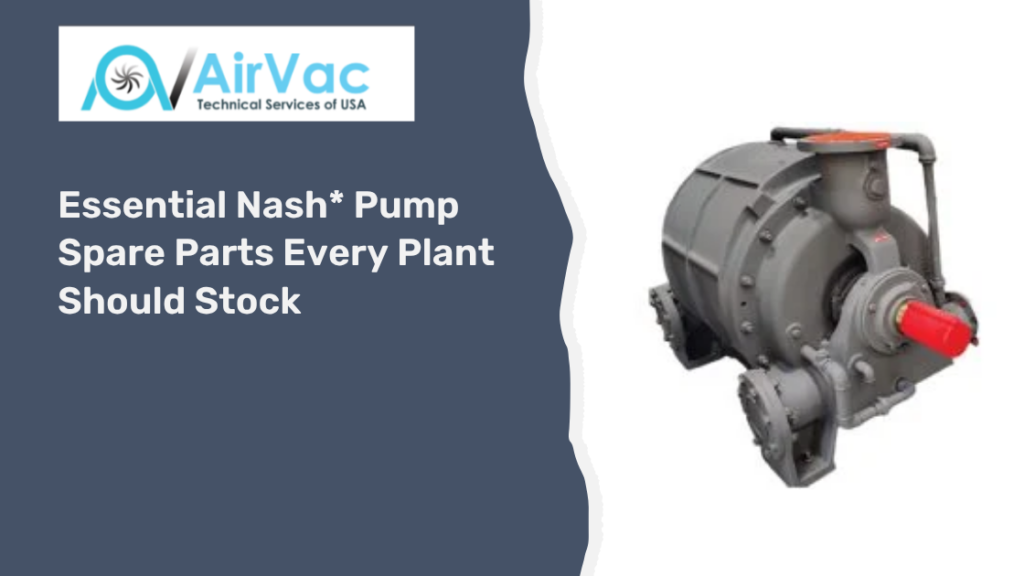
If your plant depends on a Nash vacuum pump, you should keep a planned inventory of the parts most likely to wear out, leak, fail, or delay restart. In most facilities, that means stocking bearings, seals, gaskets, O-rings, packing, wear components, coupling elements, and selected rotating parts based on model, age, duty cycle, and lead time. A spare-parts plan lowers the risk of long outages, helps maintenance teams respond faster, and supports more predictable repair costs.
That matters because downtime and maintenance problems are expensive. NIST estimates that inadequate maintenance practices cost U.S. manufacturers an average of $222 billion per year, and it also found that plants using more predictive maintenance generally report less downtime and better operating outcomes. For industrial operations that rely on vacuum for production, filtration, drying, packaging, condenser duty, or medical systems, a single missing part can turn a manageable repair into a prolonged disruption.
This guide explains which Nash vacuum pump spare parts are most important, how to decide what your plant should stock, and how to avoid tying up capital in the wrong inventory. It is written for U.S. maintenance managers, plant engineers, reliability teams, and procurement professionals who need practical guidance, not guesswork.
Why should a plant stock spare parts for Nash* vacuum pumps?
A plant should stock Nash vacuum pump spare parts because waiting until a failure happens is usually more expensive than carrying the right inventory. Spare parts support three things that operations teams care about most:
- Faster recovery after a breakdown
- More consistent maintenance planning
- Lower risk of extended production loss
For Airvac’s target customers, that need is especially clear. The company’s core buyers are industrial plants, processing facilities, and medical systems that rely on Nash equipment for continuous operation, with uptime, total lifecycle cost, quick turnaround, and technical expertise as key decision drivers. Airvac also positions stocked rebuilt pumps and spare parts as a direct answer to long OEM lead times, high replacement costs, and downtime during repair cycles.
In plain terms, a spare parts plan is not just a maintenance issue. It is a business continuity issue.
What spare parts are most essential for a Nash* vacuum pump?
The most essential Nash vacuum pump spare parts are those that fail most often, wear gradually, or cause the longest downtime when unavailable.
Core spare parts that most plants should evaluate first
| Part category | Why it matters | Typical reason to stock it |
| Bearings | Support rotating assembly and protect shaft stability | Bearing wear can shut down the pump quickly |
| Mechanical seals or packing | Prevent leakage and protect the shaft area | Seals are common wear items and are often replaced during service |
| Gaskets and O-rings | Maintain sealing at casing joints, covers, and fittings | Low cost, high value during rebuilds and repairs |
| Coupling elements | Transfer power from the motor to the pump | Couplings wear, misalign, or fail without much warning |
| Shaft sleeves | Protect shaft surfaces from wear and corrosion | Faster repair when sleeves are damaged |
| Wear plates or internal wear parts | Help maintain internal clearances and efficiency | Worn parts reduce performance and raise energy use |
| Impellers | Critical rotating component | Long lead time and major downtime if damaged |
| Packing sets and sealed water parts | Needed on pumps with packed sealing arrangements | Useful for routine service and leakage control |
| Fasteners, keys, and locking hardware | Small parts that can stall a repair | Cheap insurance for field work |
| Instrumentation-related consumables | Gauges, switches, fittings, and tubing | Helps confirm correct startup and operating condition |
Not every plant needs all of these on the shelf at all times. The right list depends on the pump model, process criticality, duty severity, and supply risk.
Which parts fail most often on Nash* vacuum pumps?
The parts that fail most often are usually not the most expensive parts. They are the parts exposed to wear, heat, vibration, contamination, or repeated maintenance handling.
1) Bearings
Bearings are among the most important parts to stock because they directly affect shaft support, alignment, vibration, and the health of the rotating assembly. Once a bearing starts to fail, damage can spread to other components fast.
Common causes of bearing failure include:
- Improper lubrication
- Misalignment
- Contamination
- Heat
- Excess vibration
- Long operating hours
Signs you may need bearing spares on hand:
- Rising vibration
- Unusual noise
- Higher bearing temperature
- Shaft movement
- Repeated lubrication issues
If your site runs aging Nash CL, SC, XL, or 904 series pumps continuously, bearing availability is a basic protection against long downtime. Airvac’s ICP specifically highlights older Nash equipment in these model families as a strong fit for spare-parts support and technical service.
2) Mechanical seals, packing, and seal-related parts
Seal-related parts are high-priority inventory because leakage often starts small and becomes urgent fast. Depending on the pump design and service setup, your maintenance team may deal with:
- Mechanical seals
- Packing
- Lantern rings
- Sleeves
- Seal housings
- Gland components
- O-rings and seal elastomers
Why these parts matter:
- They are routine service items
- Incorrect installation can shorten the life
- Leakage can create safety and housekeeping problems
- A seal issue can force an unplanned shutdown
OSHA stresses that routine preventive maintenance helps prevent incidents caused by equipment failure, which is one more reason seal leaks should not be treated as minor nuisances.
3) Gaskets and O-rings
Plants often underestimate how often simple sealing parts delay repairs. A pump can be ready for assembly, but the job stalls because the correct gasket set or O-ring material is missing.
Stocking gasket and O-ring kits make sense because they are:
- Low cost compared with downtime
- Frequently replaced during disassembly
- Easy to damage during emergency work
- Required for a reliable reassembly
Good practice is to stock complete gasket sets by pump model instead of trying to piece together individual seals during a shutdown.
4) Couplings and coupling inserts
Coupling failures are common enough to merit a place on most spare parts lists. Even when the pump itself is fine, a worn or failed coupling can take the unit offline.
Why stock them:
- They are wearable items
- Misalignment accelerates failure
- Replacement is often straightforward if parts are available
- They can fail without a long warning period
A coupling spare is especially valuable for critical pumps where a restart window is tight.
5) Shaft sleeves
Shaft sleeves protect the shaft in areas exposed to packing, seals, corrosion, and wear. When sleeves are damaged, the repair may stay small if the sleeve is replaced quickly. Without the sleeve, the shaft itself may need repair or replacement, which is slower and more expensive.
Stock shaft sleeves when:
- The pump runs in corrosive or abrasive service
- The shaft sealing area sees repeated wear
- Lead times are uncertain
- The pump is critical to production
6) Wear parts and internal clearance components
Liquid ring vacuum pumps depend on correct internal clearances to maintain performance. When wear parts degrade, the pump may still run but lose efficiency, vacuum stability, or capacity.
These parts vary by model but can include:
- Wear plates
- Port plate components
- End clearances parts
- Bushings or internal contact surfaces
- Casing repair components
These are not always the first parts plants think to stock, but they become important when the site wants to shorten rebuild time rather than simply respond to small leaks.
7) Impellers
Not every plant needs an impeller sitting on the shelf, but every plant should at least evaluate that risk. Impellers are major components, and the right decision depends on process severity and supply chain exposure.
Consider stocking or pre-planning impeller access when:
- The pump handles corrosive gases or contaminated service liquid
- Erosion is common
- The model is old or hard to source
- Downtime cost is very high
- The pump is essential, and there is no installed standby unit
If your plant cannot justify a full spare impeller, it may still make sense to identify a source, confirm lead time, and keep dimensional records ready.
How do you decide which spare parts your plant should stock?
The best spare-parts plan is not based on guesswork. It is based on risk.
Use these five factors
1) How critical is the pump to production?
Ask:
- Does this pump support a bottleneck process?
- Can the plant run without it?
- Is there a standby unit installed?
- How much does one day of downtime cost?
The more critical the pump, the deeper the spare-parts list should be.
2) What is the actual failure history?
Review:
- Past bearing failures
- Seal leakage frequency
- Repeat gasket use
- Vibration issues
- Impeller or internal wear history
- Emergency part orders
If the same parts keep causing trouble, those parts belong in inventory.
3) How old is the pump, and how available are parts?
Older equipment usually requires more robust spare planning, especially for legacy Nash models. Airvac’s customer profile identifies older CL, SC, XL, and 904 pumps as common equipment in plants seeking parts, rebuilds, and replacements.
4) How long are supplier lead times?
A low-cost part with a 12-week lead time may be more important to stock than a high-cost part with next-day availability.
5) Can maintenance replace the part in-house?
Some parts are easy field replacements. Others require shop tools, dimensional checks, balancing, or outside support. That changes what it makes sense to carry.
What is the difference between a minimum spare list and a critical spare list?
Many plants do better with a two-level strategy than with one giant inventory.
Minimum spare list
This is the base inventory needed for routine repairs and short outages.
Typical items:
- Bearings
- Seal kits
- Packing
- Gaskets
- O-rings
- Coupling inserts
- Fasteners
- Keys
- Common fittings
Critical spare list
This is the second level for pumps with a high risk of downtime.
Typical items:
- Shaft sleeves
- Complete seal assemblies
- Wear plates
- Impeller
- Shaft
- Rotor-related parts
- Replacement cartridge assemblies, where applicable
This approach helps procurement control costs without exposing the plant to preventable outages.
What spare parts should be stocked by different plant scenarios?
For a single critical Nash pump with no standby
Stock more aggressively.
Recommended focus:
- Full bearing set
- Complete seal or packing kit
- Gasket and O-ring set
- Coupling set
- Shaft sleeve
- Key internal wear parts
- Selected rotating components based on lead time
For two pumps running duty/standby
Stock moderately, but do not get careless.
Recommended focus:
- Routine wear items for both pumps
- One set of critical seal-related parts
- Bearings for at least one full failure event
- Coupling spares
- Shared gasket and hardware kits
For older legacy pumps with uncertain parts supply
Stock strategically and document everything.
Recommended focus:
- Model-specific kits
- Sleeves
- Bearings
- Seal hardware
- Internal wear parts
- Drawings, serial data, and part cross-reference records
For plants with a swap-out or rebuild strategy
Stock fewer large components, but do not ignore short-lead wear items.
Airvac’s site overview notes that its services include spare parts, rebuilt pumps, and a swap-out approach designed to reduce downtime. In that type of strategy, the plant may not need every major rotating part on the shelf, but it still benefits from keeping fast-moving consumables in stock.
How much spare inventory is enough?
Enough inventory means you can absorb the failures you are most likely to face without tying up money in parts you may never use.
A practical method is to assign each part a score based on:
- Failure likelihood
- Downtime cost
- Lead time
- Part cost
- Ease of replacement
- Model specificity
Simple stocking matrix
| Risk level | Example parts | Typical action |
| High likelihood + high downtime impact | Bearings, seals, gaskets | Keep on site |
| Low likelihood + high downtime impact | Impeller, shaft, internal wear parts | Stock for critical pumps or secure rapid source |
| High likelihood + low cost | O-rings, packing, coupling inserts | Keep multiple sets |
| Low likelihood + low impact | Noncritical hardware | Order as needed or keep a limited quantity |
This method also supports better conversations between maintenance and procurement. Instead of arguing about cost alone, both teams can compare risk against carrying cost.
What mistakes cause spare-parts programs to fail?
A spare-parts program usually fails for one of these reasons:
- The plant stocks parts by habit instead of by failure history
- Inventory records do not match actual pump models
- Seal materials are wrong for the service
- One missing small part blocks a larger repair
- No one owns the spare-parts strategy
- Parts are stored poorly and degrade before use
- Critical pumps are treated like noncritical pumps
- Maintenance relies too heavily on rush orders
Ready.gov advises businesses to identify critical resources, note their location, and include estimated delivery or response times for outside support. That logic applies directly to spare-parts planning for critical process equipment.
How should Nash* vacuum pump spare parts be stored?
Correct storage matters. A perfect spare part is useless if it corrodes, hardens, deforms, or gets mixed with the wrong model.
Storage best practices
- Label by exact pump model and serial reference
- Keep seals and elastomers in clean, controlled conditions
- Protect bearings from moisture and contamination
- Store machined metal parts with corrosion protection
- Separate active inventory from obsolete stock
- Use clear cycle counting and reorder points
- Keep kits intact rather than splitting them for unrelated jobs
Good storage also supports trust. When a team reaches for a spare during an outage, it needs confidence that the part is correct and usable.
Should you stock a full rebuild kit or individual parts?
That depends on how your plant performs maintenance.
Stock a full rebuild kit when:
- The pump model is common in your plant
- You perform planned overhauls
- The same wear items are replaced together
- You want to shorten shutdown planning
Stock individual parts when:
- Failures are less predictable
- The fleet has many different models
- Budget control is tight
- You rely more on condition-based maintenance than fixed overhaul cycles
Many plants use both. They keep full kits for their most common or most critical pumps and smaller targeted inventories for less critical units.
What role do maintenance strategy and condition monitoring play?
Spare parts planning works best when it is tied to a maintenance strategy.
NIST found that manufacturers using more predictive maintenance generally experienced better outcomes, including lower downtime and better quality metrics. (NIST) That matters because the best spare-parts program is not just about holding parts. It is about using vibration, leakage trends, temperature, inspection findings, and repair history to decide what parts to hold and when to reorder them.
Condition monitoring helps teams answer questions like:
- Are bearings failing faster than expected?
- Are seal problems tied to misalignment or process upset?
- Is one model consuming sleeves or packing more often than others?
- Should the plant move from minimal stock to critical stock?
How can procurement and maintenance work together to build a better spare-parts plan?
The strongest plans are shared plans.
Maintenance should provide:
- Model list and serial information
- Failure history
- Repair frequency
- Criticality ranking
- Planned outage schedule
Procurement should provide:
- Lead times
- Supplier options
- Price history
- MOQ concerns
- Obsolescence risk
Reliability or engineering should provide:
- Root-cause findings
- Standardization opportunities
- Storage and preservation rules
- Repair-versus-replace guidance
This cross-functional approach is important because Airvac’s ICP shows that maintenance managers, plant engineers, procurement officers, and reliability professionals are all involved in decisions around Nash pump uptime, replacement cost, and vendor selection.
What is a practical spare-parts checklist for Nash* vacuum pumps?
Use this checklist as a working template.
Basic checklist for most plants
- Bearing set
- Mechanical seal kit or packing set
- Gasket and O-ring kit
- Coupling insert or coupling assembly
- Shaft sleeve
- Common fasteners and keys
- Seal water fittings or tubing items as needed
- Model and serial record
- Vendor and lead-time record
Expanded checklist for critical pumps
- Complete seal assembly
- Wear plates or internal wear components
- Impeller
- Shaft
- Backup coupling hub components
- Spare instrumentation for startup confirmation
- Rebuild kit
- Emergency vendor contact list
- Documented installation instructions
FAQ: Essential Nash* Vacuum Pump Spare Parts
What spare parts should every plant keep for a Nash* vacuum pump?
Most plants should start with bearings, seals or packing, gaskets, O-rings, coupling elements, and shaft sleeves. These parts are relatively common failure points or routine replacement items, and stocking them can greatly reduce downtime.
Are bearings and seals the most important Nash* vacuum pump spares?
In many plants, yes. Bearings and seals are among the most frequently needed parts because they are directly exposed to wear, vibration, heat, leakage, and normal service intervals.
Should plants stock an impeller for every Nash* pump?
No. An impeller is usually a critical spare only for pumps with high downtime cost, hard-to-source models, severe service, or no standby unit. Many plants are better off evaluating impellers case by case.
How do I know whether my spare parts inventory is too small?
Your inventory is probably too small if routine repairs are delayed by missing parts, if emergency freight is common, or if one seal, bearing, or sleeve issue can stop production for days.
Is it better to stock rebuild kits or individual components?
It depends on your fleet and maintenance strategy. Rebuild kits work well for common models and planned overhauls. Individual components work better when models vary widely or failures are less predictable.
How often should spare parts lists be reviewed?
Review them at least annually and after every major failure, rebuild, supplier disruption, or process change. Older pumps and critical services may need more frequent review.
Conclusion
The best spare-parts plan for a Nash vacuum pump is not the biggest one. It is the most deliberate one. Plants that identify critical pumps, track failure history, understand lead times, and stock the parts most likely to cause a repair to stop can reduce downtime without overloading the storeroom with slow-moving inventory.
For operations running legacy Nash equipment, the smartest approach is usually a balanced one: keep the essential wear and sealing parts on site, identify critical long-lead components in advance, and review the list as operating conditions change. In the final step, when your team needs help deciding what to stock, rebuild, and source for older CL, SC, XL, or 904 pumps, Airvac Technical Services can provide practical, model-specific guidance.