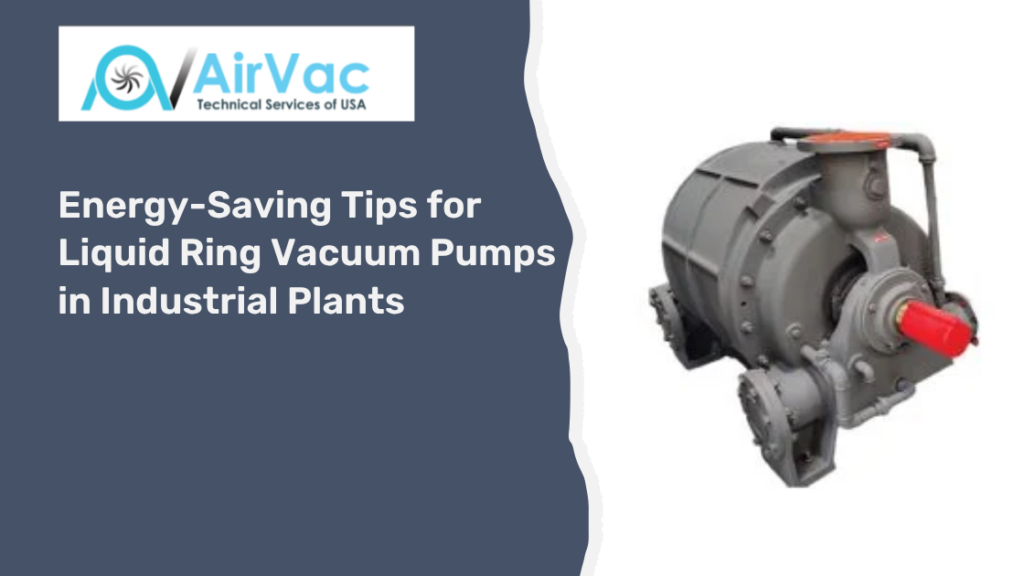
Liquid ring vacuum pumps can often use less energy without changing the entire system. In most industrial plants, the biggest savings come from correcting oversizing, controlling seal water correctly, reducing pressure losses, maintaining internal clearances, and matching the pump to the actual process load rather than the original design assumption. Motor-driven systems already account for a large share of manufacturing electricity use in the U.S., so even a modest improvement in pump efficiency can meaningfully lower operating cost.
Liquid ring vacuum pumps are valued for their ability to handle wet gases, vapors, and contaminated streams better than many dry technologies. That strength can also hide inefficiency. A pump may still run every day, hit a “good enough” vacuum level, and quietly waste power due to hot seal water, throttled operation, worn internals, poor piping, or unnecessary runtime. In plants where these units support filtration, dewatering, condenser exhausting, vapor recovery, packaging, or medical vacuum systems, that hidden energy loss adds up fast.
This guide explains where energy gets lost, what plant teams should inspect first, and which changes usually deliver the best payback. The goal is simple: help maintenance managers, plant engineers, and reliability teams reduce energy use while protecting uptime and process stability.
Why does liquid ring pump efficiency matter so much?
It matters because pump and motor systems are among the largest electrical loads in the industry. DOE notes that machine-driven processes such as pumps, fans, compressed air, and materials handling accounted for 68% of electricity use in U.S. manufacturing in one major assessment, and that significant energy and cost savings can be achieved through improved pump-system practices.
For an industrial site, the practical impact is straightforward:
- Higher amp draw raises energy bills
- Excessive pump load increases heat and wear
- Poor vacuum performance can hurt the process
- Reactive maintenance raises lifecycle cost
- Wasteful operation can shorten rebuild intervals
A pump that is “still running” is not the same as a pump that is running efficiently.
What usually causes high energy use in a liquid ring vacuum pump?
In most plants, the root causes fall into a short list:
- The pump is oversized for the current load
- Seal water temperature is too high
- Seal water flow is too high or poorly controlled
- Internal clearances have opened due to wear
- Piping losses force the system to work harder
- The pump runs far from its best operating point
- The motor or coupling has its own efficiency issues
- Operators keep the unit running when demand is low or absent
DOE guidance for pumping systems repeatedly points to system mismatch, worn components, throttling, bypass flow, and poor maintenance as common efficiency problems.
How do you reduce energy use without risking process reliability?
Start with changes that improve both efficiency and stability. That usually means measuring first, fixing obvious losses second, and only then considering a larger modification such as a replacement pump or controls upgrade.
Quick priority checklist
| Priority | Action | Why it matters | Typical impact |
| 1 | Verify actual vacuum, flow, amps, seal water temperature, and run hours | Confirms where energy is being lost | Establishes baseline |
| 2 | Check for hot seal water, scaling, worn internals, and suction leaks | These are common hidden losses | Fast operational gains |
| 3 | Review whether the pump is oversized | Oversized units waste energy and may run off the best point | Often large savings |
| 4 | Reduce pressure drop in piping and separators | Lowers unnecessary system resistance | Improves load and stability |
| 5 | Improve maintenance strategy | Prevents gradual efficiency drift | Sustained savings |
| 6 | Evaluate controls, staging, or replacement | Best when data proves a mismatch | Medium to large savings |
What are the most effective energy-saving tips?
Below are the most practical tips for U.S. industrial plants using liquid ring vacuum pumps.
1) Measure the real operating point before making changes
Do not rely on nameplate assumptions. Measure what the pump is actually doing in normal production.
Track:
- Motor amps or kW
- Inlet vacuum level
- Seal water temperature
- Seal water flow rate
- Discharge pressure
- Run hours
- Process demand changes by shift or season
DOE recommends surveying pumping systems to identify inefficient operation, establish a baseline, and prioritize improvement projects. DOE also notes that pumps with high maintenance needs, throttled operation, cavitation, wear, bypass flow, and noisy service should be addressed first.
A simple baseline often reveals an uncomfortable truth: the pump is running longer than necessary, with hotter service liquid than expected, against a process load much lower than the system was designed for.
2) Control seal water temperature
In a liquid ring vacuum pump, the condition of the seal water directly affects performance. When seawater gets too warm, vapor pressure rises. That reduces achievable vacuum and often causes operators to compensate by running longer, running harder, or accepting poor process performance.
Watch for:
- Seasonal performance drop in summer
- Warmer recirculated seal water
- Cooling-water fouling
- Increased kW with reduced vacuum performance
- Higher discharge temperatures
Practical actions:
- Verify inlet seal water temperature at the pump, not just at the cooling source
- Clean heat exchangers and strainers
- Reduce recirculated water temperature where possible
- Confirm the seal water rate is neither starved nor excessive
- Compare warm-weather and cool-weather operating data
For many plants, seal water control is one of the easiest ways to recover lost vacuum performance without mechanical changes.
3) Stop overfeeding the seal with water
More seawater is not always better. Excessive flow increases hydraulic load, drives up water-related operating costs, and can reduce overall system efficiency. Too little water also causes problems. The goal is controlled flow based on process conditions, pump design, and actual service requirements.
Signs of poor seal water control:
- Operators use one valve position for every season and load
- No one knows the design flow rate
- Discharge separators are overloaded
- The pump “needs more water” to maintain a vacuum
- Water use looks high, but the vacuum is still inconsistent
Good practice:
- Verify manufacturer guidance or rebuild specification
- Use stable, repeatable valve settings
- Check actual flow with instrumentation where possible
- Review whether once-through or partial recirculation still makes sense for the application
4) Check whether the pump is oversized
This is one of the most overlooked causes of energy waste. DOE notes that many pumping systems operate inefficiently because actual requirements differ from the original design conditions, and oversized pumps are a common cause. DOE recommends a deeper review when measured operating conditions are significantly out of balance relative to the required conditions.
Oversizing often happens because:
- The system was designed conservatively
- Future production growth never happened
- Process changes reduced demand
- One pump was selected to cover every scenario
- A replacement was chosen on availability, not true duty
Common warning signs:
- Control valves stay throttled
- Bypass flow is common
- Vacuum level is controlled by “wasting” capacity
- The pump rarely operates near intended conditions
- Energy use stays high even after maintenance
When oversizing is confirmed, the fix may be:
- Impeller adjustment where appropriate
- Better staging with multiple pumps
- Smaller trim or auxiliary pump
- Variable-speed strategy if the application supports it
- Rebuild-versus-replace review based on actual duty
If your site is weighing that decision, the guide on rebuild or replace your Nash vacuum pump is a logical next step.
5) Reduce suction and discharge pressure losses
Piping losses quietly increase the pump’s work. Restrictions in suction piping, separators, strainers, elbows, undersized lines, and fouled internals all raise the energy needed to move gas and liquid through the system.
Inspect for:
- Dirty strainers
- Partially blocked suction piping
- Liquid carryover issues
- Fouled separators
- Unnecessary valves or fittings
- Undersized piping from previous modifications
A system-level view matters here. DOE’s pump guidance emphasizes improving overall system efficiency rather than focusing only on the pump as an isolated machine.
6) Maintain internal clearances and hydraulic surfaces
A liquid ring vacuum pump can gradually lose efficiency as internal clearances increase due to wear, corrosion, erosion, or improper rebuild tolerances. The pump may still run, but it works harder for the same result.
Typical causes:
- Wear plates out of tolerance
- Erosion from solids
- Corrosion from aggressive process chemistry
- Impeller or cone damage
- Improper assembly after service
What to look for:
- Higher power use at the same operating point
- Lower achievable vacuum
- More noise or vibration
- More heat
- Longer time to reach the target vacuum
This is where a quality repair or rebuild matters. If the pump is showing mechanical wear along with higher energy use, the repair checklist in the Nash liquid ring vacuum pump repair guide and the detailed rebuild process guide can help teams decide whether the issue is operational, mechanical, or both.
7) Keep the pump closer to its best operating range
The Hydraulic Institute defines the best efficiency point (BEP) as the flow rate and head at which pump efficiency is highest for a given speed and impeller diameter. Operating too far away from that point generally reduces efficiency and reliability.
Even though liquid ring vacuum pumps are not managed exactly like all centrifugal process pumps, the underlying lesson still applies: equipment performs best when it is selected and operated near the conditions it was meant to handle.
What that means in practice:
- Do not treat a broad operating envelope as equally efficient everywhere
- Avoid using one oversized unit for widely variable duty when staging could do better
- Re-check process assumptions after line changes, production shifts, or bottleneck removal
- Review performance after rebuilds and system modifications
8) Fix maintenance issues before they become energy issues
Reactive maintenance is expensive. NIST reports that preventable maintenance losses in U.S. manufacturing are significant, and establishments relying more heavily on reactive maintenance were associated with much more downtime than those with stronger preventive or predictive approaches. NIST also found that greater use of predictive maintenance was associated with lower downtime and defect rates among surveyed manufacturers. (
For vacuum pumps, that matters because many energy losses show up long before outright failure.
Build a maintenance routine around:
- Bearing condition
- Vibration trend
- Alignment
- Seal water temperature and quality
- Internal wear trend
- Motor condition
- Suction leaks
- Performance trend against baseline
A smarter maintenance plan does not just prevent failures. It also slows the gradual decline in quiet efficiency that drives up kWh month after month.
9) Review the motor, coupling, and drive train
Not every energy problem is inside the pump casing.
Check:
- Motor efficiency and loading
- Voltage imbalance
- Coupling wear
- Alignment accuracy
- Soft foot
- Belt or gearbox losses, where applicable
DOE’s broader motor-system guidance is relevant here because the pump may only be part of the loss. If the motor is poorly matched or the drive train is out of alignment, the site can waste energy even if the hydraulic side looks acceptable.
10) Eliminate unnecessary run time
One of the simplest savings opportunities is also one of the most ignored: stop running the pump when the process does not need it.
Audit:
- Idle operation during breaks or cleanup
- Night shift demand differences
- Weekend operation
- Seasonal process changes
- Redundant parallel operation
A 100-hp pump running continuously can consume substantial electricity over a year. DOE’s pumping survey example shows how quickly annual energy cost accumulates even before energy prices rise.
Practical run-time questions
- Does the pump need to run at full duty for the entire shift?
- Can vacuum receivers or controls reduce cycling losses?
- Can a smaller lead pump handle off-peak periods?
- Are operators leaving a standby unit online “just in case”?
11) Use system tools instead of guesswork
DOE specifically points industrial users to tools such as PSAT and MEASUR to evaluate pumping-system efficiency and estimate energy savings. These tools support a more disciplined review than simply replacing parts and hoping for a better result.
A data-based review helps answer:
- Is the pump oversized?
- Is there a control problem?
- Is the motor loading appropriate?
- Are piping losses too high?
- Is a rebuild enough, or is replacement the better long-term move?
What does a plant energy review look like in practice?
Here is a practical field approach.
A simple 7-step audit process
| Step | What to do | What you learn |
| 1 | Record vacuum, amps, temperature, flow, and run hours | Current operating baseline |
| 2 | Inspect seal water, cooling, strainers, and separators | Easy losses and restrictions |
| 3 | Compare the current duty to the original or expected duty | Oversizing or mismatch |
| 4 | Check wear indicators, vibration, and clearances | Mechanical efficiency loss |
| 5 | Review controls, staging, and idle run time | Avoidable energy use |
| 6 | Estimate savings from operational fixes first | Lowest-risk improvements |
| 7 | Evaluate, rebuild, or replace only after data review | Best lifecycle decision |
Which upgrades usually deliver the best return?
The answer depends on the root cause, but these upgrades are usually the most practical:
- Seal water control improvements
- Cooling improvements
- Internal restoration through rebuild
- Better spare parts strategy to avoid degraded operation
- Piping cleanup and restriction removal
- Pump right-sizing
- Motor or control review
- Parallel pump optimization
If reliability issues are also part of the energy problem, building the right recommended spare parts inventory for Nash vacuum pumps can help prevent degraded operation from turning into emergency downtime.
If the current unit is structurally sound but worn, a professional repair and rebuild service may restore performance more economically than a rushed replacement. If the issue is a chronic mismatch, a modern replacement Nash series pump may be the better fit.
What should you avoid when trying to save energy?
Avoid these common mistakes:
- Chasing vacuum problems without measuring seal water temperature
- Assuming more water always improves performance
- Replacing the motor before checking the system mismatch
- Treating throttle losses as normal
- Running the same setup year-round without seasonal adjustment
- Accepting gradual and amp increases as “normal aging.”
- Rebuilding without confirming the root cause
- Comparing pumps by nameplate only instead of actual duty
How can plant teams balance energy savings with uptime?
The safest approach is to prioritize “no-regret” actions first:
- Measure the operating baseline
- Fix obvious maintenance and water-side issues
- Reduce restrictions and idle run time
- Re-check performance
- Then decide whether controls, rebuild, or replacement are justified
That order protects uptime by avoiding major changes before the root cause is known.
FAQ: Energy Saving Tips for Liquid Ring Vacuum Pumps
How can I quickly reduce power consumption in a liquid ring vacuum pump?
Start by measuring actual amps, vacuum level, seal water temperature, and run hours. Then check for hot seal water, oversized operation, throttling, fouled piping, suction leaks, and worn internals. These are the most common causes of avoidable energy use.
Does hotter seal water increase energy use?
Yes. Hotter seal water raises vapor pressure, reduces achievable vacuum, and can force the system to work harder or run longer to meet the same process target. In many plants, warm seawater is a major factor in the worsening of summer performance.
Is an oversized vacuum pump less efficient?
Often, yes. DOE notes that oversized pumps and mismatched systems are common sources of inefficiency. A pump selected for old or overly conservative conditions may waste energy under current plant demand.
Should I rebuild or replace an inefficient liquid ring pump?
Rebuild when the casing and major components are structurally sound and the main losses come from wear, clearances, or damaged internals. Replace when the pump is chronically oversized, materially outdated for the duty, or no longer a good fit for the process after system changes.
What is the first thing to inspect during an energy audit?
Inspect operating data first: amps, vacuum, seal water temperature, seal water flow, discharge condition, and run hours. Without that baseline, most “energy-saving fixes” are guesswork.
Can predictive maintenance help lower energy use?
Yes. Predictive maintenance helps detect wear, vibration, alignment, and condition changes before they lead to major efficiency losses or failures. NIST links stronger predictive maintenance practices with lower downtime and quality losses in manufacturing.
Conclusion
The most effective way to cut energy use in liquid ring vacuum pumps is not a single product or a quick adjustment. It is a disciplined process: measure the real duty, correct water-side and piping losses, restore internal conditions, and ensure the pump still matches the job it is doing today. That approach improves both operating cost and reliability.For plants that depend on Nash vacuum pumps, energy efficiency usually improves most when maintenance, repair, and system fit are reviewed together rather than as separate issues. In the final step, if your team needs support evaluating whether a pump should be repaired, rebuilt, or replaced, Airvac Technical Services can help you assess the practical path based on operating condition, turnaround needs, and long-term reliability goals.