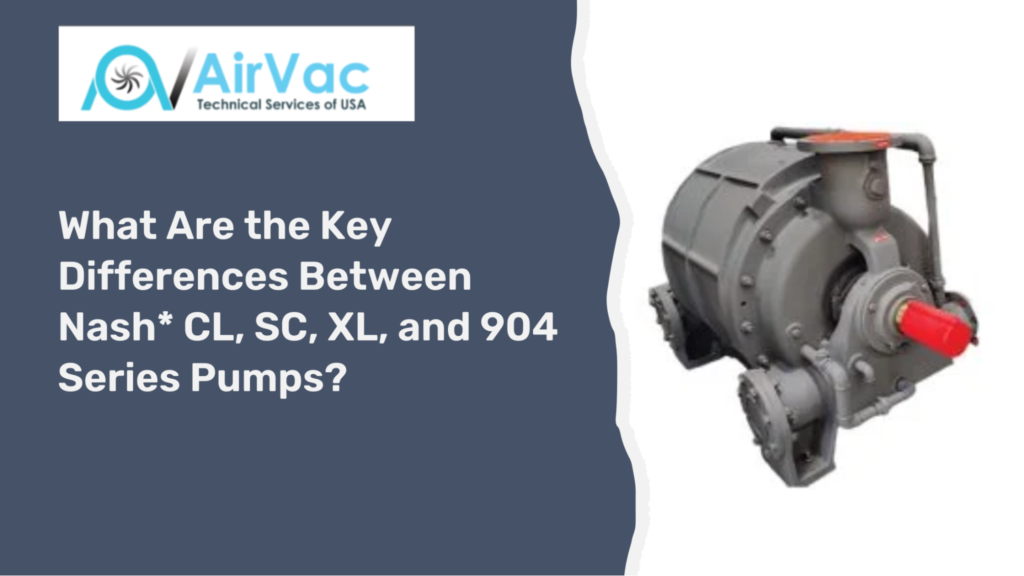
Nash liquid ring vacuum pumps are widely used in industrial systems where reliability, stable vacuum, and continuous operation matter. Over the years, Nash has developed several pump series to meet a range of capacities, pressure levels, and operating conditions. Among the most commonly used models are the CL, SC, XL, and 904 series.
This article provides a clear, practical comparison of the Nash vacuum pump series. It explains how each series works, where it performs best, and what makes each different from the others. The goal is to help maintenance engineers, plant managers, and procurement teams select the right pump or replacement with confidence. By understanding the differences between the Nash vacuum pump series, you can reduce downtime, improve efficiency, and avoid costly mismatches.
Overview of Nash* Liquid Ring Vacuum Pump Design
Before comparing individual series, it is important to understand how Nash liquid ring vacuum pumps operate.
A liquid ring vacuum pump uses a rotating impeller and a liquid seal, usually water, to compress gas and create a vacuum. The liquid forms a ring inside the casing, sealing the impeller blades and allowing compression without metal-to-metal contact.
Key advantages of this design include:
- High tolerance to wet and dirty gases
- Smooth and quiet operation
- Long service life when properly maintained
- Stable vacuum under continuous duty
These features make Nash liquid ring vacuum pump models common in paper mills, power plants, chemical facilities, and food processing plants.
Why Nash* Developed Multiple Pump Series?
No single pump design fits every industrial need. Process requirements vary by:
- Required vacuum level
- Gas volume
- Operating pressure
- Available space
- Water quality
- Duty cycle
To meet these demands, Nash developed multiple series with different internal designs, capacities, and construction features. Each series targets a specific range of applications rather than trying to do everything.
High-Level Comparison of CL, SC, XL, and 904 Series
The table below shows a high-level overview of how the four series compare.
| Series | Typical Capacity Range | Vacuum Level | Common Applications |
| CL | Medium to high | Moderate | Paper, general industry |
| SC | Low to medium | Moderate | Power, process systems |
| XL | High | High | Large industrial systems |
| 904 | Medium | High | Power and heavy process |
This overview helps frame the detailed differences explained below.
Nash* CL Series Vacuum Pumps
General Description
The Nash CL series is one of the most widely used families of liquid ring vacuum pumps. It is known for its simple design, solid construction, and broad range of applications.
CL pumps are typically single-stage units designed for steady operation and reliable performance.
Design Features
Key design features include:
- Single-stage liquid ring construction
- Rugged cast iron casing
- Simple internal geometry
- Easy access for maintenance
The CL design focuses on durability and serviceability rather than extreme vacuum levels.
Performance Characteristics
The CL series offers:
- Moderate vacuum capability
- Stable capacity across a wide range
- Good tolerance for wet and contaminated gases
These pumps perform well in processes where extreme vacuum is not required but uptime is critical.
Typical Applications
Common uses include:
- Paper and pulp dewatering
- General manufacturing
- Material handling
- Filtration systems
Because of its flexibility, the CL series often becomes a standard plant pump.
Strengths and Limitations
Strengths:
- Proven design
- Easy to maintain
- Broad application use
- Long service life
Limitations:
- Not designed for very deep vacuum
- Lower efficiency at extreme pressure ranges
Nash* SC Series Vacuum Pumps
General Description
The Nash SC series is designed for applications requiring reliable vacuum at lower capacities. These pumps are often used where space and efficiency are at a premium.
Design Features
Notable features include:
- Compact frame
- Optimized impeller design
- Lower water consumption compared to larger pumps
The SC series balances size and performance.
Performance Characteristics
SC pumps typically provide:
- Moderate vacuum levels
- Consistent performance under steady load
- Efficient operation for smaller systems
They are well-suited for systems that run continuously but do not need high flow rates.
Typical Applications
Common SC applications include:
- Power plant condenser exhausting
- Smaller process vacuum systems
- Utility vacuum services
These pumps often support critical systems where reliability matters more than capacity.
Strengths and Limitations
Strengths:
- Compact design
- Good efficiency in its range
- Reliable continuous operation
Limitations:
- Limited capacity
- Not ideal for large volume processes
Nash* XL Series Vacuum Pumps
General Description
The Nash XL series features higher capacity and a higher-vacuum design. These pumps are built for large industrial systems with high-performance demands.
Design Features
XL pumps include:
- Larger casing and impeller
- Heavy-duty construction
- Optimized internal clearances
- High-strength materials
The design supports high flow and deep vacuum operation.
Performance Characteristics
The XL series delivers:
- High vacuum capability
- Large gas handling capacity
- Stable performance under heavy load
These pumps are often selected for large-scale operations with strict performance requirements.
Typical Applications
Common uses include:
- Large paper mills
- Chemical processing plants
- Mining and metals processing
- Central vacuum systems
XL pumps are usually installed where downtime is extremely costly.
Strengths and Limitations
Strengths:
- High capacity
- Deep vacuum capability
- Robust construction
Limitations:
- Larger footprint
- Higher initial cost
- Greater power demand
Nash* 904 Series Vacuum Pumps
General Description
The Nash 904 series is a specialized design often used in power generation and heavy industrial service. It is known for strong vacuum performance and long operating life.
Design Features
Key features include:
- Precision-machined components
- Optimized liquid ring geometry
- Strong focus on condenser duty performance
The 904 series is built to handle demanding conditions.
Performance Characteristics
The 904 series provides:
- High vacuum levels
- Consistent performance in continuous duty
- Good efficiency at the design point
These pumps perform best when properly matched to system conditions.
Typical Applications
Common applications include:
- Steam turbine condenser systems
- Utility vacuum services
- Large industrial process units
These systems often operate around the clock.
Strengths and Limitations
Strengths:
- High reliability
- Strong vacuum performance
- Proven in power generation
Limitations:
- Less flexible outside design range
- Requires proper system matching
Detailed Comparison by Key Criteria
Capacity Range
Capacity is one of the most important differences between series.
- The CL series covers a broad medium range
- The SC series focuses on lower capacity needs
- The XL series supports very high-capacity systems
- 904 series targets medium capacity with high vacuum
Vacuum Level Capability
Vacuum depth varies by design.
- CL pumps provide a moderate vacuum
- SC pumps provide a moderate vacuum with efficiency
- XL pumps deliver high vacuum
- 904 pumps deliver high vacuum optimized for condensers
Efficiency Considerations
Efficiency depends on proper selection and operating conditions. According to the U.S. Department of Energy, properly sized vacuum pumps can reduce energy use by up to 25 percent in industrial systems.
Oversizing any series reduces efficiency and increases operating cost.
Maintenance and Serviceability
All Nash series share common maintenance traits:
- Simple internal design
- Long bearing life
- Predictable wear patterns
However, larger pumps like XL and 904 require more planning during service due to size.
Choosing the Right Nash Pump Series
Selecting the right pump requires understanding your system needs.
Consider:
- Required vacuum level
- Gas volume
- Operating hours
- Water quality
- Available space
- Energy cost goals
A mismatch can lead to poor performance and early wear.
Industry Specific Selection Considerations
Paper and Pulp
CL and XL series are common due to their moisture tolerance and capacity range.
Power Generation
SC and 904 series are often preferred for condenser duty.
Chemical Processing
XL series is often selected for high flow and corrosion-resistant builds.
Food and Beverage
CL and SC series are common due to sanitation and reliability needs.
Replacement and Compatibility Considerations
Many plants operate older Nash pumps that are no longer supported by the original manufacturers. In these cases, drop-in compatible replacements are often used to maintain performance without system changes.
When replacing:
- Match capacity and vacuum level
- Confirm footprint compatibility
- Verify material suitability
- Review seal water requirements
Key Differences Summary Table
| Feature | CL | SC | XL | 904 |
| Capacity | Medium | Low to medium | High | Medium |
| Vacuum Level | Moderate | Moderate | High | High |
| Footprint | Medium | Compact | Large | Medium |
| Typical Duty | General | Utility | Heavy process | Condenser |
| Flexibility | High | Medium | Medium | Low |
Efficiency and Lifecycle Cost Impact
Efficiency affects the total cost of ownership more than purchase price. The International Energy Agency reports that energy costs often exceed equipment costs over the life of industrial pumps.
Choosing the right series reduces energy waste and maintenance costs.
Common Selection Mistakes to Avoid
- Oversizing the pump
- Ignoring seal water conditions
- Selecting based on price alone
- Failing to consider future process changes
Avoiding these mistakes improves reliability and efficiency.
FAQs
What is the difference between Nash* CL and SC vacuum pumps?
The CL series offers greater capacity and flexibility, while the SC series is more compact and suited to lower-capacity systems.
Which Nash* pump series is best for power plants?
SC and 904 series pumps are commonly used for condenser duty in power generation.
Are Nash* XL pumps more efficient than CL pumps?
Efficiency depends onthe application. XL pumps are more efficient at high capacity and deep vacuum, while CL pumps perform better in moderate ranges.
Can I replace a Nash* CL pump with a pump from another series?
Replacement is possible if capacity, vacuum level, and system conditions match. An engineering review is recommended.
How long do Nash* liquid ring vacuum pumps last?
With proper maintenance, many pumps operate for decades before requiring major rebuilds.
Final Thoughts
Understanding the differences between Nash CL, SC, XL, and 904 vacuum pumps helps industrial teams make informed decisions. Each series serves a clear purpose, and selecting the right one improves reliability, efficiency, and system life. Careful evaluation of process needs, operating conditions, and long-term costs ensures the best outcome.For expert guidance, rebuilds, and compatible replacement solutions backed by decades of experience, many industrial facilities rely on Airvac Technical Services.