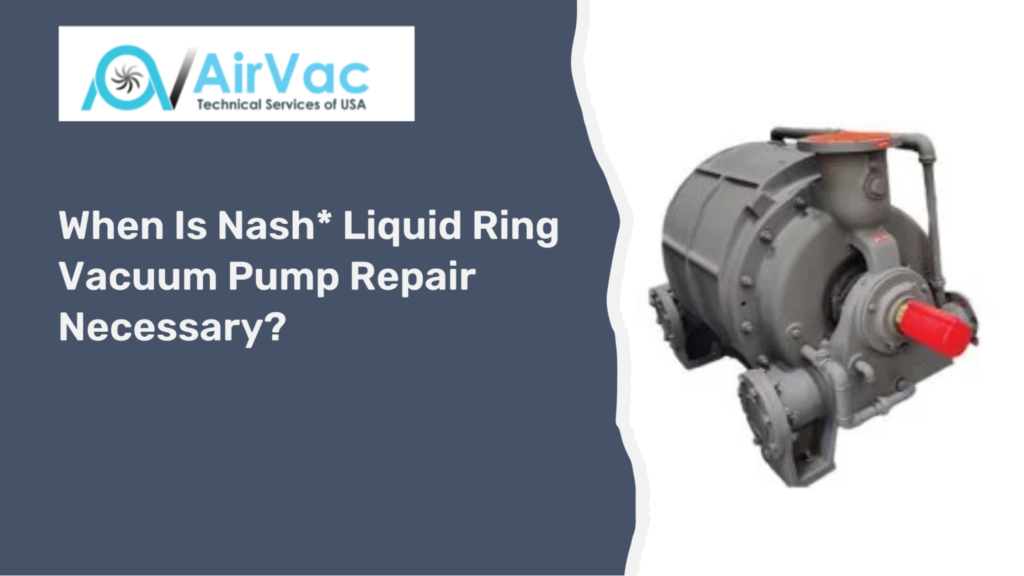
Nash liquid ring vacuum pumps are critical to daily operations in many industries. Paper mills, chemical plants, refineries, power stations, and food processing facilities depend on them to maintain stable vacuum levels. These pumps handle wet gases, vapors, and demanding process conditions. When performance drops or a failure occurs, production can slow down or stop completely. That can lead to lost output, safety concerns, and expensive emergency downtime.
Nash liquid ring vacuum pump repair is necessary when there is measurable performance loss, mechanical wear, or recurring operational issues. Changes in vacuum level, rising vibration, increased power consumption, or frequent seal failures are clear warning signs. In some cases, problems develop slowly over time. In other situations, failure happens without much warning. Understanding these indicators helps maintenance teams act early and avoid major damage.
This guide explains:
- The most common failure signs
- Measurable performance indicators
- When repair makes sense
- When is rebuilding or replacement is better
- What inspections should include
- How to prevent repeat failures
The goal is simple. Help plant managers, maintenance engineers, and reliability teams make informed decisions based on facts and data.
Understanding How a Nash* Liquid Ring Vacuum Pump Works
Before discussing repair, it helps to understand basic operation.
A Nash vacuum pump uses seal water to form a rotating liquid ring inside the casing. The impeller rotates off-center. This creates compression chambers between the blades and the liquid ring. Gas enters through the inlet port, gets compressed, and exits through the discharge port.
Because the pump uses liquid sealing, it tolerates:
- Wet gases
- Vapors
- Process carryover
- Light solids
However, internal components still wear over time.
Main components include:
- Impeller
- Shaft
- Bearings
- Mechanical seal or packing
- End plates
- Casing
- Distribution plate
Any damage in these parts affects the vacuum level, efficiency, and reliability.
Why Timely Nash* Liquid Ring Vacuum Pump Repair Matters?
According to the United States Department of Energy, poor maintenance practices can reduce industrial equipment efficiency by up to 30 percent. Source: energy.gov
For vacuum systems, even a small drop in vacuum can impact:
- Paper sheet quality
- Distillation performance
- Evaporation rates
- Drying time
- Energy usage
Delayed repair often leads to:
- Bearing seizure
- Shaft damage
- Impeller contact
- Excessive vibration
- Seal failure
- Motor overload
Repairing early is often far less expensive than replacing a complete unit.
Key Signs That Nash* Liquid Ring Vacuum Pump Repair Is Necessary
1. Reduced Vacuum Level
One of the first warning signs is low vacuum.
If your system normally operates at 24 inHg and drops to 18 inHg, something is wrong.
Common causes include:
- Internal wear
- Excessive clearances
- Damaged impeller
- The seal’s water temperature is too high
- Air leaks
If process conditions remain the same and the vacuum continues to drop, repair is likely required.
Performance Rule of Thumb
| Vacuum Drop | Action Recommended |
| 5 percent loss | Inspect and monitor |
| 10 percent loss | Schedule repair |
| 15 percent or more | Immediate repair |
2. Increased Power Consumption
When internal clearances increase due to wear, the pump must work harder.
Signs include:
- Motor amperage rising above normal
- Higher energy bills
- Motor overheating
The Department of Energy states that electric motors account for nearly 70 percent of industrial electricity use. Inefficient equipment wastes money.
Monitoring motor amps weekly helps identify early problems.
3. Excessive Vibration
Vibration often signals internal mechanical issues.
Possible causes:
- Bearing wear
- Shaft misalignment
- Impeller imbalance
- Cavitation damage
If vibration exceeds manufacturer limits, do not ignore it.
High vibration can damage:
- Bearings
- Couplings
- Motor windings
- Foundations
A vibration analysis test can confirm if repair is needed.
4. Abnormal Noise
Liquid ring pumps normally run smoothly. Grinding, knocking, or rattling sounds mean trouble.
Common reasons:
- Impeller contact with casing
- Broken vanes
- Foreign object damage
- Bearing failure
Noise changes are often early warnings.
5. Seal Water Problems
Seal water quality and temperature directly affect pump performance.
Problems include:
- High-temperature water
- Dirty water
- Insufficient flow
- Scale buildup
High seal water temperature reduces vacuum capacity. Research shows that for every 10-degree Fahrenheit increase in seawater temperature, vacuum performance can drop significantly.
If adjusting water conditions does not fix the issue, internal repair may be necessary.
6. Frequent Seal Failures
Mechanical seals should not fail every few months.
Repeated failure may indicate:
- Shaft wear
- Excessive runout
- Internal misalignment
- High vibration
- Poor installation
Seal failure is often a symptom, not the root cause.
7. Visible Internal Corrosion or Erosion
Liquid ring pumps often operate in corrosive environments.
Damage can include:
- Pitting
- Cavitation erosion
- Rust scale
- Metal thinning
If erosion affects the impeller vanes or the casing surfaces, repair is urgent.
Common Failures That Require Nash* Vacuum Pump Repair
Below are the most frequent mechanical failures seen in field service.
Bearing Failure
Bearings fail due to:
- Poor lubrication
- High temperature
- Misalignment
- Contamination
Symptoms:
- High vibration
- Noise
- Heat
Bearing damage can spread quickly to the shaft.
Impeller Wear
Impellers wear from:
- Cavitation
- Corrosive gases
- Solids carryover
Repair may include:
- Machining
- Coating
- Replacement
Shaft Damage
Shafts may show:
- Grooving
- Bending
- Runout
Shaft repair is possible if within tolerance. Severe damage may require replacement.
Casing Wear
- Internal clearances matter in liquid ring vacuum pumps.
- Excessive clearance reduces compression efficiency.
- Re-machining or sleeving can restore tolerance.
When Is Repair Better Than Replacement?
Not every issue requires a new pump.
Repair is often recommended when:
- Casing is structurally sound
- The shaft is repairable
- Impeller damage is moderate
- Parts are available
Replacement may be better when:
- The casing is cracked
- Severe corrosion has weakened the structure
- Repeated failures occur despite repair
- Parts are obsolete
Cost Comparison Table
| Option | Typical Cost Range | Downtime | Best For |
| Minor Repair | 10 to 25 percent of the new pump | Short | Early wear |
| Full Rebuild | 40 to 60 percent | Moderate | Major wear |
| New Pump | 100 percent | Longer | Structural damage |
Repair usually offers strong cost savings if done before catastrophic failure.
Inspection Checklist Before Deciding on Repair
A proper inspection should include:
- Dimensional measurements
- Bearing condition check
- Shaft runout test
- Impeller clearance measurement
- Casing inspection
- Seal inspection
- Performance test
Without testing, repair decisions are guesswork.
How Often Should Nash* Liquid Ring Vacuum Pumps Be Inspected?
Inspection frequency depends on service conditions.
General guideline:
| Application | Inspection Interval |
| Clean water service | 12 months |
| Paper mill | 6 to 12 months |
| Chemical plant | 6 months |
| Severe corrosive service | 3 to 6 months |
Facilities using predictive maintenance often extend pump life by 20 to 40 percent.
Warning Signs You Should Not Ignore
Some conditions require immediate shutdown and repair:
- Sudden drop in vacuum
- Severe vibration spike
- Metal-to-metal contact noise
- Seal water contamination
- Oil leakage at bearings
Ignoring these can cause secondary damage.
Role of Preventive and Predictive Maintenance
The Occupational Safety and Health Administration emphasizes the safe operation of equipment. Source: osha.gov
Preventive maintenance includes:
- Lubrication checks
- Seal water monitoring
- Vibration testing
- Performance tracking
Predictive tools include:
- Vibration analysis
- Infrared thermography
- Oil analysis
- Ultrasonic testing
How Climate Affects Repair Frequency?
Climate directly affects how often a Nash liquid ring vacuum pump needs repair. Ambient temperature, humidity, and seasonal changes all influence internal wear and performance stability.
In high temperature environments, seawater temperature rises. Warmer seal water reduces vacuum capacity and lowers gas compression efficiency. When the pump runs hotter, bearings and mechanical seals also face higher stress. Over time, this accelerates wear and increases the need for repair. Plants in desert or tropical regions often undergo more frequent inspections to prevent performance loss.
Cold climates create a different challenge. Rapid temperature changes during startup can cause thermal shock. Metal parts expand and contract at different rates. This can affect internal clearances and seal integrity. In extreme cases, improper winterization may cause cracking or damage to the seal.
Humidity also affects repair frequency. Moist air promotes corrosion inside the casing and on impeller surfaces. In coastal or high-humidity areas, corrosion can develop faster, especially if the process gas contains chemicals.
Facilities that adjust maintenance schedules based on local climate often reduce emergency repairs. Regular monitoring of seal water temperature, corrosion levels, and vibration trends helps extend pump life and maintain stable operation.
Repair Process Overview
A proper Nash liquid ring vacuum pump repair includes:
- Complete disassembly
- Cleaning and blasting
- Dimensional inspection
- Machining or replacement
- New bearings and seals
- Balancing
- Hydrostatic testing
- Performance testing
Skipping testing leads to repeat failures.
Energy Efficiency After Repair
A properly repaired pump restores internal clearances.
Benefits include:
- Improved vacuum level
- Lower energy usage
- Reduced motor load
- Stable operation
Many facilities report energy savings after a rebuild.
Frequently Asked Questions
What causes Nash* liquid ring vacuum pump failure?
Common causes include bearing wear, cavitation, corrosion, seal water issues, and poor maintenance.
How long does a Nash* vacuum pump last?
With proper maintenance, many liquid ring pumps operate 15 to 25 years. Harsh service may reduce lifespan.
Can a Nash* liquid ring vacuum pump be rebuilt?
Yes. Most units can be rebuilt if the casing and shaft remain within tolerance.
How much does a Nash* vacuum pump repair cost?
Minor repairs may cost 10 to 25 percent of the cost of a new pump. Full rebuilds often cost 40 to 60 percent of the replacement cost.
What happens if vacuum pump repair is delayed?
Delayed repair can cause shaft damage, impeller failure, and motor burnout. Costs increase significantly.
Final Thoughts
So, when is Nash liquid ring vacuum pump repair necessary?
Repair becomes necessary when performance drops, vibration increases, noise changes, seals repeatedly fail, or internal wear exceeds tolerance. The key is early detection. Monitoring vacuum levels, motor amps, seal water temperature, and vibration trends helps identify issues before they escalate.
Repair decisions should rely on inspection data, not guesswork. In many cases, timely repair restores performance and extends equipment life at a fraction of replacement cost.
For professional inspection, rebuild services, performance testing, and expert support for Nash liquid ring vacuum pump repair, contact Airvac Technical Services.