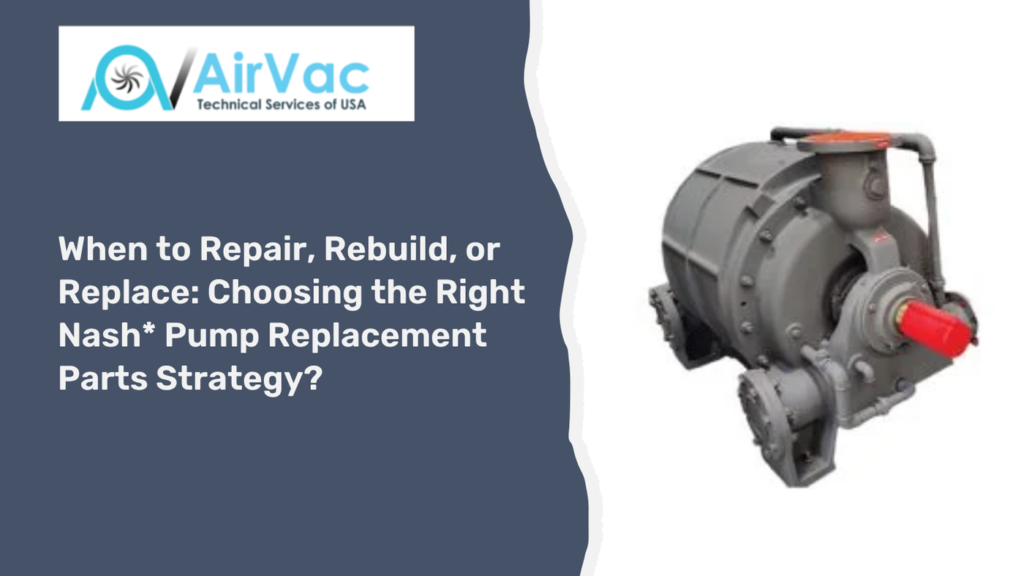
If your Nash vacuum pump is losing performance, running hotter, vibrating more, or failing parts too often, the right decision is usually this: repair the pump when the issue is isolated, rebuild it when wear is widespread but the core machine is still sound, and replace it when the pump has major structural damage, poor economics, or no longer fits the process. In most plants, the best choice depends on five factors: the condition of the casing and rotor, how often failures are repeating, downtime cost, parts availability, and whether the pump still matches the duty point.
That answer matters because pump decisions affect both reliability and energy use. The U.S. Department of Energy says pumping systems account for 25 per cent of the total energy consumed by electric motors in the U.S. industrial sector and more than 50 per cent of electricity use in pumping-intensive industries. When a pump operates with worn internals, poor clearances, or unstable conditions, the problem is not only the maintenance cost. It can also increase energy use, reduce vacuum performance, and raise the risk of unplanned shutdowns.
For plants running older Nash equipment, the decision is rarely just technical. It is also operational. Airvac’s ideal buyers are maintenance managers, plant engineers, procurement teams, and reliability staff who need to restore uptime, lower lifecycle cost, and source compatible solutions for ageing CL, SC, 904, and XL series pumps. Airvac’s files also show that customers often face long OEM lead times, high replacement costs, and pressure to keep production moving through rebuilds, swap-out options, or drop-in-compatible replacement models.
This guide explains how to choose a Nash pump replacement parts strategy that makes sense in the real world. It will help you decide when a small repair is enough, when a full rebuild is the smarter move, and when replacement gives you the best long-term value.
What is the difference between repair, rebuild, and replacement?
Before choosing a strategy, define the terms clearly.
| Option | What it means | Best use case | Main goal |
| Repair | Fixing a specific fault or replacing limited failed components | One clear issue is low wear elsewhere | Fast return to service |
| Rebuild | Disassembling, inspecting, machining, restoring tolerances, and replacing worn parts across the pump | General wear, repeat failures, ageing internals, but salvageable core | Restore reliability and performance |
| Replacement | Installing another pump, either rebuilt, refurbished, or a direct compatible replacement | Severe damage, poor economics, chronic mismatch, or urgent downtime | Reset risk and improve fit |
A repair is usually the least disruptive option when the failure is narrow. That may include replacing bearings, seals, gaskets, or other service items after a known event. A rebuild is broader. It addresses the pump as a system, including internal wear, alignment checks, tolerances, and test readiness. A replacement is the best choice when the pump is too damaged, too outdated, too slow to repair, or no longer cost-effective to keep alive.
Airvac’s website overview reflects this three-path model. The company offers rebuild services, spare parts, ready-to-ship rebuilt pumps, and replacement AV series models for CL, SC, 904, and XL pumps. It also emphasises swap-out support to reduce downtime during unit rebuilds.
When should you repair a Nash* pump?
Repair is usually the right decision when the pump has a single dominant failure mode, and the rest of the machine is in reasonable condition.
Repair usually makes sense when:
- The casing and major internal components are still sound
- The pump has been operating reliably before the current issue
- The failure was caused by a known event such as contamination, poor lubrication, seal liquid upset, or temporary misalignment
- The needed parts are available quickly
- Your process can tolerate a short repair window
- Inspection shows wear is limited rather than widespread
Typical repair scenarios
A plant notices an increase in vibration after a coupling issue. Inspection shows the bearings and seal need replacement, but the rotor and casing are still usable. That is often a repair case.
Another example is a pump that lost performance after poor seal-liquid quality caused temporary trouble, but the damage did not extend to major internal surfaces. Again, a targeted repair may be enough.
This approach aligns with well-known pump reliability guidance. EASA notes that misalignment and improper piping can distort bearing and seal alignment, raise vibration, and lead to premature failure, which means not every pump problem points to a full rebuild or replacement. Sometimes the right fix is to correct the system issue and repair the damaged components before wear spreads.
Benefits of repair
- Lowest immediate cost
- Fastest path back to service when damage is limited
- Preserves capital budget
- Useful for pumps with otherwise solid maintenance history
Risks of repair
- May only treat the symptom, not the underlying wear pattern
- Can lead to repeat failures if the root cause is missed
- Not ideal for pumps with broad age-related degradation
When is a rebuild the better option?
A rebuild is often the best middle ground when the pump is too worn for a simple repair but still has a salvageable core. For many industrial plants, this is the sweet spot because it restores reliability without the full cost of a brand-new machine.
Airvac’s positioning strongly reflects this need. Its files show customers often want to reduce downtime, avoid full replacement cost, and source tested rebuilds or exchange units for ageing Nash pumps. That is especially relevant for medium to large operations where uptime matters more than brand loyalty alone.
Rebuild usually makes sense when:
- The pump has multiple worn components
- Performance has declined gradually over time
- Clearances are out of tolerance
- Failures are repeating
- Parts replacement alone will not restore confidence
- The housing and major rotating elements remain rebuildable
- Downtime cost is high enough that better reliability matters more than the lowest short-term spend
Signs your pump may need a rebuild instead of a repair
- The vacuum level is unstable even after the recent parts replacement
- Bearings, seals, or wear items keep failing
- The pump has visible signs of internal wear
- Efficiency has dropped, and power use appears higher
- The unit has years of service in a demanding application
- You do not have confidence that replacing one or two parts will solve the problem
Why rebuilds often pay off
A rebuild helps correct the issues that targeted repairs often miss. That includes worn clearances, cumulative wear, rotor condition, casing damage that can still be restored, and overall fit between parts. In many plants, this prevents a pattern in which one repair leads to another.
This matters because pump inefficiency is not a small problem. DOE resources show that pumping systems represent a major share of industrial electric motor energy use, so restoring a worn pump to better mechanical condition can support both reliability and operating cost control.
Rebuild checklist
Use a rebuild path when you can answer yes to most of these questions:
| Rebuild question | Yes or No |
| Is the pump structurally salvageable? | |
| Is wear spread across multiple parts? | |
| Have failures repeated in the past 12 to 24 months? | |
| Is downtime expensive enough to justify a deeper fix? | |
| Are compatible rebuild parts and machining support available? | |
| Does the pump still fit the process requirements? |
If most answers are yes, rebuild is usually the smarter long-term decision.
When should you replace a Nash* pump?
Replacement becomes the best choice when repair or rebuild no longer makes economic or operational sense.
Replace the pump when:
- The casing or major pressure retaining structure is badly damaged
- Corrosion or erosion has gone too far
- The rotor or major internals are beyond usable limits
- The pump has become a chronic maintenance problem
- Parts availability is poor or lead times are unacceptable
- You need a faster swap than a rebuild timeline allows
- The existing pump is no longer the right match for the application
- The total expected cost of repeated repairs approaches the replacement value
Replacement does not always mean buying a new OEM. In practice, it can mean a rebuilt exchange unit, a refurbished pump, or a compatible replacement model that fits the original duty.
Airvac’s website overview highlights direct, compatible AV series replacements for the Nash CL, SC, 904, and XL lines, along with rebuilt and refurbished options and ready-to-ship inventory designed to reduce downtime.
Strong replacement scenarios
One common example is a plant that has repaired the same pump multiple times over two years, but vibration, leakage, and vacuum instability keep recurring. Another is a heavily corroded process pump that still runs, but its structural life is clearly limited. In both cases, replacement often reduces risk more effectively than another repair cycle.
Why replacement may be the lowest risk option
Replacement can:
- Shorten downtime if a compatible unit is in stock
- Reset the maintenance clock
- Improve fit if the old pump was mismatched
- Reduce repeated labour and emergency spending
- Support more predictable planning for procurement and operations
How do you choose the right strategy for Nash* pump replacement parts?
The smartest strategy is not based on purchase price alone. It should balance condition, fit, downtime risk, and total lifecycle cost.
Here is a practical framework.
1. Start with condition, not assumptions
Inspect the failed parts, but also inspect the pump as a system. A seal failure by itself does not always mean the seal was the true problem. It may point to shaft movement, misalignment, poor lubrication, piping strain, vibration, or process upset. EASA highlights that misalignment and piping strain can distort bearing and seal alignment and drive premature failure.
2. Identify the root cause
Before ordering parts, ask:
- What failed first?
- What evidence supports that?
- Was the failure sudden or progressive?
- Did operating conditions change?
- Has the same issue happened before?
Without root cause analysis, even high quality parts can fail again.
3. Look at the full repair history
One isolated event supports repair. Repeated failures support rebuild or replacement. Chronic breakdowns usually indicate deeper pump wear or an unstable application.
4. Compare downtime cost, not just invoice cost
The cheapest repair on paper may be the most expensive decision if it causes another shutdown next month. For many plants, lost production, labor disruption, and emergency freight matter more than the price of parts.
5. Check whether the pump still fits the duty
A pump that is mechanically repairable may still be the wrong pump for the job. Process changes, different load conditions, contamination, or temperature shifts can make the old setup less reliable than it used to be.
6. Evaluate parts availability and turnaround
This is especially important for older equipment. Airvac’s ICP notes that long OEM lead times and ageing Nash models are common buyer pain points, which is why ready stock, rebuild programs, and compatible replacements matter so much.
What failures push the decision toward rebuild or replacement?
Not every failure means the same thing. This table helps.
| Failure pattern | Likely meaning | Best first decision path |
| One failed seal after a known upset | Isolated event or installation issue | Repair and correct root cause |
| Repeated bearing and seal failures | Deeper alignment, vibration, or wear problem | Rebuild investigation |
| Persistent performance loss | Internal wear, tolerance loss, process mismatch | Rebuild or replace |
| Heavy corrosion or erosion | Material and life limit issue | Replace or major rebuild review |
| Frequent emergency stops | Reliability risk is already high | Rebuild or replace |
| Parts obsolete or very delayed | Maintenance support risk | Replace or exchange the unit |
EASA also notes that common pump failure categories include seal failure, impeller damage, and bearing failures, which reinforces why repeat failure patterns should not be treated as one off events forever.
Why do parts fail again after a repair?
This question matters because many plants assume a bad part caused the issue, when the real cause was elsewhere.
Common reasons include:
- Misalignment
- Pipe strain
- Poor lubrication
- Contaminated or unstable seal liquid
- Cavitation or unstable process conditions
- Poor installation practices
- Reusing damaged mating components
- Ordering parts without confirming fit and wear pattern
Cavitation is especially destructive because it can damage internals, reduce performance, and contribute to seal, bearing, and impeller related problems.
That is why a parts strategy should never be only about buying the lowest cost item. It should be tied to inspection, root cause, and application review.
What does a practical decision matrix look like?
Use this simplified scoring model.
| Factor | Repair | Rebuild | Replace |
| Low immediate cost | 5 | 3 | 1 |
| Restores full confidence | 2 | 4 | 5 |
| Best for limited damage | 5 | 3 | 1 |
| Best for broad wear | 1 | 5 | 4 |
| Best for urgent swap out | 2 | 3 | 5 |
| Best for obsolete or hard-to-source parts | 1 | 3 | 5 |
| Best for long-term lifecycle control | 2 | 4 | 5 |
How to use it:
If your issue is isolated and your pump is otherwise healthy, repair usually wins. If wear is broad and the pump is rebuildable, rebuilding often gives the best balance. If the unit is structurally compromised, mismatched, or no longer economical, replacement is usually the best long-term answer.
What questions should procurement and maintenance ask before ordering parts?
This is where many good decisions go wrong.
Ask these before you approve a repair order
- What exactly failed?
- What evidence supports that diagnosis?
- Will replacing this part restore the pump, or only restart it temporarily?
- Has this failure happened before?
- What is the condition of the casing, rotor, and clearances?
- What is the cost of downtime if this repair does not hold?
- Is a rebuilt or replacement unit available faster?
- Does the current pump still match the process duty?
These questions matter because Airvac’s buyer profiles are not just looking for parts. They are trying to protect uptime, control total cost, and avoid long lead times on legacy Nash equipment.
Should you choose OEM, rebuilt, or compatible replacement parts?
The right answer depends on the pump, the application, the quality of the support partner, and your turnaround window.
OEM may make sense when:
- You need a very specific configuration
- Site standards require it
- The application is highly controlled
Rebuilt or refurbished options may make sense when:
- The lead time is better
- Cost matters
- The equipment is older
- You need tested performance without paying new equipment pricing
Compatible replacements may make sense when:
- You need a drop-in fit
- The original model is ageing
- Availability is more important than brand continuity
- Your current pump can no longer justify another repair cycle
Airvac’s own materials emphasize independence from Nash OEM status, while still offering compatible rebuilds and replacements engineered for reliability. Its voice guide also stresses straightforward, non-hyped claims and tested performance.
A simple example decision scenario
A paper mill has a Nash CL pump with unstable vacuum, rising vibration, and two seal-related failures in the last 10 months. The latest inspection also shows wear beyond the last replaced components. Production loss from one day of downtime is significant.
A repair may look attractive because it has the lowest invoice cost. But given the repeat failure pattern, broader wear, and high risk of downtime, a rebuild or swap-out replacement is more likely to protect operations. That is the kind of situation where the cheapest answer is not necessarily the best.
FAQs
How do I know if my Nash* pump needs repair or rebuilding?
If the problem is isolated and the rest of the pump is sound, repair is usually enough. If wear is spread across several components, performance has declined over time, or failures keep recurring, a rebuild is usually the better choice.
When should a Nash* pump be replaced instead of repaired?
Replace it when the casing or major internals are severely damaged, the pump no longer fits the application, parts lead times are unacceptable, or repeated repairs cost more than a better long-term solution.
What causes repeat failures after new pump parts are installed?
Repeat failures often come from root causes that were never corrected. Common causes include misalignment, piping strain, poor lubrication, unstable seal liquid, cavitation, and installation errors.
Is rebuilding a vacuum pump cheaper than replacing it?
Often, yes. But the right comparison is not only parts and labour. You also need to compare downtime cost, expected service life after the work, and the risk of repeat failure.
Are compatible replacement pumps a good option for older Nash models?
They can be, especially when lead times, budget, and uptime are the main concerns. For older CL, SC, 904, and XL models, compatible replacements may offer a practical path when another repair cycle is hard to justify.
What should procurement ask before buying Nash* pump replacement parts?
Ask what failed, why it failed, whether the rest of the pump is in good condition, how quickly parts can arrive, whether a rebuilt or replacement unit is available sooner, and whether the current pump still matches the process duty.
Conclusion
The best Nash pump replacement parts strategy is usually not about choosing the cheapest option. It is about choosing the option that restores reliable performance with the lowest total risk. Repair is best for isolated problems. Rebuild is best when the pump is worn but still worth saving. Replacement is best when damage is severe, fit is poor, or the risk of downtime is too high to accept another short-term fix.For plants running older Nash equipment, that decision should be based on inspection, root cause, repair history, parts availability, and the real cost of lost uptime. Airvac Technical Services is positioned around exactly those needs, with support for rebuilt pumps, replacement pumps, spare parts, and legacy Nash models where uptime, turnaround, and practical engineering judgment matter most.