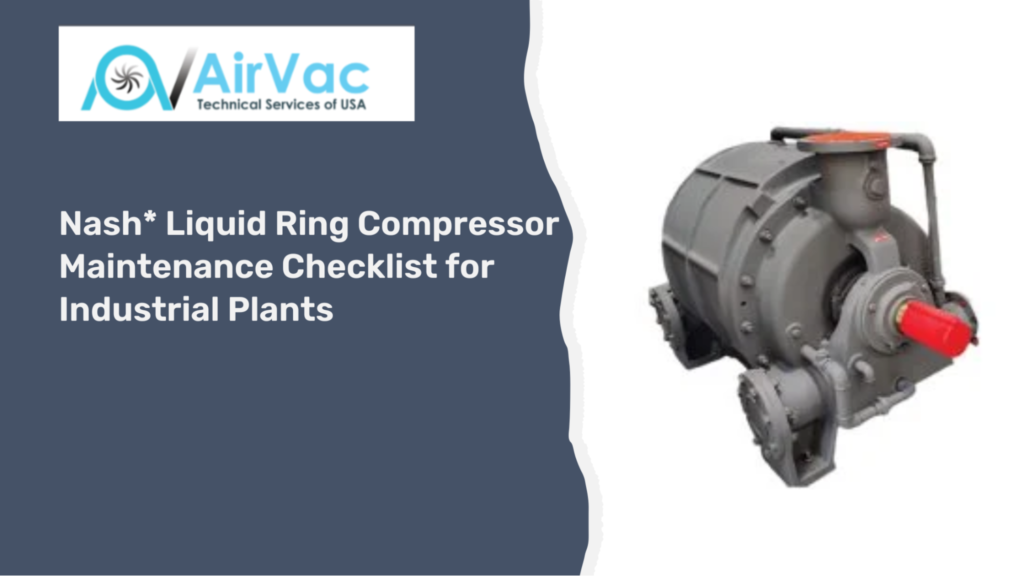
A Nash liquid ring compressor should be inspected regularly for seal liquid flow, temperature, pressure, vibration, noise, bearing condition, lubrication, internal wear, corrosion, leaks, and operating efficiency. The most effective maintenance program combines daily operator checks, weekly visual inspections, monthly performance reviews, and planned annual shutdown inspections.
For industrial plants, the goal is simple: keep the compressor running safely, efficiently, and predictably. Liquid ring compressors often serve demanding processes in paper mills, chemical plants, food processing facilities, power plants, mining operations, wastewater systems, and general manufacturing. When these systems lose performance, production can slow, energy use can rise, and unplanned downtime can become costly.
A good Nash liquid ring compressor maintenance checklist should answer four questions:
- Is the compressor operating within normal pressure, temperature, and flow ranges?
- Is the seal liquid clean, cool, and supplied at the right rate?
- Are bearings, seals, couplings, and drive components in good condition?
- Are there early signs of internal wear, corrosion, scale buildup, or cavitation?
This guide provides maintenance managers, reliability engineers, plant supervisors, and operators with a practical checklist to support uptime. It is not a substitute for your OEM manual, plant safety procedures, or a licensed service provider. Always follow your site rules, lockout procedures, and applicable federal, state, and local requirements. OSHA’s lockout/tagout standard applies to servicing and maintenance where unexpected energisation or stored energy could injure workers.
What Is a Nash* Liquid Ring Compressor?
A Nash liquid ring compressor is a positive-displacement machine that uses a rotating impeller and a seal liquid to compress gas. As the impeller rotates, the liquid forms a ring inside the casing. This creates chambers that pull in gas, compress it, and discharge it.
The seal liquid does several jobs:
| Function | Why It Matters |
| Creates the liquid ring | Allows gas compression to occur |
| Removes heat | Helps control operating temperature |
| Seals internal clearances | Supports compressor efficiency |
| Handles vapour or wet gas | Helps the compressor work in harsh process conditions |
Nash describes liquid ring machines as using a simple working principle where seal liquid forms the ring and creates gas chambers for compression. This design is one reason liquid ring compressors remain common in tough industrial environments.
Why Does Maintenance Matter for Industrial Plants?
Maintenance matters because small issues often become larger failures. A slightly hot seal water supply, a worn bearing, or scale inside the casing may not stop production today. Over time, it can reduce capacity, increase power draw, damage internal parts, or create an emergency shutdown.
Nash notes that calcium buildup can cause higher horsepower use, reduced pump capacity, lost production, and equipment damage. That is a clear example of why routine checks are not just paperwork. They protect reliability and cost control.
The U.S. Department of Energy also notes that better energy management practices can help industrial compressed air systems improve performance and reduce energy use. While every plant is different, the same reliability mindset applies to process compressors: measure, maintain, and correct problems early.
Daily Nash* Liquid Ring Compressor Maintenance Checklist
Daily checks should be simple enough for operators to complete during normal rounds. The goal is to catch visible or audible changes before they become failures.
| Daily Check | What to Look For | Why It Matters |
| Seal liquid flow | Stable flow, no sudden drop | Low flow can cause overheating or poor compression |
| Seal liquid temperature | Temperature within plant limits | Hot liquid can reduce compressor performance |
| Suction and discharge pressure | Readings match normal operating range | Pressure changes may show process or compressor issues |
| Noise | New knocking, grinding, or rattling | Noise may indicate bearing, coupling, or internal wear |
| Vibration | Change from normal feel or reading | Rising vibration can signal misalignment or imbalance |
| Leaks | Water, oil, gas, or process fluid leaks | Leaks affect safety, performance, and housekeeping |
| Motor load | Normal amps or power draw | Higher load may show scale, wear, or process restriction |
| Discharge condition | Stable discharge flow and temperature | Changes can point to process or internal problems |
Practical daily tip
Keep a simple log. Do not only record “OK.” Record actual pressure, temperature, flow, and vibration readings when possible. Trend data helps you see slow changes that a single inspection may miss.
Weekly Maintenance Checklist
Weekly checks should go deeper than daily rounds. These inspections help confirm that the compressor, motor, piping, and support systems are still in good working order.
Inspect the seal liquid quality
Check for:
- Scale
- Solids
- Oil contamination
- Chemical contamination
- Rust or discolouration
- Excessive temperature
Poor seal liquid can reduce performance and increase internal wear. If your plant uses hard water, scaling can become a major issue. Review water treatment, strainers, filters, and heat exchangers if you see repeated buildup.
Check strainers and filters
A restricted strainer can reduce the flow of seal liquid. That can raise operating temperature and reduce capacity. Clean or replace strainers based on your plant schedule and process conditions.
Review bearing temperature
Warm bearings may be normal, but a rising trend is not. Compare the reading with your baseline. If bearing temperature increases with vibration or noise, schedule inspection before the next production-critical run.
Inspect the coupling and guard condition
Look for:
- Loose hardware
- Coupling wear
- Damaged guard
- Misalignment signs
- Rubber element wear, if applicable
Coupling problems often show up as vibration, heat, or abnormal noise.
Monthly Maintenance Checklist
Monthly maintenance should focus on performance trends and mechanical condition. This is where reliability teams can prevent repeat failures.
| Monthly Task | Action |
| Review operating data | Compare pressure, temperature, flow, vibration, and motor load against baseline |
| Check alignment indicators | Look for coupling wear, soft foot signs, or mounting movement |
| Inspect foundation bolts | Tighten loose fasteners according to plant procedure |
| Review the seal liquid system | Confirm valves, strainers, temperature controls, and flow controls work correctly |
| Check lubrication records | Confirm correct lubricant, quantity, and interval |
| Inspect for corrosion | Check casing, piping, baseplate, and exposed surfaces |
| Review spare parts | Confirm critical parts are available before planned shutdowns |
What performance changes should you investigate?
Investigate the compressor if you see:
- Lower compression performance
- Rising discharge temperature
- Higher horsepower or motor amps
- Unstable pressure
- Higher seal liquid consumption
- New vibration
- Unusual noise
- Repeated bearing issues
- Seal liquid flow changes
Do not treat these symptoms as isolated events. Look for root causes.
Quarterly Maintenance Checklist
Quarterly checks are useful for facilities that run compressors continuously or in harsh service.
Inspect process conditions
Ask these questions:
- Has the gas composition changed?
- Has the inlet temperature changed?
- Has the plant increased production load?
- Has the liquid temperature of the seal increased due to seasonal changes?
- Has the system started pulling more vapour, liquid carryover, or solids?
A compressor problem may actually start as a process change. Maintenance teams should compare compressor symptoms with production changes.
Check for scale and mineral buildup
Scale can narrow passages, reduce efficiency, and increase power draw. If your system uses water with high mineral content, schedule cleaning based on actual buildup, not guesswork.
Review vibration data
If your site uses vibration monitoring, compare quarterly trends against the baseline. Rising vibration may show:
- Misalignment
- Bearing wear
- Cavitation
- Foundation looseness
- Impeller damage
- Coupling problems
Annual Shutdown Inspection Checklist
Annual inspections should be planned before production shutdowns. This helps you order parts, schedule service, and avoid delay.
| Annual Inspection Area | What to Review |
| Internal clearances | Confirm wear is within acceptable limits |
| Impeller condition | Look for erosion, corrosion, cracks, or buildup |
| Casing condition | Inspect for wear, corrosion, or damage |
| Bearings | Replace or inspect based on service history and condition |
| Seals and gaskets | Replace worn or leaking components |
| Shaft condition | Check for wear, scoring, or runout |
| Wear plates or cones | Inspect for erosion and clearance issues |
| Piping | Inspect for restriction, corrosion, or leaks |
| Instrumentation | Calibrate or verify readings |
| Motor and drive | Inspect alignment, coupling, and electrical condition |
Annual service is also the right time to decide whether to repair, rebuild, or replace the unit.
How Do You Know a Nash* Liquid Ring Compressor Needs Service?
A Nash liquid ring compressor may need service if it cannot hold the expected pressure, uses more power than normal, runs hotter than usual, or shows signs of vibration, noise, leaks, or internal wear.
Common warning signs include:
- Reduced gas flow
- Loss of compression
- Increased motor amps
- Frequent trips or shutdowns
- Seal liquid problems
- Water carryover issues
- Bearing noise
- Excessive vibration
- Visible corrosion
- Scale buildup
- Longer startup time
- Unstable discharge pressure
If two or more symptoms appear together, schedule a detailed inspection. For example, high motor amps plus reduced capacity may point to internal buildup or mechanical drag. Vibration plus bearing temperature may indicate alignment issues or bearing wear.
What Causes Poor Performance?
Poor performance usually stems from one of five areas: seal-liquid problems, process changes, mechanical wear, internal buildup, or system restrictions.
1. Seal liquid problems
Seal liquid that is too hot, dirty, restricted, or chemically aggressive can reduce performance and damage parts.
2. Process changes
A change in gas load, temperature, vapour content, or process pressure can make the compressor look weak even when the machine is mechanically sound.
3. Mechanical wear
Worn internal clearances reduce efficiency. Bearings, shaft components, and seals can also affect operation.
4. Internal buildup
Scale, rust, solids, and process deposits can reduce capacity and increase power use.
5. System restrictions
Blocked strainers, closed valves, damaged piping, or fouled heat exchangers can limit flow.
Maintenance Schedule for Industrial Plants
Use this schedule as a starting point. Adjust it based on your process, duty cycle, water quality, gas composition, and plant safety rules.
| Frequency | Maintenance Task |
| Daily | Check seal liquid flow, pressure, temperature, noise, vibration, leaks, and motor load |
| Weekly | Inspect filters, strainers, couplings, bearing temperature, and seal liquid quality |
| Monthly | Review trends, lubrication records, alignment indicators, fasteners, and corrosion |
| Quarterly | Inspect scale risk, process changes, vibration trends, and system restrictions |
| Annually | Plan internal inspection, rebuild review, part replacement, and performance testing |
How Can Plants Reduce Downtime?
Plants can reduce downtime by keeping good operating records, stocking critical parts, inspecting seal liquid systems, and planning rebuilds before failure.
A practical downtime reduction plan includes:
- Keep a baseline for pressure, temperature, flow, amps, and vibration
- Train operators to report changes early
- Keep strainers and seal liquid systems clean
- Review hard water or scaling risk
- Stock common wear parts
- Plan annual inspections around shutdown windows
- Use qualified service support for internal repairs
- Document root causes after every failure
Procurement teams should also review lead times before a shutdown. Waiting until a compressor fails can limit options.
Should You Rebuild or Replace the Compressor?
Rebuild the compressor when the casing and major components are serviceable, the frame still fits the process, and the repair cost is reasonable compared with replacement. Replace it when damage is severe, parts are difficult to source, performance no longer meets the process needs, or the risk of downtime is too high.
| Situation | Better Option |
| Bearings, seals, gaskets, or wear parts are worn | Rebuild or repair |
| Internal clearances are out of tolerance, but the casing is usable | Rebuild |
| Severe corrosion or cracked major components | Replacement may be better |
| The unit fails often after repeated repairs | Evaluate replacement |
| Production cannot wait for a long repair cycle | Consider rebuilding the exchange or replacement |
| Process requirements changed | Review replacement sizing |
Safety Notes Before Maintenance
Before inspecting or servicing any industrial compressor, follow your plant’s safety procedures. This may include lockout/tagout, pressure release, draining, cooling, confined space review, chemical exposure controls, and PPE.
OSHA’s lockout/tagout rule sets minimum requirements for controlling hazardous energy during servicing and maintenance. State, local, environmental, and site-specific rules may also apply. Requirements can vary by location and industry, so confirm with your safety team or qualified provider.
FAQ
How often should a Nash* liquid ring compressor be maintained?
Operators should check basic readings daily. Maintenance teams should complete deeper inspections weekly, monthly, quarterly, and annually. The right schedule depends on hours of operation, process gas, seal liquid quality, and plant risk.
What is the most common cause of liquid ring compressor problems?
Seal liquid issues are common. Hot, dirty, restricted, or chemically aggressive seal liquid can reduce performance and increase wear. Scale buildup is also a frequent problem in plants that use hard water.
Why is my liquid ring compressor losing capacity?
Capacity loss may result from hot seal liquid, low seal liquid flow, internal wear, suction leaks, scale buildup, process changes, or piping or strainer restrictions. Start with operating data before opening the machine.
Can a Nash* liquid ring compressor be rebuilt?
Yes. Many Nash liquid ring compressors can be rebuilt if the major components are still serviceable. A rebuild may include bearings, seals, gaskets, wear parts, cleaning, machining, and performance checks.
When should a plant replace instead of rebuild?
Replacement may make more sense when the casing is badly damaged, corrosion is severe, internal parts are no longer practical to repair, or the compressor no longer meets process requirements.
What records should maintenance teams keep?
Keep pressure, temperature, seal liquid flow, motor amps, vibration, bearing temperature, lubrication, repairs, and parts history. These records help identify trends and support better decisions about rebuilds or replacements.
Conclusion
A Nash liquid ring compressor maintenance checklist should be practical, consistent, and based on real operating data. Daily checks catch early changes. Weekly and monthly inspections help prevent repeat issues. Quarterly reviews show process and vibration trends. Annual shutdown inspections help teams decide when to repair, rebuild, or replace the unit. When plants follow a clear checklist, they improve reliability, reduce surprise failures, and make better maintenance decisions. For rebuild, replacement, and parts support, contact Airvac Technical Services.