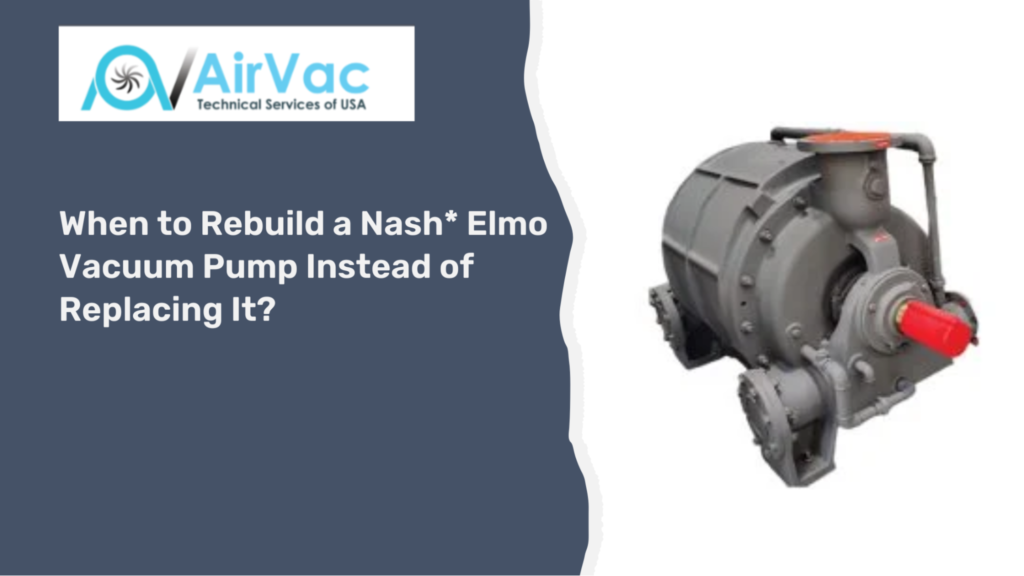
You should rebuild a Nash Elmo vacuum pump when the main casing, rotor, shaft, and major cast components are still serviceable, but wear parts such as bearings, seals, gaskets, cones, or internal clearances need repair. Replacement makes more sense when the pump has severe corrosion, cracked castings, repeated failures, unavailable parts, poor efficiency after prior rebuilds, or no longer meets the plant’s process requirements.
For many industrial plants, a rebuild is the first option to evaluate. Nash liquid ring vacuum pumps are built for tough process environments, and many units can run for years when properly maintained and repaired. NASH describes liquid ring vacuum pumps as durable solutions for challenging process applications, which is why many plants keep older units in service rather than replace them immediately.
The right choice depends on more than age. A 20-year-old pump may still be a good candidate for a rebuild if its body is sound and the process duty has not changed. A newer pump may need replacement if it has major internal damage, wrong sizing, or severe chemical attack.
This guide explains how maintenance managers, reliability engineers, plant managers, and procurement teams can decide whether to rebuild or replace a Nash Elmo vacuum pump. It covers warning signs, cost factors, downtime, safety, and practical decision points. Always compare these points with your pump manual, site procedures, and qualified service recommendations.
What Is a Nash* Elmo Vacuum Pump?
A Nash Elmo vacuum pump is commonly associated with liquid ring vacuum technology used in industrial and process applications. Liquid ring pumps use a rotating impeller and a seal to draw liquid into a vacuum. The seal liquid forms a ring inside the pump body, creating chambers that move and compress gas.
NASH’s liquid ring operating principle states that the seal liquid forms the ring inside the pump body, while the rotor creates gas chambers for the pumping action. This simple design is one reason liquid ring pumps remain common in wet, dirty, vapour-heavy, and demanding process environments.
Industrial applications may include:
- Chemical processing
- Paper and pulp production
- Food and beverage processing
- Power generation
- Medical vacuum systems
- Mining and metals
- General manufacturing
- Wastewater and environmental systems
Airvac’s ideal customers are usually industrial facilities that use Nash vacuum equipment and need uptime, repair support, compatible replacements, and spare parts.
Rebuild vs. Replace: What Is the Main Difference?
A rebuild restores the existing pump by repairing or replacing worn components. A replacement removes the existing unit and installs another pump, which may be new, rebuilt, refurbished, or a compatible replacement model.
| Option | What It Means | Best For |
| Repair | Fixes a specific problem | Minor leaks, bearing issues, and seal problems |
| Rebuild | Restores the pump more fully | Worn internal parts, performance loss, planned shutdowns |
| Replacement | Installs another unit | Severe damage, poor fit, repeated failures, process changes |
A rebuild is often the more practical first choice when the pump still meets the application’s requirements. Replacement becomes more attractive when reliability risk, repair cost, or downtime exposure becomes too high.
When Should You Rebuild a Nash* Elmo Vacuum Pump?
You should consider rebuilding a Nash Elmo vacuum pump when the pump shows performance loss or mechanical wear, but the major housing and structure are still usable.
1. The pump has lost vacuum performance
Loss of vacuum is one of the most common reasons plants inspect a liquid ring pump. It may happen slowly, so operators may not notice it until production drops or cycle times increase.
Common causes include:
- Worn internal clearances
- Damaged cones or port plates
- Seal liquid problems
- Suction leaks
- Scale buildup
- Worn bearings
- Impeller wear
If the casing is sound, a rebuild can often restore performance. Nash notes that calcium buildup can increase horsepower use, reduce pump capacity, cause lost production, and damage equipment. That makes cleaning, inspection, and rebuild evaluation important.
2. Internal wear is measurable but repairable
A rebuild may be the right choice when wear exists but has not destroyed the main components. During inspection, a service team may check:
- Rotor condition
- Shaft wear
- Bearing fit
- Cone or port plate wear
- Casing condition
- Internal clearances
- Corrosion depth
- Gasket and seal condition
If clearances can be restored and parts can be repaired or replaced, rebuilding can extend service life without a full replacement.
3. Bearings, seals, and gaskets are failing
Bearings, seals, and gaskets are common wear items. If these parts fail but the pump body remains healthy, a rebuild may solve the issue.
Warning signs include:
- Bearing noise
- High bearing temperature
- Shaft movement
- Seal leakage
- Water or process fluid leakage
- Vibration
- Oil contamination, where applicable
Replacing only one failed part may work in the short term. But if the pump has several wear symptoms, a rebuild gives the maintenance team a better chance of correcting the root cause.
4. The pump still fits the process
Rebuilding makes sense when the pump’s capacity, materials, and duty still match the plant’s needs. Ask these questions:
- Has the process gas changed?
- Has the flow requirement changed?
- Has the vacuum level changed?
- Has the operating temperature changed?
- Has the seal liquid source changed?
- Has production increased beyond the original design?
If the process has not changed much, rebuilding the existing pump may be practical. If the process has changed, replacement or re-sizing may be smarter.
5. Downtime can be planned
A rebuild is easier to justify when it can happen during a planned outage. Maintenance teams should schedule an inspection before the shutdown, not during it. That gives procurement time to source parts and service support.
When Should You Replace Instead of Rebuild?
Replacement may be the better choice when the existing pump is no longer reliable, economical, or suitable for the application.
1. The casing or major casting is damaged
A cracked casing, severe erosion, or deep corrosion can make rebuilding impractical. If the pump body can no longer hold proper clearances or pressure, replacement may reduce long-term risk.
2. The pump has repeated failures
If a pump fails again soon after repairs, the root cause may be deeper than wear-and-tear on the parts. Repeated failures may point to:
- Process mismatch
- Poor installation
- Severe internal wear
- Wrong materials for the service
- Chronic seal liquid problems
- Misalignment
- Foundation or piping strain
In this case, another rebuild may only delay the same failure.
3. Parts are hard to source
Older pumps may have long lead times for some components. If the plant cannot wait for parts, replacement with a rebuilt, refurbished, or compatible unit may reduce downtime.
Airvac’s website focuses on rebuilt Nash pumps, replacement pumps, and spare parts support for Nash models such as the CL, SC, 904, and XL series.
4. Energy use is too high
A worn or poorly matched vacuum pump can draw more power than necessary. The U.S. Department of Energy states that best energy management practices and energy-efficient equipment can improve performance and save energy in compressed air systems. The same thinking applies to plant vacuum systems: measure performance, compare it to the duty, and correct waste.
5. Safety or compliance risk is increasing
A pump that leaks process fluid, runs hot, vibrates heavily, or fails without warning can create safety concerns. Maintenance work should follow site procedures and OSHA requirements. OSHA’s lockout/tagout standard covers servicing and maintenance where unexpected energisation or stored energy could cause injury. Rules and enforcement can vary by state and industry in the USA, so teams should confirm requirements with safety staff, official agencies, or licensed providers.
Rebuild or Replace Decision Table
| Condition | Rebuild | Replace |
| Bearings or seals worn | Yes | Not usually |
| Casing is sound | Yes | Maybe |
| Severe casing corrosion | No | Yes |
| Pump still meets process duty | Yes | Maybe |
| Process requirements changed | Maybe | Yes |
| Parts are available | Yes | Maybe |
| Repeated failures after repairs | Maybe | Yes |
| Downtime must be minimal | Maybe, with an exchange option | Yes, if the unit is ready |
| Internal clearances can be restored | Yes | Not usually |
| Major casting is cracked | No | Yes |
What Should a Rebuild Include?
A proper rebuild should do more than replace obvious failed parts. It should identify why the pump lost performance and restore the unit to a reliable operating condition.
A typical rebuild review may include:
- Disassembly and cleaning
- Inspection of rotor, shaft, cones, casing, and wear surfaces
- Measurement of internal clearances
- Bearing and seal replacement
- Gasket replacement
- Repair or replacement of damaged wear parts
- Scale and corrosion removal
- Alignment review
- Reassembly to correct tolerances
- Performance testing is available
Airvac’s brand position focuses on clear, practical, technically confident service for Nash vacuum pump rebuilding, replacement, and parts supply. That type of service approach matters because rebuild quality depends on inspection, measurement, and testing.
What Information Should You Collect Before Calling a Service Provider?
Before requesting a rebuild or replacement quote, gather basic information. This helps the provider give better guidance and avoids delays.
| Information Needed | Why It Helps |
| Pump model and serial number | Confirms parts and design details |
| Current symptoms | Helps identify likely failure points |
| Operating vacuum level | Shows process demand |
| Gas type | Helps assess material and safety concerns |
| Seal liquid type and temperature | Affects performance and wear |
| Flow requirement | Confirms sizing |
| Photos of the nameplate and installation | Speeds review |
| Maintenance history | Reveals repeat failures |
| Shutdown deadline | Helps plan repair or exchange |
Photos are especially useful. Include the nameplate, coupling area, piping, seal liquid connections, and any visible leaks or corrosion.
Practical Example: Rebuild Makes Sense
A food processing plant has a Nash Elmo vacuum pump that runs every day. Operators report lower vacuum and a slight increase in motor amps. Maintenance finds scale buildup and worn bearings, but the casing is still in good condition. The process has not changed.
In this case, rebuilding may be the right choice. The team can clean the pump, replace wear parts, restore clearances, and return the unit to service during a planned shutdown.
Practical Example: Replacement Makes Sense
A chemical plant has an older liquid ring pump with severe internal corrosion in the casing. The pump has been repaired twice in two years. It still loses capacity, and parts have long lead times. Production needs have also changed.
In this case, replacement may be safer and more practical. A rebuilt exchange unit or compatible replacement may reduce risk and downtime.
How Can You Lower the Risk of the Wrong Decision?
Use a structured review before choosing rebuild or replacement.
- Confirm the pump model and duty.
- Review symptoms and operating data.
- Inspect seal liquid quality and temperature.
- Check for suction leaks or process restrictions.
- Measure vibration and motor load.
- Inspect internal wear if symptoms continue.
- Compare rebuild cost, replacement cost, lead time, and downtime risk.
- Choose the option that supports reliability, not just the lowest upfront cost.
The lowest quote is not always the lowest total cost. Downtime, lost production, emergency freight, and repeat repairs can change the true cost.
FAQ
Is it worth rebuilding a Nash* Elmo vacuum pump?
Yes, it can be worth rebuilding if the pump body and major parts are still serviceable. A rebuild may restore performance at a lower cost than full replacement, especially when the pump still fits the process.
How do I know if my vacuum pump needs a rebuild?
Common signs include loss of vacuum, high motor amps, vibration, bearing noise, seal leaks, overheating, and repeated performance problems. If these symptoms continue after basic maintenance, schedule an inspection.
How long does a liquid ring vacuum pump last?
Service life depends on operating hours, gas type, seal liquid quality, maintenance, materials, and process conditions. Some liquid ring pumps remain in service for many years when properly maintained and rebuilt.
What causes a Nash* Elmo vacuum pump to lose vacuum?
Possible causes include worn internal clearances, hot seal liquid, low seal liquid flow, suction leaks, scale buildup, damaged cones, worn bearings, process changes, or blocked piping.
Is replacement better than rebuilding?
Replacement is better when the pump has severe corrosion, cracked major components, repeated failures, poor efficiency, or no longer fits the process. Rebuilding is better when the structure is sound, and wear is repairable.
Should I use a licensed or qualified service provider?
Yes. Industrial vacuum pumps involve rotating equipment, pressure, electrical power, and process hazards. Use qualified service providers and follow official safety procedures, site rules, and state-specific requirements.
Conclusion
A Nash Elmo vacuum pump should be rebuilt when wear is repairable, major components are sound, and the pump still matches the process. Replacement is the better choice when damage is severe, failures repeat, parts are difficult to source, or the process has changed. The best decision comes from inspection, operating data, downtime planning, and a clear view of lifecycle cost. For support with Nash vacuum pump rebuilds, replacement options, and spare parts, contact Airvac Technical Services.