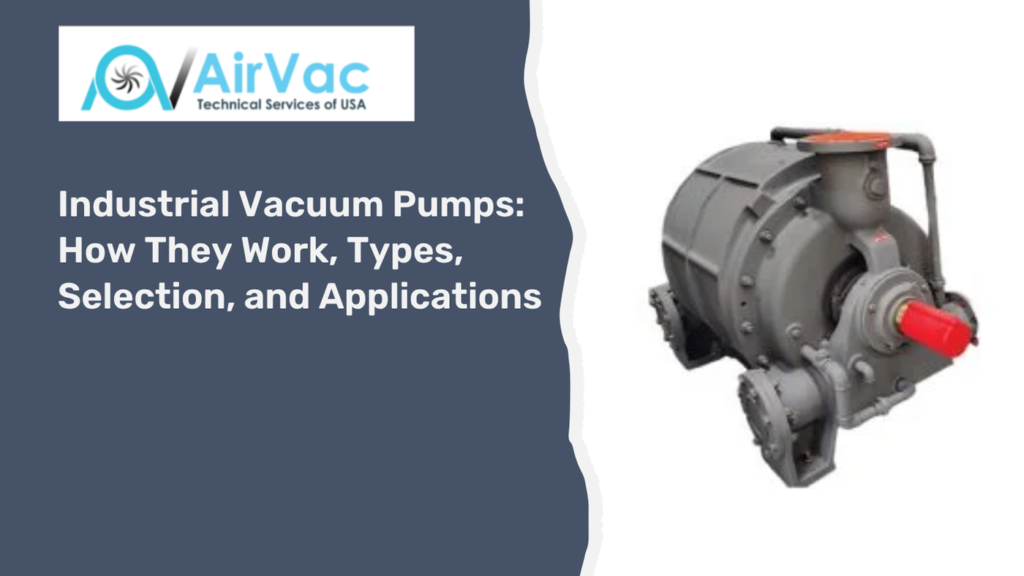
Industrial vacuum pumps are essential to modern manufacturing. They remove gas from sealed environments to create controlled, low-pressure conditions that enable critical processes from packaging food to fabricating semiconductors with nanometer precision.
At their core, vacuum pumps work through a repeating intake-isolate-exhaust cycle that progressively lowers pressure inside a sealed chamber. The mechanism varies by pump type: rotary vane, liquid ring, dry screw, turbomolecular, and diffusion pumps. Each serves different pressure ranges, gas types, and process demands. Selecting the right type starts with understanding these differences.
Beyond the pump itself, a complete vacuum system integrates motors, valves, filters, and sensors, each playing a defined role in achieving and maintaining stable vacuum conditions. Performance is measured across six parameters: ultimate and operating pressure, pumping speed, flow rate, temperature tolerance, energy consumption, and efficiency. Together, these values determine whether a pump matches the real demands of a process.
Selecting the right pump requires more than matching pressure specs. Gas composition, contamination sensitivity, duty cycle, operating environment, and total cost of ownership all shape the correct specification. A pump that looks right on paper but is wrong for the process costs far more in failures and downtime than a correctly specified unit costs upfront.
Vacuum pumps serve industries as varied as semiconductors, pharmaceuticals, food processing, automotive, aerospace, power generation, and mining. Each application has distinct vacuum requirements, pump preferences, and maintenance demands.
This guide covers everything needed to understand, select, operate, and maintain industrial vacuum pumps effectively.
What is a Vacuum Pump?
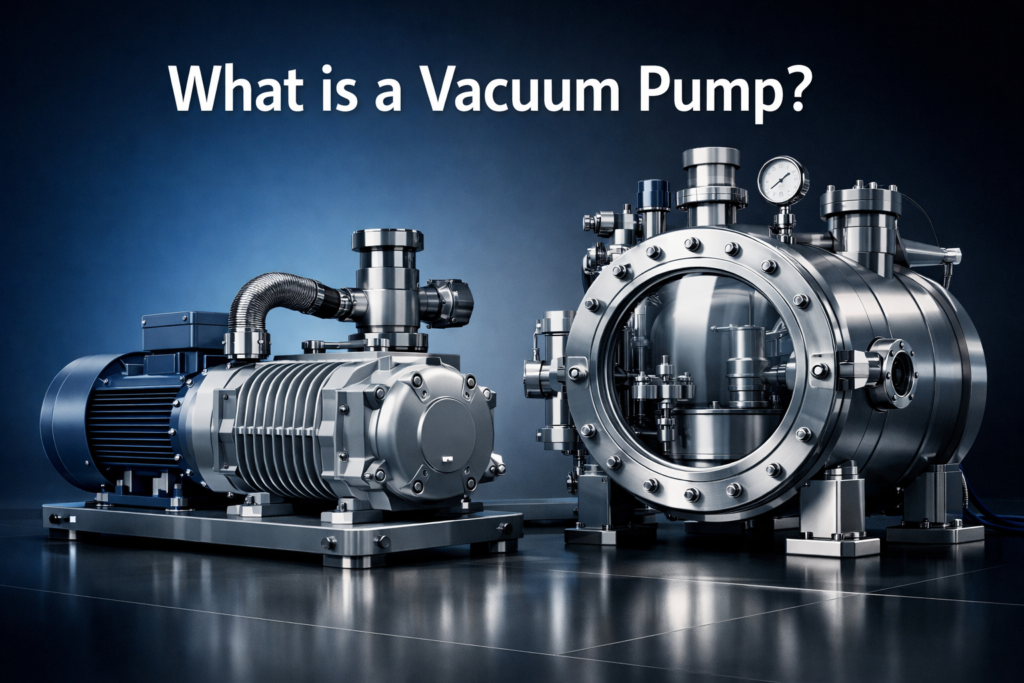
A vacuum pump is a mechanical device that removes gas molecules from a sealed chamber, creating a partial or near-total vacuum. It works against atmospheric pressure, lowering the air density inside an enclosed space below the surrounding environment’s pressure level.
Industrial vacuum pumps serve a core function: moving gas out and reducing pressure in. They are used across manufacturing, chemical processing, food packaging, pharmaceuticals, and semiconductor fabrication, anywhere a controlled low-pressure environment is required.
Vacuum pumps are rated by two key specs:
- Ultimate vacuum – the lowest pressure the pump can achieve
- Pumping speed – the volume of gas displaced per unit of time (measured in m³/h or CFM)
These two values determine whether a pump is suitable for a light-duty application or a high-demand industrial process.
How Do Vacuum Pumps Work?
A vacuum pump works by repeatedly expanding a cavity on the inlet side, allowing gas to flow in from the chamber, then compressing and expelling that gas through the exhaust. Each cycle removes a portion of the remaining gas, progressively lowering the pressure inside the system.
Most industrial vacuum pumps follow this principle across three stages:
- Intake – The pump opens a cavity connected to the sealed chamber. Gas flows in from the high-pressure side (the chamber) toward the low-pressure side (inside the pump).
- Isolation: The cavity seals off, trapping the captured gas volume within the pump mechanism.
- Exhaust – The cavity compresses, forcing the trapped gas out through the exhaust valve and releasing it into the atmosphere or a downstream system.
This cycle repeats continuously, removing more gas with each revolution or stroke until the target vacuum level is reached.
The exact mechanism varies by pump type. Rotary vane pumps use offset vanes inside a rotor. Liquid ring pumps use a rotating liquid seal. Dry screw pumps use counter-rotating screws. Diaphragm pumps use a flexible membrane. Each mechanism applies the same intake-isolate-exhaust logic but with different physical components suited to different pressures, temperatures, and gas types.
What Are the Types of Industrial Vacuum Pumps?
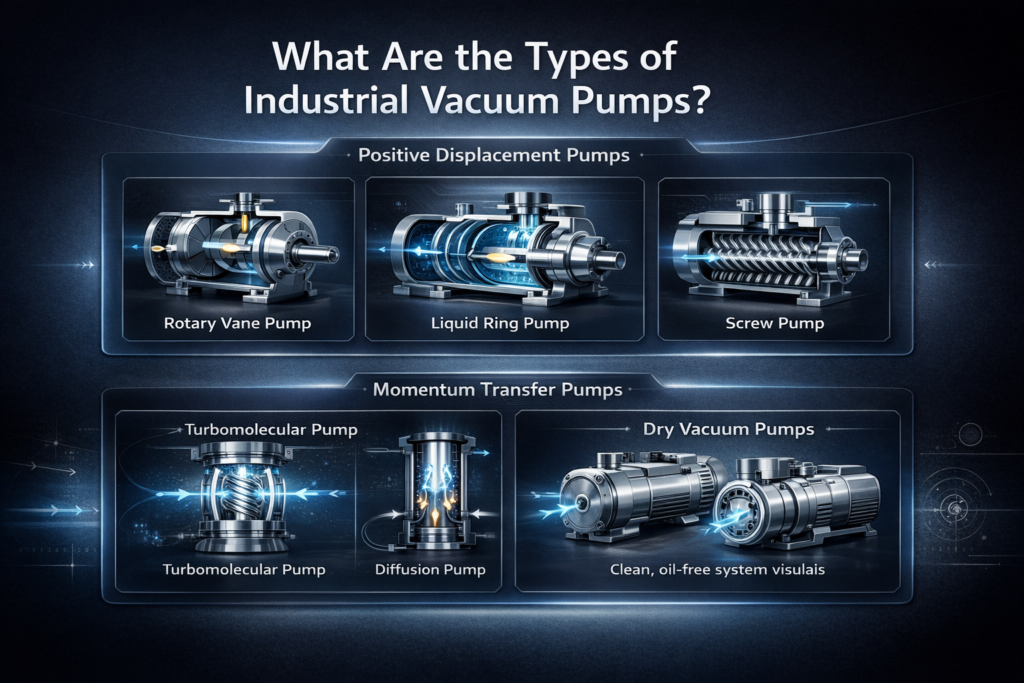
Industrial vacuum pumps are grouped by their operating mechanism. Each category suits different pressure ranges, gas types, and process demands. Choosing the wrong type leads to premature wear, contamination, or insufficient vacuum depth.
Positive Displacement Pumps
Positive displacement pumps work by trapping a fixed volume of gas and physically moving it from the inlet to the exhaust. They are the most widely used category in industrial settings due to their reliability across a broad pressure range.
Rotary vane pumps
A rotary vane pump uses an offset rotor fitted with sliding vanes inside a cylindrical housing. As the rotor spins, the vanes extend outward against the housing wall, creating expanding and contracting chambers that capture and expel gas.
A rotary vane pump uses an offset rotor fitted with sliding vanes inside a cylindrical housing. As the rotor spins, the vanes extend outward against the housing wall, creating expanding and contracting chambers that capture and expel gas.
- Operating range: Atmosphere down to 0.1 mbar (single-stage) or 0.001 mbar (two-stage)
- Common uses: Packaging, laboratory equipment, printing, refrigeration, and HVAC systems
- Key trait: Oil-lubricated models deliver deep vacuum levels; dry vane models suit clean-process environments
Rotary vane pumps offer a balance of compact size, low cost, and reliable vacuum depth, making them one of the most common pumps in light-to-medium industrial use.
Liquid ring pumps
A liquid ring pump uses a rotating impeller inside an eccentric casing partially filled with liquid (usually water). The spinning impeller flings the liquid outward, forming a rotating ring that creates and collapses gas chambers with each revolution.
- Operating range: Down to approximately 25–50 mbar (single-stage); ~1 mbar with two stages
- Common uses: Chemical processing, paper and pulp industries, power generation, and vacuum distillation
- Key trait: The liquid seal continuously absorbs heat and handles wet, condensable, or corrosive gases without damage
Liquid ring pumps tolerate harsh, moisture-laden, and chemically aggressive gas streams that would destroy dry mechanical pumps.
Screw pumps
A dry screw vacuum pump uses two counter-rotating helical screws to trap gas between the screw flights and the pump casing, moving it axially from inlet to exhaust without contact between moving parts.
- Operating range: Atmosphere down to 0.01 mbar
- Common uses: Semiconductor manufacturing, chemical processing, freeze-drying, and pharmaceutical production
- Key trait: No oil in the gas stream process gases remain uncontaminated, and exhaust is clean
Screw pumps deliver deep vacuum without lubrication in the gas path, making them the preferred choice for sensitive or high-purity processes.
Momentum Transfer Pumps
Momentum transfer pumps do not mechanically trap and displace gas. Instead, they accelerate gas molecules in a specific direction using high-speed rotation or a high-velocity vapor jet. These pumps operate exclusively in the medium-to-high vacuum range and always require a backing pump to work.
Turbomolecular pumps
A turbomolecular pump uses a series of angled, high-speed rotor blades spinning at 20,000–90,000 RPM. The blades strike gas molecules and direct them toward the exhaust, compressing them into the backing pump.
- Operating range: 10⁻³ mbar down to 10⁻¹¹ mbar (high to ultra-high vacuum)
- Common uses: Semiconductor fabrication, mass spectrometry, electron microscopy, particle accelerators, and thin-film coating
- Key trait: Extremely clean vacuum, no oil contamination, no process gas interference
Turbomolecular pumps achieve the deepest clean vacuum levels available in industrial and scientific applications.
Diffusion pumps
A diffusion pump uses a boiled pump fluid (oil or mercury) to produce a high-velocity vapor jet directed downward into the pump body. Gas molecules entering the pump are captured by the jet, compressed, and pushed toward the exhaust, where a backing pump removes them.
- Operating range: 10⁻² mbar down to 10⁻¹⁰ mbar
- Common uses: Vacuum metallurgy, coating systems, research equipment, and high-vacuum furnaces
- Key trait: No moving parts, completely silent, mechanically simple, and capable of very high throughput at low pressures
Diffusion pumps combine high vacuum performance with mechanical simplicity, though they require careful fluid management to prevent backstreaming contamination.
Dry Vacuum Pumps
Dry vacuum pumps operate without oil or other liquids in the pumping chamber. This is a design philosophy shared across several pump types, including dry screw, claw, and scroll pumps united by one principle: the gas path stays clean.
Oil-free advantages
- No fluid contamination – process gases and exhaust streams remain free of oil vapor
- Lower maintenance – no oil changes, no separator filters, no fluid monitoring required
- Safer exhaust handling – clean exhaust simplifies downstream scrubbing and waste management
- Longer service intervals – non-contact internal clearances reduce mechanical wear
Dry vacuum pumps eliminate the contamination risk and maintenance burden that oil-sealed pumps introduce into sensitive industrial processes.
Industrial relevance
Dry vacuum pumps have become the standard in industries where product purity, process cleanliness, and regulatory compliance are non-negotiable.
- Semiconductor fabs rely on dry screw and scroll pumps to handle reactive process gases without oil-related contamination
- Pharmaceutical manufacturers use dry pumps during drying, filling, and packaging to meet FDA and GMP cleanliness requirements
- Food processing facilities choose oil-free systems to eliminate any risk of product contamination
- Chemical plants benefit from dry pumps’ ability to handle aggressive or polymerizing gases that would degrade oil seals
As environmental standards tighten and process purity demands increase, dry vacuum technology continues to replace oil-sealed alternatives across industrial sectors.
What Are the Key Components of an Industrial Vacuum System?
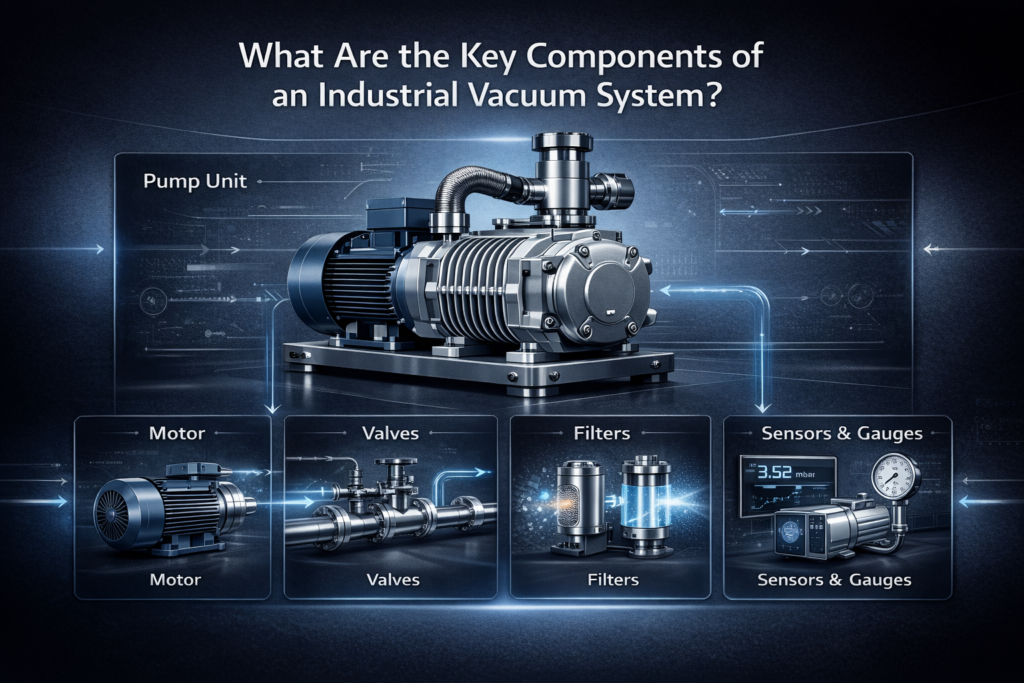
An industrial vacuum system is more than just a pump. It is an integrated assembly of mechanical, electrical, and control components working together to achieve and maintain a stable vacuum. Understanding each component helps with correct specification, preventive maintenance, and faster fault diagnosis.
Pump Unit
The pump unit is the core of the system it is the mechanical assembly that physically removes gas from the process chamber. It defines the system’s ultimate vacuum level, pumping speed, and compatibility with specific gases or process conditions.
The pump unit includes the pumping mechanism (rotary vanes, screws, impeller, or rotor blades), the pump casing, inlet and exhaust ports, and in oil-sealed models, the lubrication reservoir. Its size, material construction, and seal type determine whether it can handle corrosive gases, high temperatures, or condensable vapors.
The pump unit determines the entire system’s vacuum capability and process compatibility.
Motor
The motor drives the pump mechanism and must be matched precisely to the pump’s torque and speed requirements. Most industrial vacuum pumps use AC induction motors, though variable frequency drive (VFD) motors are increasingly common in energy-conscious facilities.
Key motor specifications include:
- Power rating (kW or HP) – must match pump load under full operating conditions
- Speed (RPM) – directly governs pumping speed and vacuum depth
- IP rating – defines protection against dust and moisture ingress in harsh environments
- Efficiency class – IE3 and IE4 motors reduce operating costs over long run cycles
Motors fitted with VFDs allow pump speed to vary with process demand, cutting energy consumption by 30–50% compared to fixed-speed motors running at full load continuously.
The motor controls pumping speed, energy consumption, and system responsiveness.
Valves
Valves manage gas flow throughout the vacuum system. Each valve type serves a specific control function:
- Inlet valve – isolates the pump from the process chamber during startup, shutdown, or power failure, preventing sudden pressure surges or oil backflow
- Exhaust valve – controls discharge flow and prevents atmospheric air from re-entering the pump when it stops
- Isolation valve – seals off sections of the system for maintenance or process changeover without venting the entire system
- Throttling valve – regulates pumping speed to control vacuum level in processes requiring a specific pressure setpoint
- Anti-suckback valve – activates automatically on shutdown to protect the process chamber from contamination if the pump loses power
Valves protect both the pump and the process from pressure shocks, contamination, and uncontrolled venting events.
Filters
Filters protect the pump from particulates and protect the process or atmosphere from pump exhaust. They sit at two critical points in the system:
Inlet filters sit between the process chamber and the pump inlet. They capture dust, particles, and condensed liquids before they reach the pumping mechanism. Without inlet filtration, abrasive particles accelerate internal wear, and contamination builds up on pump surfaces.
Exhaust filters (oil mist eliminators) are fitted to the exhaust of oil-sealed pumps. They capture oil aerosols and vapors that would otherwise be discharged into the facility or exhaust ducting. In oil-free dry pump systems, exhaust filtration focuses on capturing process gas residues before they reach the atmosphere or scrubber systems.
- Coalescing filters – capture fine oil mist droplets and coalesce them into liquid for drainage
- Particulate filters – trap solid contamination at the inlet
- Chemical scrubbers – neutralize toxic or corrosive exhaust gases in semiconductor and chemical applications
Filters extend pump service life and ensure that neither the pump nor the surrounding environment is exposed to harmful contaminants.
Sensors and Gauges
Sensors and gauges monitor system performance in real time, providing the data needed to maintain target vacuum levels, detect faults early, and trigger automated responses.
Pressure gauges and vacuum sensors are the most critical instruments. Different sensor technologies cover different pressure ranges:
- Pirani gauges – measure thermal conductivity of gas; effective from atmosphere down to ~10⁻⁴ mbar
- Capacitance manometers – provide highly accurate, gas-independent pressure measurement; used in precise process control
- Penning (cold cathode) gauges – measure ionization of gas molecules; suited for high and ultra-high vacuum ranges below 10⁻³ mbar
- Combination gauges – pair two sensor types to cover a wide pressure range from rough vacuum to high vacuum in a single instrument
Temperature sensors monitor the pump body, motor winding, and exhaust temperatures to detect overheating before it causes mechanical failure.
Flow sensors track gas throughput at the inlet, identifying sudden load changes that signal a process leak or upstream equipment fault.
Vibration sensors on larger pump units detect bearing wear, rotor imbalance, or mechanical loosening, enabling predictive maintenance before a failure occurs.
Sensors and gauges convert physical vacuum conditions into actionable data, enabling both process control and equipment protection.
What Are the Critical Performance Parameters of Industrial Vacuum Pumps?
Selecting or evaluating an industrial vacuum pump requires understanding its performance parameters. These values define what a pump can achieve, how efficiently it operates, and whether it matches the demands of a specific process. Misreading even one parameter leads to undersized equipment, wasted energy, or process failure.
Pressure (Ultimate & Operating)
Ultimate pressure is the lowest pressure a pump achieves under ideal, no-load conditions its theoretical floor. Operating pressure is the actual pressure maintained during a live process with continuous gas flow, and is always higher than the ultimate pressure.
The gap between the two matters: a pump operating near its ultimate pressure is close to its limit and will lose stability under any additional gas load.
| Range | Pressure | Typical Applications |
| Rough vacuum | 1013 – 1 mbar | Packaging, clamping, lifting |
| Medium vacuum | 1 – 10⁻³ mbar | Drying, distillation, coating |
| High vacuum | 10⁻³ – 10⁻⁷ mbar | Semiconductor, thin-film deposition |
| Ultra-high vacuum | Below 10⁻⁷ mbar | Particle accelerators, space simulation |
Pumping Speed
Pumping speed measures how quickly a pump removes gas, expressed in m³/h, l/s, or CFM. It is not constant; it peaks in the mid-pressure range and drops as the pump approaches ultimate pressure. Manufacturers publish pumping speed curves across the full pressure range.
Key implications:
- Larger chambers need higher pumping speeds to hit the target pressure within cycle time
- High gas load processes need speed to handle continuous outgassing and vapor evolution
- Long, narrow inlet pipework degrades the effective pumping speed at the chamber significantly
Flow Rate
Pumping speed describes volumetric capacity. Flow rate describes the actual gas volume moved at operating pressure, accounting for real-gas density.
- Volumetric flow rate – gas volume per unit time at inlet conditions (l/s or m³/h)
- Mass flow rate – actual molecule quantity moved, expressed in sccm or kg/h
Mass flow rate is critical in CVD, semiconductor thin-film processes, and leak testing, anywhere gas concentration or throughput must stay within tight tolerances.
Temperature
Temperature affects performance in two ways: the gas entering the pump and the pump’s own operating temperature.
- Hot inlet gas – less dense, reducing effective mass removed per cycle; condensable vapors liquefy inside the pump if the temperature drops below the dew point
- Too cold – oil viscosity increases in oil-sealed pumps, slowing startup and reducing lubrication
- Too hot – seals degrade, oil oxidizes, dry pump clearances expand, bearing life shortens
Management strategies include inlet gas coolers, cooling water jackets, and thermal sensors with automatic shutdown.
Energy Consumption
Vacuum pumps run continuously in most facilities, making energy the dominant long-term operating cost. Key drivers:
- A deeper vacuum requires more work per cycle
- IE3 and IE4 motors reduce baseline consumption without affecting output
- Fixed-speed pumps run at full power regardless of load; VFD pumps match speed to actual demand
- Undetected system leaks force the pump to run harder to hold the setpoint pressure
A 20% reduction in specific energy consumption across a multi-pump facility produces significant annual savings with no process impact.
Efficiency
Efficiency measures how effectively a pump converts input energy into useful vacuum work across three levels:
- Volumetric efficiency – actual gas displaced versus theoretical swept volume; reduced by internal leakage and valve pressure drop
- Mechanical efficiency – useful pumping work versus shaft power input; reduced by friction, bearing losses, and seal drag
- System efficiency – overall performance accounting for motor losses, pipework drop, and valve restrictions
Efficiency degrades through worn vanes, degraded oil, fouled filters, and bearing wear. A pump at reduced efficiency either consumes more energy for the same vacuum or fails to hold target pressure entirely. Benchmarking against baseline efficiency values is the most reliable early indicator of mechanical deterioration.
How to Select the Right Industrial Vacuum Pump?
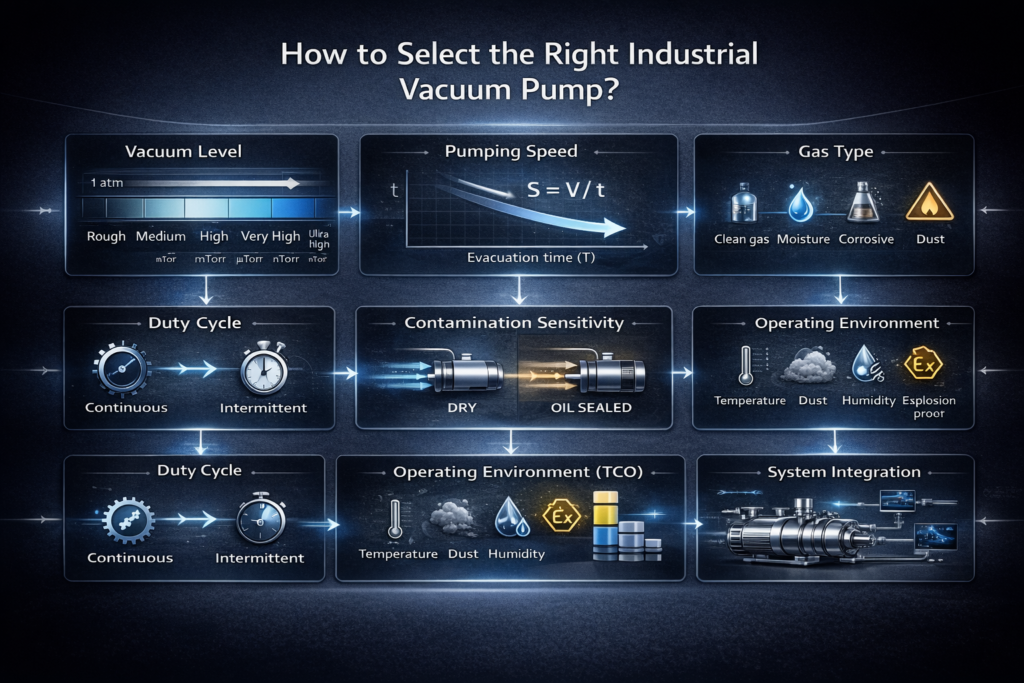
Selecting the wrong vacuum pump costs more than the unit itself: downtime, process failures, and wasted energy. Match pump capability to process requirements across these criteria.
Define the Required Vacuum Level
Start with pressure. Identify both the target operating pressure and the deepest point the process demands.
- Rough vacuum (above 1 mbar) – rotary vane, liquid ring, or claw pumps
- Medium vacuum (1 – 10⁻³ mbar) – two-stage rotary vane or dry screw pumps
- High vacuum (below 10⁻³ mbar) – turbomolecular or diffusion pumps with a backing pump
Never select a pump whose ultimate pressure equals your operating pressure. A pump running near its pressure floor is unstable under any additional gas load.
Determine the Required Pumping Speed
Calculate the pumping speed needed to reach the target vacuum within the required cycle time:
S = V × ln(P₁/P₂) / t
- S = pumping speed (m³/h or l/s)
- V = chamber volume
- P₁ = starting pressure, P₂ = target pressure
- t = acceptable pump-down time
Add a 20–30% margin for outgassing from chamber walls, fixtures, and process materials a real gas load that theoretical calculations exclude.
Identify the Gas Type and Composition
Gas chemistry is the most critical and most overlooked selection factor.
- Clean and dry – standard rotary vane or dry screw pumps
- Moisture or condensable vapors – liquid ring pumps; dry pumps need inlet condensers or gas ballast
- Corrosive, toxic, or reactive – stainless steel or PTFE-lined wetted parts required
- Particulates or dust – inlet filtration mandatory
- Flammable or explosive – ATEX-rated pump and motor required
Gas composition dictates material selection, sealing technology, and safety certification.
Assess Contamination Sensitivity
Determine whether the process allows pump fluid to contact the gas stream.
- Oil-sealed pumps introduce trace oil vapor backstreaming unacceptable in semiconductors, pharma, food, and analytical instruments
- Dry pumps keep the gas path oil-free mandatory in clean process environments
- Liquid ring pumps introduce seal liquid vapor must be chemically compatible with the process gas
If contamination tolerance is zero, specify a dry pump and add cold traps or inline filters as additional safeguards.
Consider Duty Cycle
How the pump runs over time changes its required specification.
- Intermittent duty – rotary vane and dry scroll pumps handle frequent start-stop cycles well
- Continuous duty – demands robust construction, effective cooling, and long-life bearings
- Variable load – VFD-equipped motors adapt speed to demand, reducing wear and energy use
A pump specified for intermittent use but run continuously will overheat and fail ahead of its rated service life.
Evaluate the Operating Environment
- High ambient temperature – additional cooling required
- Cold environments – oil heaters or low-viscosity lubricants for reliable cold starts
- Dust and humidity – IP-rated motor and enclosure protection
- Explosive atmospheres – ATEX Zone 1 or Zone 2 certification across pump, motor, and controls
- Noise limits – dry screw pumps are louder; acoustic enclosures may be required
Calculate Total Cost of Ownership
Purchase price is a poor basis for selection. TCO over the service life provides an accurate comparison.
| Cost Category | What to Include |
| Capital | Purchase, installation, commissioning |
| Energy | kW rating × hours × electricity rate |
| Maintenance | Oil, filters, seals, and scheduled overhauls |
| Downtime | Lost production during failures |
| Fluid disposal | Waste oil removal and compliant disposal |
| End-of-life | Decommissioning and recycling |
A dry screw pump with a higher purchase price frequently delivers lower TCO than a cheaper oil-sealed pump when energy savings, reduced maintenance, and eliminated fluid disposal are calculated over 5–10 years.
Match Pump to System Infrastructure
The pump must integrate with the facility’s infrastructure without loss of performance.
- Inlet pipework – pipe diameter must match or exceed pump inlet port size; long, narrow pipework kills effective pumping speed
- Exhaust management – oil mist eliminators, scrubbers, and ducting must match the exhaust flow rate
- Cooling water – liquid ring and water-cooled pumps need a reliable supply at the specified flow and temperature
- Electrical supply – motor kW, voltage, phase, and VFD compatibility must match the facility power
- Control integration – pressure setpoints, fault alarms, and auto-restart logic must connect to the facility PLC or SCADA
Industrial Applications of Vacuum Pumps
Vacuum pumps operate across nearly every major industry. The pump type, vacuum level, and system configuration vary, but the core need is always the same: remove gas, control pressure, enable a process that cannot run at atmospheric conditions.
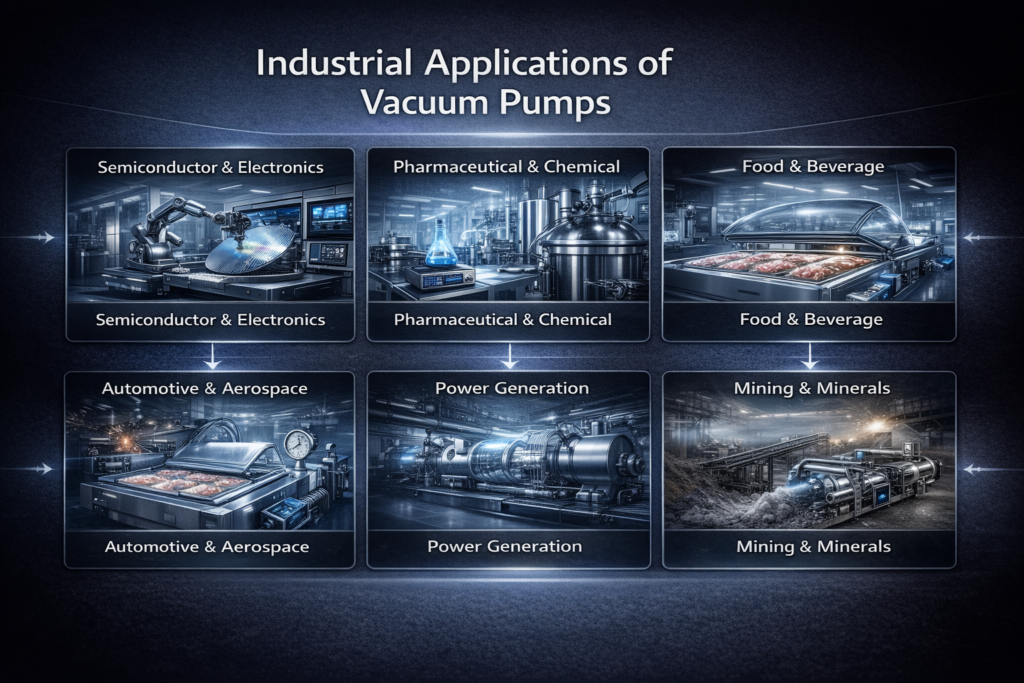
Semiconductor and Electronics Manufacturing
Every critical fabrication step, CVD, PVD, ion implantation, and dry etching, occurs inside vacuum chambers where atmospheric contamination destroys yield entirely. Dry screw and turbomolecular pumps dominate because oil contamination is completely intolerable. Pump systems must also handle corrosive process gases, including chlorine, fluorine compounds, and silane, requiring specialized materials and exhaust abatement.
Pharmaceutical and Chemical Processing
Vacuum enables lower-temperature processing, protecting heat-sensitive compounds. Key uses include vacuum drying of APIs, freeze drying (lyophilization) of vaccines and biologics, vacuum distillation, reactor evacuation, and solvent recovery. FDA, GMP, and EMA compliance drives the dominance of dry vacuum technology. Oil contamination of a product batch carries severe regulatory consequences.
Food and Beverage Processing
Vacuum extends shelf life and improves product quality by removing oxygen and controlling the processing environment. Applications include vacuum and modified-atmosphere packaging, vacuum cooking, evaporative concentration of juices and dairy, and freeze-drying of coffee and ready meals. Oil-free, food-grade pumps are mandatory; lubricant contamination triggers an immediate product recall.
Automotive and Aerospace Manufacturing
Both industries use vacuum for composite manufacturing (RTM and vacuum infusion), thermoforming, brake booster systems, vacuum furnace heat treatment, and leak testing of assembled components. Aerospace applies the most stringent vacuum process standards outside the semiconductor industry, driven by the structural consequences of material defects.
Power Generation
Steam turbine condensers use vacuum to maximize pressure differential across the turbine, directly improving thermal efficiency. Liquid ring pumps are standard for condenser air extraction. Additional applications include transformer oil degassing, nuclear fuel handling under negative pressure, and turbine blade cooling circuit leak testing.
Mining and Minerals Processing
Vacuum filtration dewatering is used for ore processing slurries on rotary drum and belt filters. Vacuum conveying transports cement, fly ash, and fine powders through enclosed pipelines without dust or spillage. Vacuum degassing of molten steel and aluminum removes dissolved hydrogen and oxygen that cause casting porosity. These applications demand robust, high-flow pumps that are tolerant to abrasive particulates, moisture, and continuous heavy-duty cycles.